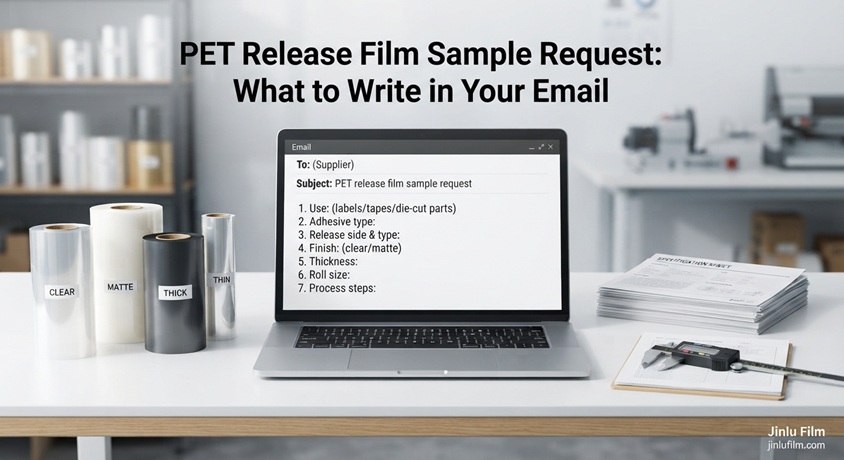
PET release film sample request: a simple email template you can copy and fill in
A PET release film sample request works best when it is short but complete. Many first emails say only “please send release film samples”, and then the supplier has to ask five questions before anything can happen. A few lines up front save days. Here is the chatty version, the way you would tell a friend what to put in the email.
PET release film sample request: what the supplier needs to know
Suppliers cannot guess your adhesive, your process or your roll size. If you give them the basics in the first email, they can suggest a suitable liner, send the datasheet and prepare samples in one go. The basics are what the liner is for, the adhesive it faces, which side releases, the finish, the thickness, the size and the quantity. If some of these words are new, our page on PET release film terms explains them in plain English.
A template you can copy
Subject: PET release film sample request
Hello, we would like to try a PET release film. Here are the details:
1. Use: (labels / tapes / die-cut parts / electronics / other)
2. Adhesive type and how long it stays on the liner:
3. Release side: (one side / both sides) and release type, if known: (silicone / non-silicone / not sure)
4. Finish: (clear / matte / either, please send both)
5. Thickness: (number and unit, for example microns or mil)
6. Roll width, length and core size, or sheet size:
7. Process steps: (coating / laminating / die cutting / heat)
8. Sample size and number of samples wanted:
9. First order quantity in mind and expected repeat orders:
10. Destination and documents your customer requires:
Please send the datasheet together with the samples. Thank you.
If you do not know an answer, write “not sure” instead of leaving it out. A supplier can then offer options and ask the right follow-up question.
Tips for filling it in
- Adhesive: name the type as well as you can, and say how it is applied. Notes on pairing are in PET release liner and adhesive match.
- Thickness: write the number and the unit together. See BOPET film specifications: microns, mil and how to write them for a clean way to do it.
- Two or three samples: ask for a clear and a matte version, or two thicknesses, so you can compare in your own process.
- Your current liner: if you already use one, say so and send a photo of its label, so the supplier knows what you want to match or improve.
- Documents: do not assume any grade carries a given approval. Write down what your customer asks for and ask what can be provided.
After the samples arrive
Test them the way you will really use them: laminate, wait, store if your product is stored, then peel. Write down what you saw and send a short reply to the supplier, because that reply is what leads to the right second round. Our page on how to test a PET release film sample shows a simple way to do it.
Comparing several suppliers
If you send the same email to more than one supplier, the answers are easier to compare, since everyone is quoting the same thing. For a list of what else to look at, see 7 things to check when choosing a PET release film supplier.
Talk to Us
Jinlu Film supplies PET film in various grades, and also supplies products with similar specifications, including domestic alternatives. We slit and convert PET film in our own facility, with custom roll widths, lengths and 76 mm cores, and we provide datasheets and samples. If you are looking for a PET film manufacturer to send release film samples, copy the template above and send it to us with your adhesive, release side, finish, size and quantity.
More PET Film Guides
PET Release Film Terms: A Plain-English Glossary: the words on a quote, explained.
PET Release Film for Electronics: Where Liners Show Up: where liners are used and why a clean surface matters.
PET Release Film for Die Cutting: What the Liner Has to Survive: kiss cut, through cut and what to tell your supplier.
PET Release Film vs Release Paper: How to Decide: what the base material changes in practice.
PET Release Film Thickness: How to Choose a Liner Gauge: how liner thickness changes cutting, coating and peeling.
General guidance for reference only. Trademarks belong to their respective owners.