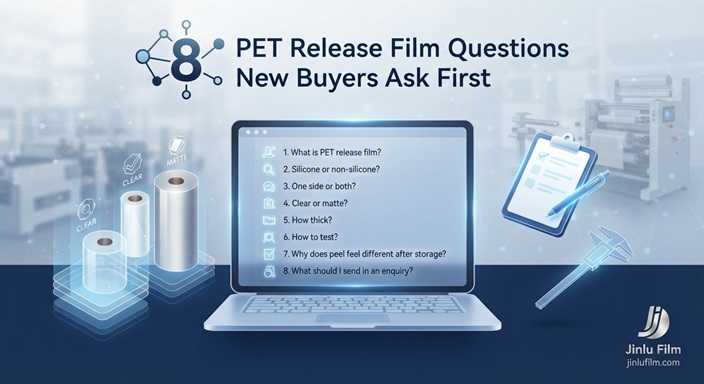
PET release film questions: eight plain answers for buyers who are just starting
PET release film questions tend to repeat from buyer to buyer. Almost everyone asks about silicone, about one side or two, about thickness, and about how to test a sample. Here are the eight we hear most, answered the way you would answer a friend who has just been asked to source a liner and does not know where to begin.
PET release film questions: the basics first
1. What is PET release film?
It is polyester film with a release layer on its surface, so it separates easily from an adhesive or a coating. When it backs a label, tape or adhesive part, it is usually called a liner. If you meet a word you do not know, our page on PET release film terms explains it in plain English.
2. Do I need silicone or non-silicone?
It depends on your adhesive and your process, and some buyers have their own rule about silicone. There is no single right answer, so say what you need and test a sample. The choice is covered in PET release film: silicone or not.
3. One release side or both sides?
If only one face meets an adhesive, one side is usually enough. If both faces have to separate from adhesive, you look at double side. Always say which face is the release face. See single side vs double side release film.
4. Clear or matte?
Clear lets you see through the liner, which helps with placement and inspection. Matte gives a softer look and can leave a different surface on the adhesive. Try both on a real sample before you decide.
Choosing and testing
5. How thick should the liner be?
Do not pick from a chart. Start with the thickness you use now and try one step thinner and one step thicker in your own process. The reasoning is in PET release film thickness: how to choose.
6. How do I test a sample?
Laminate it to your real adhesive the way you normally do, let it wait for the time your product waits, then peel it and write down what you feel and see. Keep a piece of your current liner as a reference. The steps are in how to test a PET release film sample.
7. Why does the peel feel different after storage?
Release can change after a liner has waited, either on the roll or in contact with the adhesive, and it does not change the same way for every adhesive. That is why a test on day one is not the whole story. Keep rolls clean, dry and wrapped, and retest after a long wait.
8. What should I send in an enquiry?
The use, the adhesive, the release side, the finish, the thickness with its unit, the roll or sheet size, the process steps and the quantity. A ready-to-copy email is in PET release film sample request.
A short checklist before you write to a supplier
- What the liner is for, in one sentence.
- Adhesive type and how long it stays on the liner.
- Release side or sides, release type if you know it, and finish.
- Thickness, with the unit written out.
- Roll width, length and core size. Our rolls use a 76 mm core.
- Any cutting, coating or heat step.
- Documents your customer requires, quantity, and a request for datasheets and samples.
Talk to Us
Jinlu Film supplies PET film in various grades, and also supplies products with similar specifications, including domestic alternatives. We slit and convert PET film in our own facility, with custom roll widths, lengths and 76 mm cores, and we provide datasheets and samples. If you are looking for a PET film manufacturer to answer your release film questions, send us the use, adhesive, release side, finish, size and quantity.
More PET Film Guides
PET Release Film Sample Request: What to Write in Your Email: a copy-and-paste enquiry template.
PET Release Film Terms: A Plain-English Glossary: the words on a quote, explained.
PET Release Film for Electronics: Where Liners Show Up: where liners are used and why a clean surface matters.
PET Release Film for Die Cutting: What the Liner Has to Survive: kiss cut, through cut and what to tell your supplier.
PET Release Film vs Release Paper: How to Decide: what the base material changes in practice.
General guidance for reference only. Trademarks belong to their respective owners.