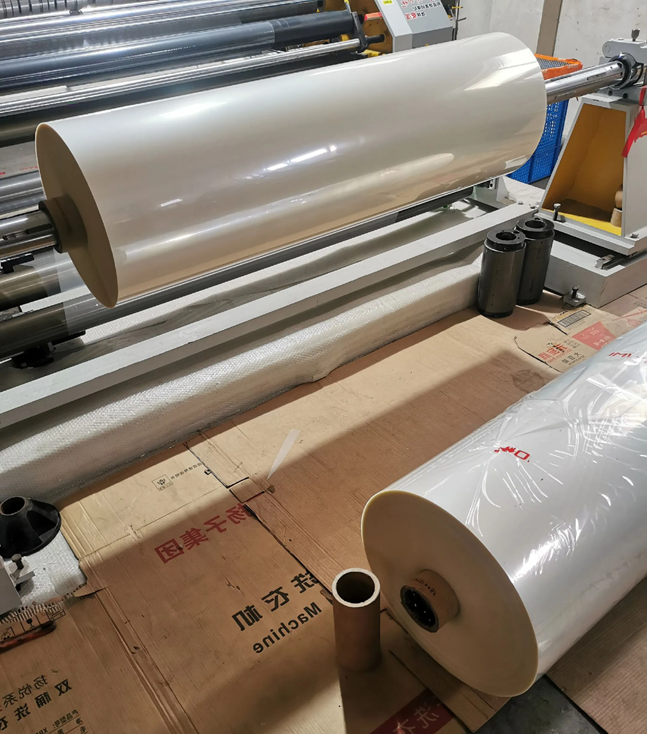
PET release liner: why the liner has to be matched to the adhesive
A PET release liner is a polyester film that carries a sticky material, such as an adhesive, a tape or a coating, and lets it come away cleanly when it is time to use it. The liner is thrown away, so buyers often treat it as an afterthought, yet a poorly matched liner can ruin the product on it. This guide explains in general terms what a release liner has to do, how to think about matching it to the adhesive, and what to tell a supplier. It is general industry information, not a recommendation for any specific grade.
What does a PET release liner do?
Generally, a release liner has three jobs. It holds the adhesive or coating flat during manufacturing and storage. It lets go when the user peels it off, with the right amount of effort. And it leaves the adhesive surface clean, so the bond is not weakened. PET is a common base for liners because it is flat, strong for its thickness and stable in size, which helps with coating, die cutting and handling. A liner made from PET film usually has a release surface, which may be a silicone coating or a non-silicone coating.
Why the liner must suit the adhesive
Different adhesives stick to a release surface with different strength. If the release is too tight, the liner is hard to peel and can tear or stretch the product. If it is too light, the liner can lift or fall away on its own during die cutting, winding or transport. The right balance depends on the adhesive type, how long the product is stored, the temperature and how the liner is removed, by hand or by machine. Because of this, “release film” on a quote is not enough. Ask which adhesive or coating the liner is meant for, and how that was confirmed.
Silicone or non-silicone release
Both types are in use, and the choice often depends on what your adhesive or process can tolerate. Silicone can transfer in small amounts to other surfaces, which matters in some printing, coating and electronics processes, so some buyers prefer a non-silicone surface. Our guide to PET release film: silicone or not explains how to decide. For a plain-language look at the silicone-coated type, see silicone release Mylar.
Release level, residue and aging
- Release level: how easily the liner peels. It is usually described as light, medium or tight, and the numbers depend on the test method, so ask which method was used.
- Residual adhesion: whether the adhesive keeps its stickiness after contact with the liner. A poor liner can lower it.
- Aging: release can change over time, with heat or humidity. If the product will be stored for months, ask how the supplier checks this.
- Surface cleanliness: particles and scratches on the liner can show up as marks in the adhesive layer.
Tape and label uses
Liners are widely used under tapes, labels and double-sided products. If your project is a tape, our overview of PET film tape covers the film side of the question, and our look at the self-adhesive film market gives wider background.
What to tell a supplier
- The adhesive or coating: its type, and whether it is applied wet onto the liner or laminated on.
- Release level: the peel effort you want, and how the liner will be removed.
- Surface: silicone or non-silicone, one side or both sides coated, and whether the other side must print or bond.
- Process: coating, drying temperature, die cutting and storage time.
- Thickness and tolerance: the nominal thickness and the allowed variation.
- Format: roll width and length, or sheets. Our roll cores are 76 mm inner diameter.
Test the liner with your own adhesive
Peel behavior depends on the liner and the adhesive together, and a datasheet cannot settle it alone. Put a sample against your adhesive, age it the way your product will be stored, then check peel effort, residue and bond strength before you place a larger order.
Talk to Us
Jinlu Film supplies PET film in various grades, and also supplies products with similar specifications, including domestic alternatives. We slit and convert PET film in our own facility, with custom roll widths, lengths and 76 mm cores, and we provide datasheets and samples. If you are choosing a release liner, send us your adhesive type, release level, thickness and format needs and our team will help you narrow the options. Learn more about us as a PET film manufacturer.
More PET Film Guides
Blue PET Film: how to get the same shade every time.
White Polyester Film: four checks that affect whiteness.
UV Resistant PET Film: why plain PET needs help outdoors.
Food Grade PET Film Wholesale: what the label really covers.
Polyester Film for Membrane Switches: what to specify.
General guidance for reference only. Trademarks belong to their respective owners.