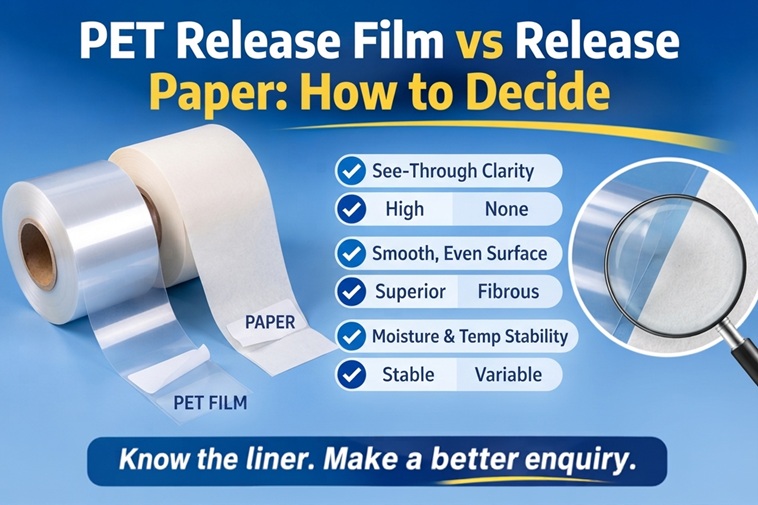
PET release film vs release paper: what the base material changes in practice
PET release film vs release paper is a choice many buyers face when they already know they need a liner but are not sure which base to ask for. Both carry a release layer and both peel away from an adhesive, but the base underneath behaves differently on the line and in the hand. Here is the chatty version, the way you would explain it to a friend who has just been handed both samples.
PET release film vs release paper: the basic difference
A release film uses a polyester film as the base, with a release coating on one or both faces. A release paper uses paper as the base, with a release coating on top. So the question is really about the base: a smooth plastic film or a paper sheet. Everything else, such as the release coating type and how it meets your adhesive, still needs to be settled separately. For that part, see our guide to PET release film: silicone or not.
How the two bases usually differ
- Surface: a film base is smooth and uniform. A paper base has a fibrous structure, so its surface can feel and look different.
- Moisture: paper tends to take up and give off moisture more than film does, which matters for storage and for processes that are sensitive to it.
- Transparency: a film liner can be clear, so operators can see through it. Paper is not see-through. For how finish changes what you see, read transparent PET release film or matte.
- Tearing and cutting: paper and film tear and cut in different ways, so die cutting and hand peeling feel different.
- Appearance on the adhesive: the liner surface can leave its texture on the adhesive layer, so look at the result on a real sample.
- Cost and availability: the two are priced and supplied differently. We do not compare figures here, and our article on what affects a BOPET film price explains how to compare quotes fairly.
When buyers lean towards film
- They want to see through the liner during placement or inspection.
- They need a smooth, even surface against the adhesive.
- Their process is sensitive to moisture or to changes in the liner as it sits.
- They work with die-cut parts that must stay flat and clean.
When buyers lean towards paper
Paper liners are widely used in many label and tape jobs, and some buyers prefer them for reasons of habit, feel or the way their line is set up. We supply PET film, so for paper liners please ask a paper liner supplier. If you are comparing the two, ask both suppliers for datasheets and samples, and test each against your own adhesive.
How to decide
- List what the liner must do: carry the adhesive, be seen through, stay flat, survive storage.
- Ask for samples of both bases with release coatings suited to your adhesive.
- Run the same test on each, using the steps in how to test a PET release film sample.
- Compare the full picture: peel feel, appearance, handling, storage behavior and total cost.
What to include in an enquiry for PET release film
- What the liner is for, and the adhesive it will face.
- Release type, release side or sides, and finish.
- Thickness, with the unit written out. See PET release film thickness for how to narrow it down.
- Roll width, length and core size. Our rolls use a 76 mm core.
- Process steps such as coating, die cutting or heat.
- Quantity, and a request for datasheets and samples before the main order.
Talk to Us
Jinlu Film supplies PET film in various grades, and also supplies products with similar specifications, including domestic alternatives. We slit and convert PET film in our own facility, with custom roll widths, lengths and 76 mm cores, and we provide datasheets and samples. If you are looking for a PET film manufacturer to supply a film liner, send us the adhesive, release side, finish, size and quantity.
More PET Film Guides
PET Release Film Thickness: How to Choose a Liner Gauge: how liner thickness changes cutting, coating and peeling.
PET Release Film Adhesive Residue: How to Describe the Problem: words and photos for a residue problem.
Single Side vs Double Side Release Film: Which One to Pick: one release face or two, and how to choose.
PET Release Film Storage: Keeping the Release Surface Good: what the release surface dislikes and what to retest.
PET Release Film for Tapes: Where the Liner Fits In: what a tape liner does and what to ask.
General guidance for reference only. Trademarks belong to their respective owners.