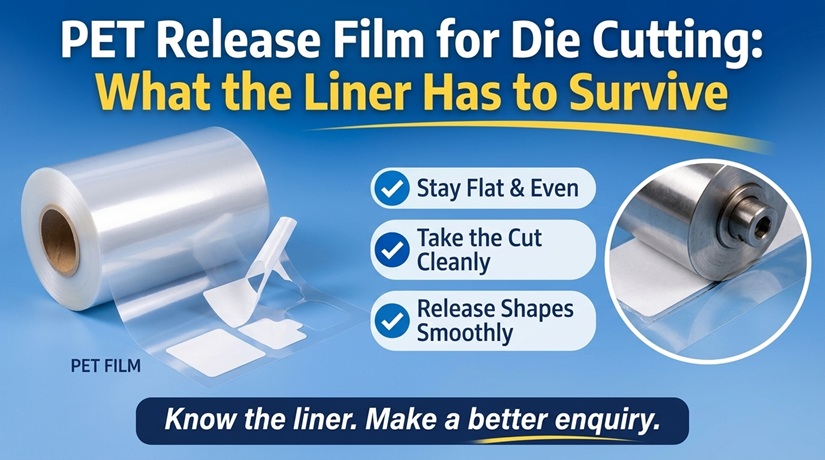
PET release film for die cutting: what the liner has to handle when the blade comes down
PET release film for die cutting is a different request from plain release film, because the blade touches the liner. In a lot of jobs the blade cuts the adhesive layer and the face material but is supposed to stop at the liner, so the shapes stay on it ready to peel. If the liner is too soft, too stiff or too uneven, the result shows up right away: shapes that fall off, shapes that will not lift, or a liner that is cut through by accident. Here is the chatty version, the way you would explain it to a friend who runs the cutter.
PET release film for die cutting: kiss cut and through cut
- Kiss cut: the blade cuts the top layers and leaves the liner whole, so the parts stay in place on the liner. This is the common case for labels, adhesive parts and stickers.
- Through cut: the blade goes all the way through, liner included. The parts then come off as separate pieces, and the liner is cut too.
Tell your supplier which one you do, because the liner is asked to do a different job in each case. Notes on how the liner is used in label work are in PET release film for labels, and for tape and adhesive parts see PET release film for tapes.
What the liner has to do in a die cutting job
- Stay flat: a liner that curls or waves makes the cut depth uneven across the width.
- Be even in thickness: if the liner varies across the roll, a blade set for one area may cut too deep or too shallow in another.
- Take the cut without splitting: a light mark from the blade is normal in kiss cutting, but the liner should not tear or open up along the cut line.
- Let the shapes lift cleanly: after cutting, the parts must peel away from the liner without sticking or leaving the adhesive behind.
- Hold the waste matrix: the leftover frame around the shapes is pulled away, and it should come off in one piece without tearing or dragging parts with it.
Things that change the result
- Liner thickness: it changes how forgiving the cut is and how the sheet feels in the hand. Our page on PET release film thickness shows a simple way to try two or three.
- Release feel: if the release is too tight, small parts are hard to lift. If it is too light, parts may lift on their own during cutting or handling.
- Finish: clear liners let operators see the cut line and the parts underneath. See transparent PET release film or matte for how finish changes what you see.
- Adhesive and face material: a softer or thicker adhesive behaves differently under the blade from a thin one, so say what you cut.
- Cutting method: flatbed, rotary or laser all treat the liner differently, so name your method in the enquiry.
Common mistakes
- Asking for “release film” and not saying it will be die cut, or whether it is kiss cut or through cut.
- Judging a sample by hand only, without running it on your own tool. A short run with your own blade shows more than a datasheet can.
- Changing the liner and not re-setting the cutting depth.
- Forgetting that the liner and the adhesive can behave differently after waiting, so test fresh and aged samples if your product sits for a while.
If a die cutting job goes wrong
Describe what you see before guessing the cause: parts lifting early, parts that will not lift, cuts that go through the liner, or a matrix that tears. Add the cutting method, the roll number and a photo of the cut line in good light. For words and photo tips, see how to describe BOPET film defects.
What to include in an enquiry
- That the liner will be die cut, and whether it is kiss cut or through cut.
- Cutting method and what is being cut: adhesive, face material and shape size in general terms.
- Adhesive type and release side.
- Finish: clear or matte.
- Thickness, with the unit written out, and the range you want to try.
- Roll width, length and core size, or sheet size. Our rolls use a 76 mm core.
- Quantity, and a request for datasheets and samples before the main order.
Talk to Us
Jinlu Film supplies PET film in various grades, and also supplies products with similar specifications, including domestic alternatives. We slit and convert PET film in our own facility, with custom roll widths, lengths and 76 mm cores, and we provide datasheets and samples. If you are looking for a PET film manufacturer to supply a liner for die cutting, send us the cutting method, adhesive, finish, size and quantity.
More PET Film Guides
PET Release Film vs Release Paper: How to Decide: what the base material changes in practice.
PET Release Film Thickness: How to Choose a Liner Gauge: how liner thickness changes cutting, coating and peeling.
PET Release Film Adhesive Residue: How to Describe the Problem: words and photos for a residue problem.
Single Side vs Double Side Release Film: Which One to Pick: one release face or two, and how to choose.
PET Release Film Storage: Keeping the Release Surface Good: what the release surface dislikes and what to retest.
General guidance for reference only. Trademarks belong to their respective owners.