PET release film terms: a plain-English glossary for the words on a quote
PET release film terms can look like a secret code when you read a datasheet or a quote for the first time. Release side, peel, kiss cut, matrix, residue: each one has a plain meaning, and once you know them, your enquiries get shorter and the answers get better. Here is the chatty version, the way you would explain the words to a friend who has just joined the purchasing team.
PET release film terms: the basics
- Release film: a film with a release layer on its surface, so it separates easily from an adhesive or a coating. Also called a release liner when it backs a label or tape.
- Liner: the backing sheet that carries an adhesive part until it is used, then is peeled off and thrown away.
- Release side: the face that carries the release coating and meets the adhesive. On a single side film, only one face is the release side.
- Release coating: the thin layer on the film that lets go of the adhesive. It may be silicone or non-silicone. See PET release film: silicone or not.
- Single side and double side: one release face or two. Our page on single side vs double side release film explains how to choose.
Words about how it peels
- Peel: the act of pulling the liner off the adhesive, and the feel while doing it.
- Light, medium and tight release: everyday words for how easy the peel is. Use them in your own words and compare with a liner you already know, instead of relying on the words alone.
- Residue: adhesive or other material left behind on the liner, or a trace left on the adhesive. See PET release film adhesive residue.
- Aging: how the peel can change after the liner waits, either on the roll or in contact with the adhesive. See PET release film storage.
Words about cutting
- Die cutting: cutting shapes with a blade or tool.
- Kiss cut: the blade cuts the top layers and stops at the liner, so shapes stay on it.
- Through cut: the blade goes through everything, liner included.
- Matrix or waste: the leftover frame around the shapes that is pulled away after cutting.
For what the liner has to handle in these steps, see PET release film for die cutting.
Words about the film itself
- Base film: the polyester film underneath the release coating.
- Thickness: usually written in microns or mil. See BOPET film specifications: microns, mil and how to write them.
- Clear and matte: how the liner looks and whether you can see through it. See transparent PET release film or matte.
- MD and TD: machine direction and transverse direction, along and across the roll. See MD and TD in PET film.
- Tolerance: how much a size is allowed to vary from the stated value.
Words about rolls
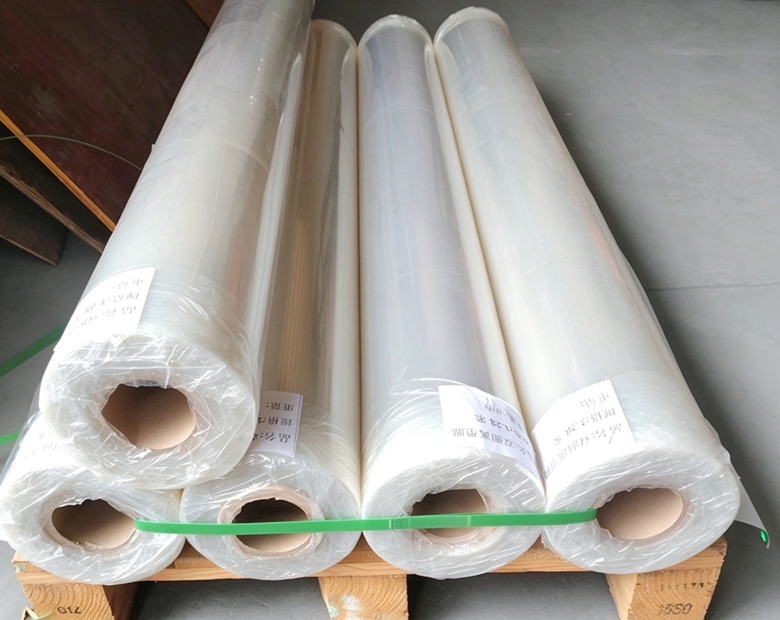
- Slitting: cutting a wide roll into narrower rolls.
- Core: the tube a roll is wound on. Our rolls use a 76 mm core.
- Telescoping: layers sliding out to one side, so the roll end looks like a cone.
- Lot or batch number: the code that links a roll to its production record, useful when you report a problem.
How to use the glossary in an enquiry
- Say what the liner is for and which adhesive it faces.
- Name the release side or sides, and the release type if you know it.
- Give the thickness with the unit written out, plus finish and any cutting step.
- Give roll width, length and core size, then quantity.
- Ask for a datasheet and samples, and test them with the steps in how to test a PET release film sample.
Talk to Us
Jinlu Film supplies PET film in various grades, and also supplies products with similar specifications, including domestic alternatives. We slit and convert PET film in our own facility, with custom roll widths, lengths and 76 mm cores, and we provide datasheets and samples. If you are looking for a PET film manufacturer who can explain a quote or a datasheet in plain words, send us your questions along with the adhesive, release side, finish, size and quantity.
More PET Film Guides
PET Release Film for Electronics: Where Liners Show Up: where liners are used and why a clean surface matters.
PET Release Film for Die Cutting: What the Liner Has to Survive: kiss cut, through cut and what to tell your supplier.
PET Release Film vs Release Paper: How to Decide: what the base material changes in practice.
PET Release Film Thickness: How to Choose a Liner Gauge: how liner thickness changes cutting, coating and peeling.
PET Release Film Adhesive Residue: How to Describe the Problem: words and photos for a residue problem.
General guidance for reference only. Trademarks belong to their respective owners.