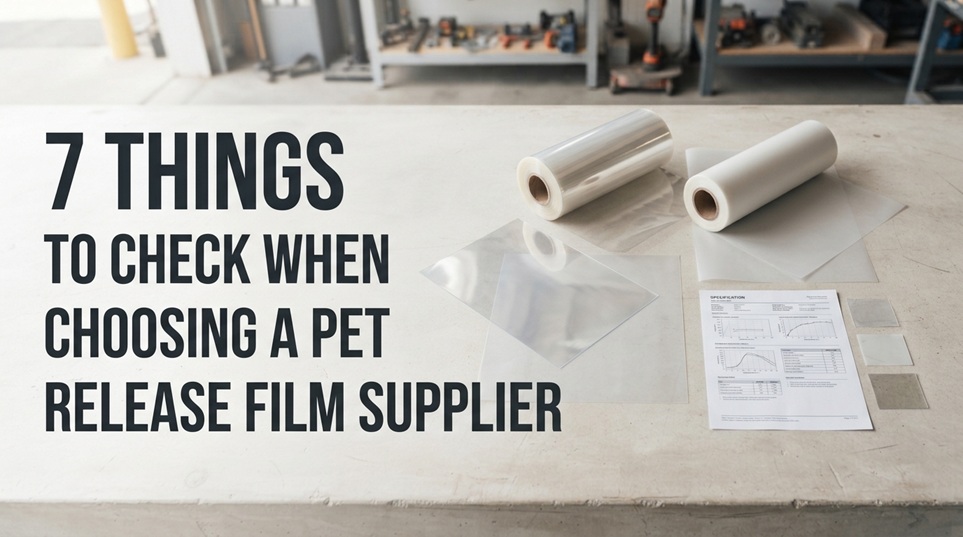
PET release film supplier: seven things to settle before you send an enquiry
A PET release film supplier can only quote correctly if the enquiry says what the liner has to do. Buyers in many countries send short requests such as “release film, clear, 50 micron”, and then spend weeks on samples that miss the point. This checklist lists the seven items that most often decide whether a release liner works, so you can write one complete enquiry and compare suppliers fairly.
PET release film supplier checklist: what the enquiry should say
The seven items below are written in the order most buyers need them. If you cannot answer one, say so in the enquiry and ask the supplier to suggest options, but do not leave it blank.
1. Release type and release side
Say whether you need a silicone or a non-silicone release surface, and whether one side or both sides must release. A coated side and an uncoated side are not interchangeable, so mark which side faces the adhesive. Our guide to PET release film: silicone or not explains how to decide.
2. The adhesive the liner will face
A release liner is chosen against an adhesive, not on its own. Write down the adhesive type, how it is applied and how long it stays in contact with the liner. Notes on pairing are in PET release liner and adhesive match.
3. Finish and appearance
State whether the liner should be clear or matte, and whether operators need to see through it during your process. A liner’s surface can leave an impression on the layer it touches, so appearance is part of the specification, not a detail.
4. Thickness and base film
Give the thickness with the unit written out, so microns and mil are not confused. If you are not sure which thickness suits your line, describe the process, such as die cutting, laminating or hand peeling, and ask what range the supplier suggests.
5. Roll format
Write the roll width, roll length and core size. Our rolls use a 76 mm core, and we slit to custom widths and lengths. If you need sheets instead of rolls, say so and give the sheet size and the tolerance you can accept.
6. Documents and export paperwork
Requirements differ by country and by product, whether your factory is in Russia, the UK, Hong Kong, Indonesia or elsewhere. Tell the supplier which documents your customer or your market asks for, and ask what can be provided. Do not assume any grade carries a given approval. For customs paperwork, our page on the PET film HS code explains the general idea.
7. Samples and datasheets
Ask for the datasheet and a sample before the main order, and test the sample the way you will use it: laminate it to your adhesive, store it if your product is stored, then peel it. Agree packing, delivery terms and the order quantity in writing once the sample passes.
PET facestock or release liner: which one are you buying?
Some enquiries use “PET facestock” and “release film” as if they were the same. In general, facestock is the printable front layer of a label, while the release liner is the backing that carries the label until it is applied. If you need both, list them as two items with their own finish, thickness and surface requirements. If you want one supplier to quote both, say that in the enquiry.
A short enquiry template
- Release type and release side.
- Adhesive type and contact time.
- Finish: clear or matte.
- Thickness, with the unit written out.
- Roll width, length and core size, or sheet size.
- Documents required, and your country of use.
- Quantity, and a request for datasheets and samples.
Talk to Us
Jinlu Film supplies PET film in various grades, and also supplies products with similar specifications, including domestic alternatives. We slit and convert PET film in our own facility, with custom roll widths, lengths and 76 mm cores, and we provide datasheets and samples. If you are looking for a PET film manufacturer to quote a release liner, send us the release type, adhesive, finish, size and quantity.
More PET Film Guides
Mylar Sheets Uses: Six Common Jobs and How to Order: what to specify for each common use.
PET Film for Electrical Insulation: What to Ask a Supplier: questions about thickness, heat, surface and documents.
BOPET Film Properties: How to Read the Datasheet: what the name means and which items to check.
Optical PET Film: What to Check Before You Buy: how to read haze, transmittance and surface defects.
Transparent PET Release Film or Matte: Which Finish to Pick: how the liner finish changes what you see.
General guidance for reference only. Trademarks belong to their respective owners.