PET release film storage: what the release surface does not like and how to keep rolls in good shape
PET release film storage is a bit different from storing plain film, because the thing you care about is not only the polyester but the thin release layer on its surface. That layer is what lets the liner come away from your adhesive, and it can be affected by dirt, contact and time. Here is the chatty version, the way you would tell a new colleague what to watch when a pallet of liner arrives.
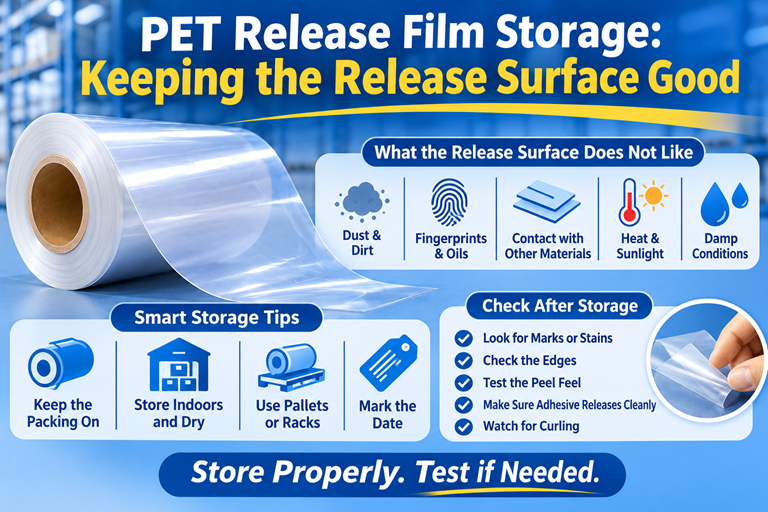
PET release film storage: what the release surface does not like
- Dust and dirt: particles on the release side can end up on your adhesive or leave marks.
- Fingerprints and oils: touching the release side with bare hands can change how it behaves in that spot.
- Contact with other materials: some materials rubbing against or sitting on the release side can leave traces. Keep the roll in its own packing.
- Heat and direct sun: strong heat or sunlight is not good for film or packing. Ask your supplier what conditions suit the grade you buy.
- Damp and dirty floors: keep rolls on pallets or racks, indoors and dry.
For the general habits that apply to any film roll, such as receiving, lifting and orientation, see our page on BOPET film storage. This page adds what is special about release film.
Keep the packing on until you need it
Leave the protective wrapping on the roll until the day you use it. If you open a roll and do not finish it, wrap it again before it goes back on the rack, covering the ends and the outer layers. Mark the roll with the date you opened it, so you know how long the surface has been exposed.
Which side is the release side?
Many release films have a release coating on one side only. Write down which side it is when the roll arrives, and keep that information with the roll, because it is easy to lose track once the packing is gone. If both sides release, note whether they release at the same ease or differently. Our guide to PET release film: silicone or not explains the release type.
Aging: what changes over time
Two kinds of time matter. The first is how long the roll waits before you use it. The second is how long the liner stays in contact with your adhesive after lamination. Both can change how the liner peels, and the change is not always the same for every adhesive. Rather than guess, test: take a roll that has been stored for a while and compare it with a fresh sample. Our article on how to test a PET release film sample shows a simple way to do the comparison.
Signs to look for on a roll that has been stored
- Marks, dirt or stains on the release side.
- Edges that are dented, loose or uneven.
- A different peel feel from a fresh roll, tighter or looser than before.
- Adhesive that does not come away as cleanly as it used to.
- Curling or waves when the film is unwound.
If you notice any of these, write down what you see and which roll it came from. Our page on how to describe BOPET film defects has words and photo tips that help a supplier understand the problem.
What to tell your supplier
- How long you usually store release film before use, in your own words.
- How you store it: pallet, rack, shaft or original carton, and whether the store is indoor and dry.
- Your adhesive type and how long it stays on the liner in your product.
- Release side and finish you use.
- Roll width, length and core size. Our rolls use a 76 mm core.
- Any special packing you need, such as extra end protection or wrapping.
Talk to Us
Jinlu Film supplies PET film in various grades, and also supplies products with similar specifications, including domestic alternatives. We slit and convert PET film in our own facility, with custom roll widths, lengths and 76 mm cores, and we provide datasheets and samples. If you are looking for a PET film manufacturer to talk through release film packing and storage, send us your roll size, storage method and quantity.
More PET Film Guides
PET Release Film for Tapes: Where the Liner Fits In: what a tape liner does and what to ask.
PET Release Film for Labels: What the Liner Has to Do: what a label liner does and what to ask.
PET Release Film Test: How to Try a Sample Step by Step: a simple way to test a liner against your adhesive.
BOPET Film Uses in Packaging: Six Common Jobs: what polyester does inside a pack.
BOPET Film vs CPET: What Is the Difference?: a thin film on a roll versus a rigid tray or sheet.
General guidance for reference only. Trademarks belong to their respective owners.