BOPET film vs CPET: two PET-family materials that do different jobs
BOPET film vs CPET is a question that comes up when someone sees both names on a packaging quote and wonders if they are the same thing. They share the same base polymer, but they are made and used in quite different ways. Here is the plain version, the way you would explain it to a friend over a cup of tea.
BOPET film vs CPET: the short answer
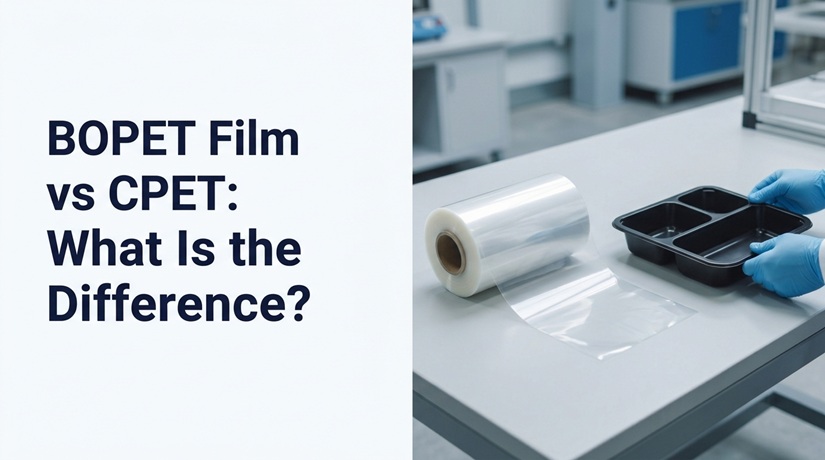
BOPET is biaxially oriented polyester film. It is stretched in two directions into a thin, strong, clear film, and it is sold on rolls for printing, laminating, coating, tapes, labels and many other jobs. CPET stands for crystallized PET. It is usually a thicker sheet or a formed tray, made so that it keeps its shape in heat, and it is mostly seen in ready meal trays. So one is a thin film on a roll, the other is a rigid tray or sheet. For the name behind BOPET, see our page on BOPET film properties and the datasheet.
Where each one is normally used
- BOPET film: printing, lamination, tapes, labels, release liners, insulation layers, protective film and lids.
- CPET: formed trays and containers, especially for food that goes into an oven or a microwave.
The two often meet in one pack. A CPET tray can be closed with a lid that has a polyester layer in it. If that is your case, our guide to polyester lidding film: five questions to ask lists what to settle before ordering a lid.
How they differ in practice
- Form: BOPET is a thin film on a roll. CPET is a sheet or a tray.
- How it is made: BOPET is stretched to orient the film. CPET is processed so that the material crystallizes and holds its shape better in heat.
- Look and feel: BOPET can be very clear, matte, white or colored. CPET trays are often opaque or dark, though this depends on the product.
- Typical buyer: BOPET buyers are converters, printers and tape or label makers. CPET buyers are mostly food packers and tray makers.
Which one do you need?
Ask what the material has to do. If you need a printable, laminable or coatable film on a roll, you are looking at BOPET. If you need a rigid tray for hot food, you are looking at CPET or another tray material. If you need a lid for that tray, you are back to a film, and the question becomes the lid structure and the sealing layer. For other differences inside the polyester family, see BOPET vs PET.
A note on food contact
If either material touches food, do not rely on a name like “food grade” alone. Tell the supplier the market you sell into and ask for the documents your customer requires. Our guide to food grade PET film explains what to ask for.
What to include in an enquiry
- What the material is for, in one sentence: a film on a roll, a lid, a tray or a sheet.
- Thickness, with the unit written out.
- Roll width, length and core size, or sheet size. Our rolls use a 76 mm core.
- Surface needs: finish, treated side and any print requirement.
- Whether it touches food, heat or a heating step, and the documents your customer needs.
- Quantity, and a request for datasheets and samples before the main order.
Talk to Us
Jinlu Film supplies PET film in various grades, and also supplies products with similar specifications, including domestic alternatives. We slit and convert PET film in our own facility, with custom roll widths, lengths and 76 mm cores, and we provide datasheets and samples. If you are looking for a PET film manufacturer to supply film for a lid or a converting job, send us the use, thickness, size and quantity.
More PET Film Guides
BOPET Film MOQ: How to Talk About Minimum Order Quantity: what a minimum order means and how to start small.
BOPET Film Defects: How to Describe a Problem to Your Supplier: words and photos that help.
BOPET Film Inspection: What to Check When Rolls Arrive: a short checklist for delivery day.
BOPET Film Storage: How to Keep Rolls in Good Shape: simple habits for receiving and storing rolls.
BOPET Film Thickness: How to Choose the Right One: a simple way to narrow down thickness.
General guidance for reference only. Trademarks belong to their respective owners.