PET release film for tapes: where the liner sits and what to tell your supplier
PET release film for tapes is the layer you peel away before the tape does its job. It might be the clear sheet on a double-sided tape, the backing on a die-cut adhesive part, or the liner on a transfer tape. Most people throw it away without a second look, but it decides whether the tape unwinds smoothly, cuts cleanly and peels off the way the user expects. Here is the chatty version, the way you would explain it to a friend who has just started buying liner for a tape line.
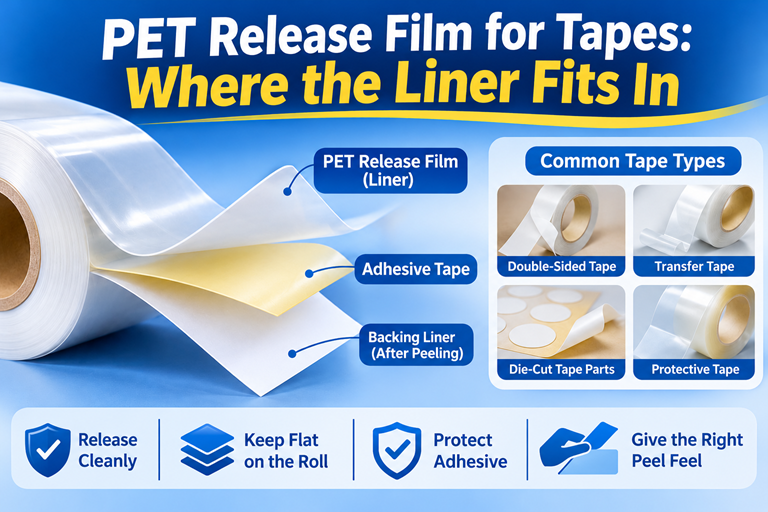
PET release film for tapes: where the liner appears
- Double-sided tape: a liner covers the adhesive on one or both sides, so the tape can be wound, stored and cut without sticking to itself.
- Transfer tape: the adhesive is carried on a liner and moved onto another surface, so the liner and the adhesive have to work together.
- Die-cut adhesive parts: small shapes cut from tape and kept on a liner until someone places them. Flatness and a clean cut matter here.
- Protective tape layers: a liner can also cover an adhesive area that stays unused until assembly.
The polyester in a tape can also be the base film that carries the adhesive. That is a different job, and our page on PET film tape covers it. For the market side of base films, see adhesive tape films market: base film. This page is only about the liner.
What a tape liner has to do
- Let go of the adhesive cleanly when it is peeled, without tearing and without pulling the adhesive off.
- Stay flat and keep its size while the tape is coated, laminated, slit and rewound.
- Protect the adhesive from dust and handling until the tape is used.
- Give the right peel feel for the way the tape is used: by hand, by a dispenser or on an assembly line.
Things to settle before you ask for a quote
- The adhesive: type, thickness of the layer if you know it, and how long it stays on the liner. Notes on pairing are in PET release liner and adhesive match.
- Release type: silicone or non-silicone, and which side releases. See PET release film: silicone or not.
- One side or two: a double-sided tape may need different release on each side, so say so if the two liners should peel at different ease.
- Finish: clear or matte, and whether operators need to see through the liner.
- Process: coating, laminating, slitting, die cutting and any heat or drying step the liner goes through.
Common mistakes with tape liners
- Asking for release film without naming the adhesive.
- Mixing up the base film of a tape with the liner on it, and sending one specification for both.
- Ordering a full quantity before testing a sample against the real adhesive. Our page on how to test a PET release film sample shows a simple way to do it.
- Forgetting that tapes are often stored for a while on the roll, so the liner has to behave after waiting, not only on day one.
What to include in an enquiry
- That the liner is for tape, and the tape type: double-sided, transfer or die-cut parts.
- Adhesive type and how it is applied to the liner.
- Release type, release side or sides, and finish.
- Thickness, with the unit written out.
- Roll width, length and core size. Our rolls use a 76 mm core.
- Process steps and any heat the liner goes through.
- Quantity, and a request for datasheets and samples before the main order.
Talk to Us
Jinlu Film supplies PET film in various grades, and also supplies products with similar specifications, including domestic alternatives. We slit and convert PET film in our own facility, with custom roll widths, lengths and 76 mm cores, and we provide datasheets and samples. If you are looking for a PET film manufacturer to supply a tape liner, send us the adhesive, release side, finish, size and quantity.
More PET Film Guides
PET Release Film for Labels: What the Liner Has to Do: what a label liner does and what to ask.
PET Release Film Test: How to Try a Sample Step by Step: a simple way to test a liner against your adhesive.
BOPET Film Uses in Packaging: Six Common Jobs: what polyester does inside a pack.
BOPET Film vs CPET: What Is the Difference?: a thin film on a roll versus a rigid tray or sheet.
BOPET Film MOQ: How to Talk About Minimum Order Quantity: what a minimum order means and how to start small.
General guidance for reference only. Trademarks belong to their respective owners.