Toray Lumirror PET Film Grades start from one standard film, S10, and branch out by adding something: clarity, heat stability, particles, pigment, or thinness
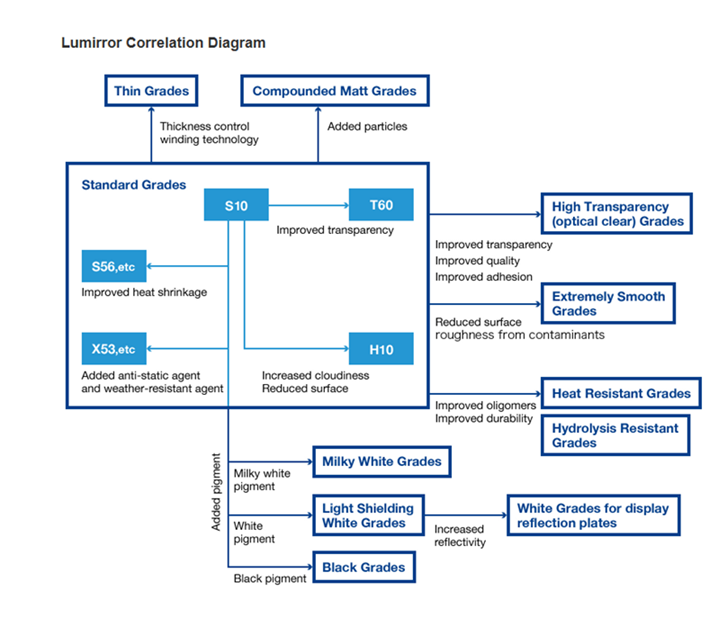
Faced with dozens of Lumirror part numbers, a buyer needs a map. Toray publishes a correlation diagram for the line, and it shows that the Toray Lumirror PET Film Grades are less a long list than a family tree with a standard film at its center.
The Center of the Map: Standard Grades
In the diagram, Toray Lumirror S10 PET Film sits at the center of the standard grades. Arrows lead from it to the variations: improved transparency, improved heat shrinkage, added anti-static and weather-resistant agents, and increased cloudiness. Treated versions of the same film, such as S105 (one side corona treated) and S28 (described as a high grade of S10), come from the datasheets rather than the diagram.
Branch by Branch
- Improved transparency: the diagram points from S10 to T60, and onward to a group of high transparency (optical clear) grades, which it describes as improved in transparency, quality, and adhesion. Related guides: T62, T56, T70A, U60, and U94.
- Improved heat shrinkage: S56 is the example named in the diagram, and its clear counterpart is covered in the T56 guide.
- Added anti-static and weather-resistant agents: X53 is the example named in the diagram.
- Increased cloudiness: H10, the hazy film used for motor insulation, sits on this branch.
- Thin grades: the diagram credits thickness control and winding technology. Guides in this group include F53, F531, F57, F552, and C21.
- Compounded matt grades: made by adding particles. See X42, X43, and X44.
- Heat resistant and hydrolysis resistant grades: the diagram links them to improved oligomers and improved durability. X10S is the guide for this branch.
- Extremely smooth grades: the diagram describes reduced surface roughness from contaminants. We have not covered a grade from this branch yet.
The Pigment Branches
Adding pigment to the base film produces the colored families in the diagram: milky white grades, light shielding white grades (and from them, white grades for display reflection plates, with increased reflectivity), and black grades. Guides in this area: X20 and X21 for pigment filled white, E60, E60L, and E63 for low density white, and X30 for black. The datasheets do not say which diagram box each white grade belongs to, so ask your supplier before treating them as milky or light shielding.
How to Use the Map to Choose
- Need a general-purpose film for insulation or converting? Start at the center, with the standard grades.
- Need it clearer? Move to the transparency branch.
- Need it to move less in a hot process? Look at the low shrinkage grades.
- Need a matte look? The compounded matt branch comes next.
- Need color or opacity? The pigment branches are the place to look.
- Need it as thin as possible? Thin grades are built for that, and the ribbon and capacitor guides show the numbers.
- Need it to survive heat and moisture? Look at the heat resistant and hydrolysis resistant grades.
What the Map Does Not Say
- It is a simplified relationship diagram. It gives no numbers, and it names only some part numbers, so the mapping of grades to branches here is our reading, not Toray’s list.
- It does not say which product to choose. Confirm grade, thickness, and availability with your supplier and refer to the latest official Toray documents.
- Food contact, safety, and handling are covered separately in the Lumirror safety data sheet guide.
Quick Answers
Which grade is at the center of the Lumirror map?
S10, the standard grade, from which transparency, heat shrinkage, anti-static, and cloudiness variations branch.
How are the thin grades made?
According to the diagram, through thickness control and winding technology.
How do the colored grades come about?
By adding pigment: milky white, white for light shielding, and black.
Can I buy Toray Lumirror PET Film from Jinlu Film?
Yes. Jinlu Film supplies Toray Lumirror PET Film grades. If you prefer a comparable-specification alternative, including domestic options, we can offer those as well, together with datasheets and samples so you can test them on your own line.
More PET Film Guides
- Toray Lumirror PET Film safety data sheet: handling, fire, and food contact points
- Toray Lumirror F57 PET Film: a wide ribbon base with heat stability
- Toray Lumirror F531 PET Film: an anti-stick back coated ribbon film
- Toray Lumirror F53 PET Film: the world standard ribbon base film
Sourcing Lumirror Film by Grade
Jinlu Film supplies Toray Lumirror PET Film grades, along with comparable polyester film grades, including domestic alternatives, for industrial, electrical, optical, and packaging uses. Tell us your application, branch of the map, and thickness, and contact us for technical data, samples, or a factory quote.
Source: Toray’s publicly available Lumirror correlation diagram and the technical data sheets summarized in the linked guides. Please refer to the latest official versions. Lumirror, Toray, and related names are trademarks of their respective owners. This article is an independent explanation for reference only.