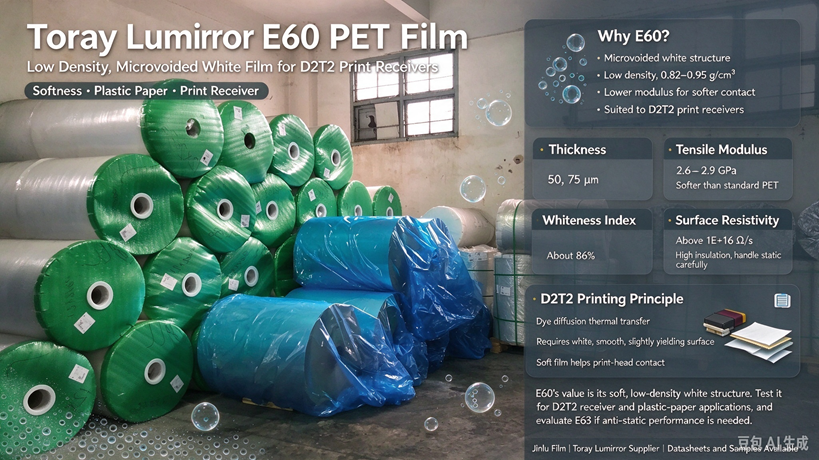
Toray Lumirror E60 PET Film is a low density, microvoided white film at 50 and 75 micron, and its datasheet says the softness is the point
Most polyester films are valued for being stiff and slick. Toray Lumirror E60 PET Film goes the other way: a microvoided, low density white film whose softness, according to its datasheet, suits the print receiver of D2T2 printers.
What D2T2 Printing Asks of a Film
D2T2 stands for dye diffusion thermal transfer, the process behind many photo and card printers. Dye moves from a ribbon into a receiving layer when heat is applied, so the receiver has to be white, smooth, and slightly yielding to make good contact with the print head (a general explanation, not from this datasheet). The datasheet lists two applications: plastic paper, and print receiver for D2T2 printers.
The Numbers That Matter
- Thickness: 50 and 75 um
- Density: about 0.82 to 0.95 g/cm3, below the roughly 1.4 typical of a solid PET film (a general reference)
- Whiteness index: about 86 percent (ASTM E313)
- Optical density: about 0.82 to 0.95 (JIS K7605)
- Tensile strength: about 105 to 127 MPa (ASTM D882)
- Tensile modulus: about 2.6 to 2.9 GPa (ASTM D882)
- Heat shrinkage at 150°C for 30 minutes: about 0.3 to 1.4 percent (ASTM D1204)
- Surface resistivity: above 1E+16 ohm per square (ASTM D257)
The modulus of roughly 2.6 to 2.9 GPa is the clue to the softness. Modulus measures stiffness, and a standard PET film such as Toray Lumirror S10 PET Film sits well above it. Softer film gives a little under the print head, which helps contact, but it also means more care in handling and tension.
How It Differs from Neighboring Grades
- Toray Lumirror E63 PET Film is the pretreated, anti-static version for print receivers at 50 and 75 um, with density around 1.00 g/cm3 and surface resistivity of about 1E+11. E60 is lighter and shows resistivity above 1E+16, so it is the untreated, non-anti-static starting point.
- Toray Lumirror E60L PET Film is the very low density cousin at 188 um for LCD back light use, with density 0.84 and whiteness 100 percent. E60’s density is similar, but it is thin and listed for printers rather than displays.
Surface Resistivity Deserves a Second Look
A resistivity above 1E+16 ohm per square means the film is an excellent insulator and can hold static charge (a general interpretation). In a printer, static can cause dust pickup or misfeeds. If that matters to you, look at the anti-static E63 instead, or ask about surface treatment.
What the Datasheet Does Not Say
- The values are typical data under specific test conditions and are not limiting specifications, as the datasheet itself notes.
- No haze, thickness tolerance, surface tension, or coating information is given, and no data on dye density or print results.
- Many figures here are summarized as ranges because the text available did not show which belong to which thickness. Please check the official datasheet for the exact value at your thickness.
Quick Answers
What is Lumirror E60?
A white, microvoided, low density film, described as soft and suited to D2T2 print receivers.
What applications does the datasheet list?
Plastic paper and print receiver for D2T2 printers.
Can I buy Toray Lumirror E60 PET Film from Jinlu Film?
Yes. Jinlu Film supplies Toray Lumirror E60 PET Film. If you prefer a comparable-specification alternative, including domestic options, we can offer those as well, together with datasheets and samples so you can test them on your own line.
More PET Film Guides
- Toray Lumirror S28 PET Film: a high-grade S10 with uniform surface
- Toray Lumirror X21 PET Film: an anti-static white film for displays
- Toray Lumirror X20 PET Film: a brilliant white film for display and tape
- Toray Lumirror X44 PET Film: the brightest matte grade of the X42 to X44 trio
Sourcing Print Receiver Film
Jinlu Film supplies Toray Lumirror E60 PET Film, along with comparable low density white polyester film grades, including domestic alternatives, for D2T2 printer receivers and plastic paper. Tell us your printer type and thickness, and contact us for technical data, samples, or a factory quote.
Source: Toray’s publicly available Lumirror E60 technical data sheet (typical values). Please refer to the latest official version. Lumirror, Toray, and related names are trademarks of their respective owners. This article is an independent explanation for reference only.