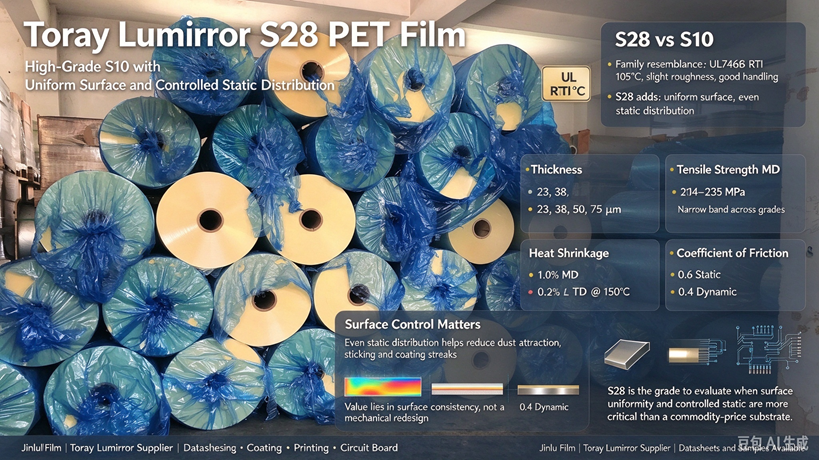
Toray Lumirror S28 PET Film is a high-grade version of S10, offered in 23, 38, 50, and 75 micron, with a uniform surface and tightly controlled static distribution
Put the S28 datasheet next to S10’s and the family resemblance is obvious: same UL rating, same slight roughness for handling, same good electrical and mechanical properties. Toray Lumirror S28 PET Film adds a surface that is uniform, plus severe control for an even distribution of static electricity on the film’s surface.
How S28 Differs from Neighboring Grades
The datasheet describes S28 as a high-ranked S10. The two films share a lot, and the differences are in the details of the surface:
- Toray Lumirror S10 PET Film is the general-purpose standard film, offered in ten thicknesses from 12 to 350 um and listed for electrical insulation, flexible print circuits, membrane switches, mold release, and adhesive tape.
- S28 is offered in four thicknesses, 23, 38, 50, and 75 um, and its datasheet lists metallized face label, silicone releasing, coating, printing, and circuit board among its applications.
- Both datasheets list a UL746B relative thermal index (RTI) of 105°C for electrical and 105°C for mechanical properties.
- Both describe slight roughness for good handling. The S28 datasheet lists a coefficient of friction of about 0.6 static and 0.4 dynamic, which is the same level S10 lists for its thinner grades.
- The new elements on S28 are the uniform surface and the tightly controlled, even distribution of static electricity on the film’s surface, neither of which is mentioned on the S10 datasheet.
That makes S28 the one to look at when the surface itself matters, for example for metallizing, coating, or printing.
What “Even Distribution of Static Electricity” Means
Static charge is nearly impossible to eliminate on a polyester film, and the trouble comes from uneven charge: patches that attract dust, cause sticking, or leave streaks in a thin coating or metal layer (a general explanation, not from this datasheet). The S28 datasheet says the distribution of static electricity on the film’s surface is under severe control so that it stays even. It does not give a numerical measure such as surface resistivity, so if static behavior is critical in your process, ask for that data and run a test on your own line.
The Numbers the Datasheet Gives
- Thickness: 23, 38, 50, and 75 um
- Tensile strength in MD: about 214 to 235 MPa, in a narrow band across the grades (ASTM D882)
- Elongation at break in MD: about 160 to 185 percent for most grades (ASTM D882)
- Heat shrinkage at 150°C for 30 minutes: about 1.0 percent in MD and very low in TD, about 0.1 percent (ASTM D1204)
- Coefficient of friction: about 0.6 static and 0.4 dynamic (ASTM D1894)
- UL746B RTI: 105°C electrical, 105°C mechanical
In plain terms, S28 behaves like a standard thin PET film in strength and heat, which is exactly the point. The value of the grade lies in its surface, not in a different set of mechanical numbers. Note that MPa is force per unit area, so a thicker film can still carry more total load. RTI is a UL rating related to the temperature a material can withstand in long-term use, and for a specific end product the current UL listing should be confirmed.
Where the Datasheet Says It Is Used
The datasheet lists metallized face label, silicone releasing, coating, printing, and circuit board, among others. These applications share a need: a surface that behaves the same from roll to roll and from one part of the film to another. In general, a uniform surface with controlled static helps a thin metal or silicone layer go down evenly (a general explanation). The datasheet does not describe the exact role of the film in each application, so confirm suitability with your own process and test samples.
What the Datasheet Does Not Say
- The values are typical data under specific test conditions and are not limiting specifications, as the datasheet itself notes.
- No surface resistivity, haze, light transmittance, gloss, tensile modulus, surface tension, or thickness tolerance are listed.
- The text available for this article does not show which figures belong to which thickness, so most values here are summarized as approximate ranges. Please check the official datasheet for the exact value at your thickness.
- Only 150°C shrinkage is given, and no electrical numbers such as breakdown voltage appear.
Quick Answers About Toray Lumirror S28 PET Film
What is Lumirror S28?
A high-ranked version of S10, described as having a uniform surface and even distribution of static electricity.
What thicknesses does the datasheet cover?
23, 38, 50, and 75 um.
What applications does the datasheet list?
Metallized face label, silicone releasing, coating, printing, circuit board, and similar uses.
What thermal rating does it carry?
UL746B RTI of 105°C for both electrical and mechanical properties.
Can I buy Toray Lumirror S28 PET Film from Jinlu Film?
Yes. Jinlu Film supplies Toray Lumirror S28 PET Film. If you prefer a comparable-specification alternative, including domestic options, we can offer those as well, together with datasheets and samples so you can test them on your own line.
More PET Film Guides
- Toray Lumirror X21 PET Film: an anti-static white film for destination displays and signs
- Toray Lumirror X20 PET Film: a brilliant white film at 38, 75, and 125 um for display and adhesive tape
- Toray Lumirror X44 PET Film: the highest-gloss grade of the X42, X43, X44 matte trio
- Toray Lumirror X43 PET Film: a direct matted film from 12 to 150 um for hot stamping foil and releasing
- Toray Lumirror X10S PET Film: a low oligomer, heat-rated film for Class B motor insulation
Sourcing a Uniform-Surface Base Film
Jinlu Film supplies Toray Lumirror S28 PET Film, along with comparable standard polyester film grades, including domestic alternatives, for metallizing, coating, printing, and release applications. Tell us your process, thickness, and surface requirements, and contact us for technical data, samples, or a factory quote.
Source: Toray’s publicly available Lumirror S28 technical data sheet (typical values). Please refer to the latest official version. Lumirror, Toray, and related names are trademarks of their respective owners. This article is an independent explanation for reference only.