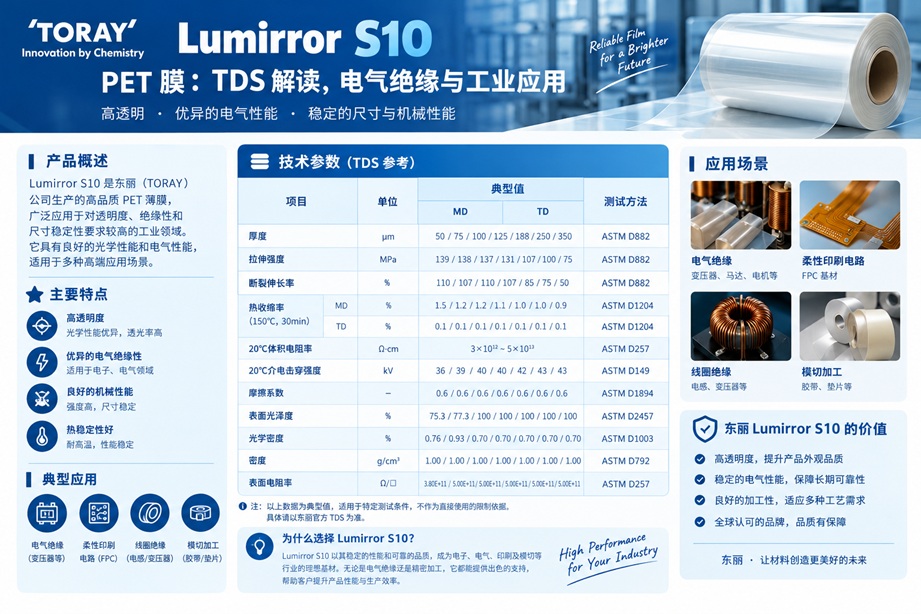
A Plain-English Reading of the Toray Lumirror S10 PET Film Datasheet: A Standard Polyester Film from 12 to 350 Micron
This guide explains the Toray Lumirror S10 PET Film technical data sheet (TDS) in plain English, so buyers and engineers can read the figures with confidence.
What Is Toray Lumirror S10 PET Film?
Toray Lumirror S10 PET Film is a standard polyester (PET) film from Toray’s Lumirror range. According to its datasheet, it is generally used in various industrial applications that require standard transparency and good handling properties. It also has good electrical properties and good dimensional and thermal stability. The datasheet covers ten thicknesses, from 12 to 350 um.
Lumirror S10 at a Glance
- Type: standard polyester film for various applications
- Available thickness: 12, 23, 38, 50, 75, 100, 125, 188, 250, and 350 um
- Listed properties: good electrical and mechanical properties, slight roughness for good handling
- Listed rating: UL746B RTI, electrical 105°C and mechanical 105°C
- Listed applications: electrical insulation, flexible print circuit (FPC), membrane switch, mold release, adhesive tape, spiral tube, and more
Key Properties from the Datasheet
Each line below lists the values in this order of grades: 12 / 23 / 38 / 50 / 75 / 100 / 125 / 188 / 250 / 350 um. MD is the machine direction (the running direction of the film) and TD is the transverse direction.
- Measured thickness, um: 11.5 / 23 / 38 / 50 / 75 / 100 / 125 / 188 / 250 / 342
- Tensile strength, MD, MPa: 271 / 215 / 217 / 218 / 216 / 221 / 208 / 183 / 177 / 164 (ASTM D882)
- Tensile strength, TD, MPa: 215 / 221 / 238 / 235 / 224 / 223 / 216 / 177 / 177 / 164 (ASTM D882)
- Elongation at break, MD, percent: 124 / 170 / 180 / 184 / 173 / 163 / 171 / 188 / 193 / 195 (ASTM D882)
- Elongation at break, TD, percent: 157 / 165 / 161 / 172 / 159 / 150 / 151 / 127 / 157 / 167 (ASTM D882)
- Thermal shrinkage at 150°C for 30 minutes, MD, percent: 1.5 / 1.2 / 1.2 / 1.1 / 1.0 / 1.0 / 0.9 / 1.0 / 1.0 / 0.9 (ASTM D1204)
- Thermal shrinkage at 150°C for 30 minutes, TD, percent: -0.1 / 0.1 / 0.2 / 0.1 / 0.2 / 0.1 / 0.1 / 0.1 / 0.7 / 0.7 (ASTM D1204)
- Breakdown voltage, kV: 4.1 / 7.5 / 10.4 / 12.1 / 14.9 / 17.4 / 19.5 / 24.6 / 28.0 / 31.2 (ASTM D149)
- Volume resistivity at 20°C, ohm-cm: 3E+17 / 2E+17 / 2E+17 / 4E+17 / 2E+17 / 2E+17 / 3E+17 / 5E+17 / 4E+17 / 3E+17
- Dissipation factor at 20°C, 1 kHz: 36 / 39 / 40 / 40 / 40 / 42 / 43 / 43 / 43 / 40 (JIS C2151)
- Coefficient of friction, static: 0.6 for the 12 to 125 um grades, not listed for 188, 250, and 350 um (ASTM D1894)
- Coefficient of friction, dynamic: 0.4 for the 12 to 125 um grades, not listed for 188, 250, and 350 um (ASTM D1894)
What the Numbers Mean
Thickness. The grades are named by nominal thickness, and the first row shows the measured thickness. Most grades match their name closely, while the thinnest measures 11.5 um and the thickest measures 342 um.
Strength. Tensile strength shows how much pulling force the film withstands before it breaks. From 23 to 125 um it is fairly steady, about 208 to 221 MPa in MD and 216 to 238 MPa in TD. The 12 um grade is stronger in MD (271 MPa) than in TD (215 MPa). From 188 um upward the figures are lower, between 164 and 183 MPa. Note that MPa is force per unit area, so a thicker film can still carry more total load.
Stretch. Elongation at break shows how far the film stretches before it breaks. Depending on thickness, it ranges from about 124 to 195 percent in MD and from 127 to 172 percent in TD.
Heat stability. After 30 minutes at 150°C, MD shrinkage is about 0.9 to 1.5 percent across all grades. TD shrinkage is very low, 0.1 to 0.2 percent for most grades, and rises to 0.7 percent for the 250 and 350 um grades. The 12 um grade shows -0.1 percent in TD, which means a very slight expansion rather than shrinkage. Lower shrinkage means better dimensional stability, which matters in heat steps such as drying, lamination, or soldering-related processing.
Breakdown voltage. This is the voltage at which the film fails electrically, so a higher number means stronger insulation. It rises steadily with thickness, from 4.1 kV at 12 um to 31.2 kV at 350 um. The datasheet does not list the detailed test conditions.
Volume resistivity. Values of 2E+17 to 5E+17 ohm-cm at 20°C are very high, which means the film strongly resists current passing through it. This supports the datasheet description of good electrical properties.
Dissipation factor. This describes how much electrical energy a material loses as heat in an alternating field. The datasheet lists values from 36 to 43 at 20°C and 1 kHz, but it does not state a unit or scaling, so please check the original datasheet before using these numbers in design calculations.
Friction and handling. Coefficient of friction describes how easily film surfaces slide over each other. The datasheet lists a static value of 0.6 and a dynamic value of 0.4 for the 12 to 125 um grades, and describes the film as having slight roughness for good handling properties.
Thermal rating. The datasheet lists a UL746B relative thermal index (RTI) of 105°C for both electrical and mechanical properties. RTI is a UL rating related to the temperature a material can withstand in long-term use. For a specific end product, please confirm the current UL listing.
Typical Applications
The datasheet says Lumirror S10 is used in a very wide range of industries because of its well balanced properties. The examples it lists are electrical insulation (flyback transformer, choke coil, wire insulation, and cable tape), flexible print circuit (FPC), membrane switch, die-cut electrical insulation, mold release, adhesive tape, and spiral tube. This reflects the combination of electrical insulation, dimensional stability, and standard transparency in one general-purpose film. Suitability always depends on your own process, so test samples first.
How to Read the Thickness Range
- If insulation strength is your priority, look at the breakdown voltage line first. It grows with thickness.
- If you need low TD shrinkage under heat, the grades up to 188 um show 0.1 to 0.2 percent, while 250 and 350 um show 0.7 percent.
- If friction data matters for your winding or converting line, note that it is only listed up to 125 um.
- Compare grades of the same thickness only, since the values change from grade to grade.
Points to Keep in Mind When Reading the TDS
- The values are typical data under specific test conditions and are not intended as limiting specifications, as the datasheet itself notes.
- The datasheet does not list haze, light transmittance, surface tension, or thickness tolerance.
- Friction values are not given for the 188, 250, and 350 um grades.
- Always test samples on your own line before placing a bulk order.
Related datasheets from the same range: Toray Lumirror E63 PET Film and Toray Lumirror E60L PET Film, two white films with different properties.
Frequently Asked Questions
What is Toray Lumirror S10 PET Film?
It is a standard polyester film for various industrial applications, described in its datasheet as having standard transparency, good handling, good electrical properties, and good dimensional and thermal stability.
What thicknesses does the Lumirror S10 datasheet cover?
12, 23, 38, 50, 75, 100, 125, 188, 250, and 350 um.
What applications does the datasheet list?
Electrical insulation such as flyback transformer, choke coil, wire insulation, and cable tape, plus flexible print circuit, membrane switch, die-cut electrical insulation, mold release, adhesive tape, and spiral tube.
What thermal rating is listed?
UL746B RTI of 105°C for both electrical and mechanical properties.
Are the datasheet values guaranteed?
No. They are typical values under specific test conditions, not limiting specifications.
Can I buy Toray Lumirror S10 PET Film from Jinlu Film?
Yes. Jinlu Film supplies Toray Lumirror S10 PET Film. If you prefer a comparable-specification alternative, including domestic options, we can offer those as well, together with datasheets and samples so you can test them on your own line.
Looking for Toray Lumirror S10 PET Film?
Jinlu Film supplies Toray Lumirror S10 PET Film, along with comparable standard polyester film grades, including domestic alternatives, for electrical insulation and other industrial applications. Tell us your application, thickness, and electrical needs, and contact us for technical data, samples, or a factory quote.
Source: Toray’s publicly available Lumirror S10 technical data sheet (typical values). Please refer to the latest official version. Lumirror, Toray, and related names are trademarks of their respective owners. This article is an independent explanation for reference only.