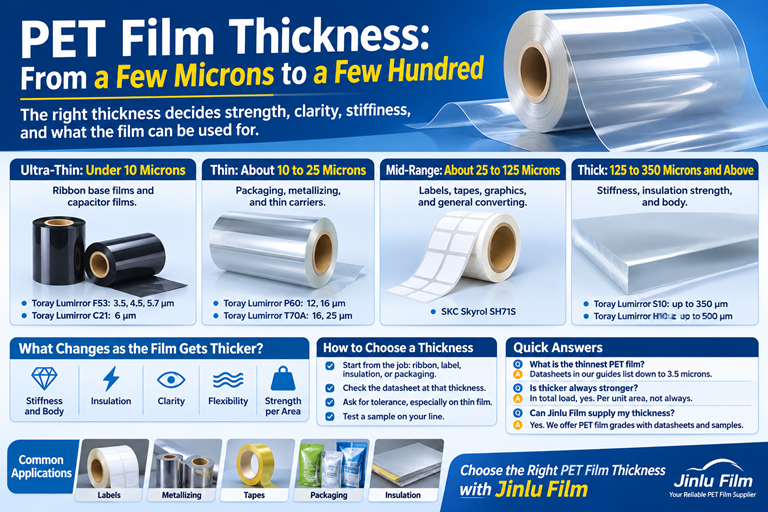
PET film thickness runs from a few microns to a few hundred, and the number you pick decides strength, clarity, stiffness, and what the film can be used for
Ask how thick PET film is and the honest answer is a range. Here is the range as it appears on real datasheets, with the kind of use that tends to sit at each end.
Ultra-Thin: Under 10 Microns
Ribbon base films and capacitor films live here. The Toray Lumirror F53 PET Film datasheet lists 3.5, 4.5, and 5.7 microns for thermal transfer ribbon, and the Toray Lumirror C21 PET Film datasheet lists 6 microns for capacitors. At this thickness a tiny force matters, so tension control on the line is critical.
Thin: About 10 to 25 Microns
Common for packaging, metallizing, and thin carriers. For example, Toray Lumirror P60 PET Film is offered at 12 and 16 microns for packaging, and Toray Lumirror T70A PET Film at 16 and 25 microns as a clear base for labels and window film.
Mid-Range: About 25 to 125 Microns
Labels, tapes, graphics, and general converting. SKC Skyrol SH71S PET Film shows light transmission staying near 93 percent across this range, with haze rising slowly as the film gets thicker.
Thick: 125 to 350 Microns and Above
Stiffness, insulation strength, and body. Toray Lumirror S10 PET Film goes up to 350 microns, with breakdown voltage rising from about 4.1 kV at 12 microns to about 31.2 kV at 350 microns. Toray Lumirror H10 PET Film reaches 500 microns for motor insulation.
What Changes as the Film Gets Thicker
- Stiffness and body: thicker film holds its shape and handles more like a sheet.
- Insulation: breakdown voltage generally rises with thickness.
- Clarity: haze generally rises with thickness, and light transmission slowly falls.
- Flexibility: thin film conforms and winds tightly. Thick film does not.
- Strength per area: a thick film carries more total load, even if the figure per unit area drops a little.
How to Choose a Thickness
- Start from the job: ribbon, label, insulation, or packaging.
- Check the datasheet at that thickness, not at a different one.
- Ask for tolerance, especially on thin film, where a small deviation is a big percentage.
- Test a sample on your line.
Quick Answers
What is the thinnest PET film?
Datasheets in our guides list down to 3.5 microns, and there are others.
Is thicker always stronger?
In total load, yes. Per unit area, not always.
Can Jinlu Film supply my thickness?
Jinlu Film supplies PET film grades, including comparable-specification alternatives and domestic options, with datasheets and samples. Tell us the thickness and use.
More PET Film Guides
- PET Film Working Temperature: three numbers to know
- PET Film HS Code: where to check before you ship
- PET Film Printing: why ink won’t stick and fixes
- PET Film DTF: what to ask before buying transfer film
- PET Film Sheet or Roll?: how to specify cut-to-size film
Talk to Us
Jinlu Film can help you pick a thickness. See our PET film manufacturer page, and contact us for technical data, samples, or a factory quote.
This article is general guidance for reference only. Please confirm the details of any grade with your supplier and the official datasheet.