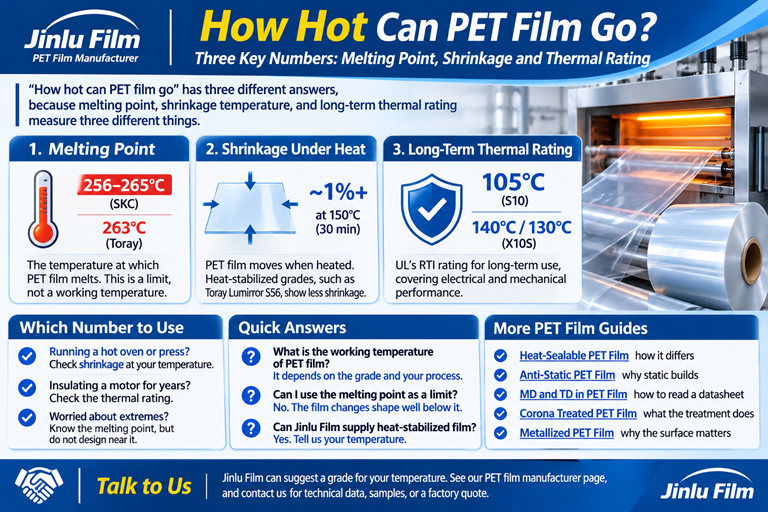
PET film working temperature has three different answers, because melting point, shrinkage temperature, and long-term thermal rating measure three different things
Buyers ask for a single number for PET film working temperature. There is no single number, and reading the three that appear on datasheets prevents costly mistakes.
1. Melting Point
The temperature at which the film melts. Safety data sheets give roughly 256 to 265°C for SKC Skyrol and 263°C for Toray Lumirror (see the SKC and Toray guides). This is a limit, not a PET film working temperature.
2. Shrinkage Under Heat
Long before it melts, PET film moves when heated. Datasheets report shrinkage after a set time at a set temperature, commonly 150°C for 30 minutes. Standard films shrink about 1 percent or more in MD at 150°C, while heat-stabilized grades such as Toray Lumirror S56 PET Film show about half that. For hot processes, this is the number that matters.
3. Long-Term Thermal Rating
UL’s relative thermal index (RTI) is a rating related to the temperature a material can withstand in long-term use. The Toray Lumirror S10 PET Film datasheet lists 105°C for both electrical and mechanical properties. The Toray Lumirror X10S PET Film datasheet lists 140°C electrical and 130°C mechanical, with low oligomer and hydrolysis resistance for hot, damp environments.
Which Number to Use for PET Film Working Temperature
- Running a hot oven or press? Check shrinkage at your temperature.
- Insulating a motor for years? Check the thermal rating.
- Worried about extremes? Know the melting point, but do not design near it.
Quick Answers
What is the PET film working temperature?
It depends on the grade and on whether you mean short-term processing or long-term use.
Can I use the melting point as a limit?
No. The film changes shape well below it.
Can Jinlu Film supply heat-stabilized film?
Jinlu Film supplies PET film grades, including comparable-specification alternatives and domestic options, with datasheets and samples. Tell us your temperature.
More PET Film Guides
- PET Film HS Code: where to check before you ship
- PET Film Printing: why ink won’t stick and fixes
- PET Film Sheet or Roll?: how to specify cut-to-size film
- PET Film vs Mylar: are they the same?
- What Is PET Film Used For?: ten everyday answers
Talk to Us
Jinlu Film can suggest a grade for your temperature. See our PET film manufacturer page, and contact us for technical data, samples, or a factory quote.
This article is general guidance for reference only. Please confirm the details of any grade with your supplier and the official datasheet.