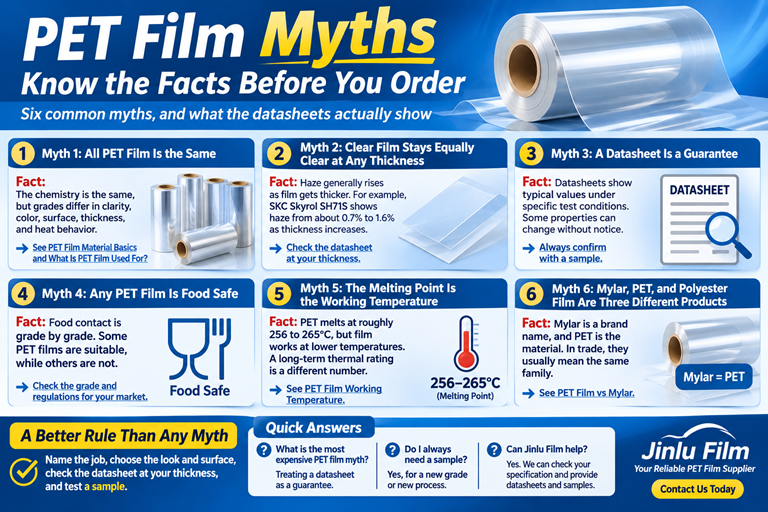
PET film myths are usually harmless in conversation and expensive in a purchase order, so here are six common ones, each with what the datasheets actually show
Most PET film myths are half-truths: there is a reason people believe them, and a limit where they stop being true. Here are six PET film myths worth correcting before you order.
Six PET Film Myths, One at a Time
Myth 1: All PET Film Is the Same
The chemistry is the same. The grades are not. Clarity, color, surface, thickness, and heat behavior all vary. See PET Film Material Basics for what stays constant, and What Is PET Film Used For? for how differently grades are used.
Myth 2: Clear Film Stays Equally Clear at Any Thickness
Haze generally rises as film gets thicker. The SKC Skyrol SH71S PET Film datasheet shows haze climbing from about 0.7 percent at its thinnest grade to about 1.6 percent at 117 microns, while light transmission holds near 93 percent. A clear film is only clear at the thickness it was measured at.
Myth 3: A Datasheet Is a Guarantee
Datasheets state typical values under specific test conditions. One manufacturer’s product sheet says the results are a general guide to material properties and not a guarantee, and that some properties can change without notice. Always confirm with a sample.
Myth 4: Any PET Film Is Food Safe
Food contact is grade by grade. The Toray Lumirror P60 PET Film datasheet describes food contact conformity, while the Toray Lumirror P52 PET Film datasheet asks that the film not touch food directly. Regulations differ by market, so confirm with your compliance team.
Myth 5: The Melting Point Is the Working Temperature
PET melts at roughly 256 to 265°C according to safety data sheets, but film moves long before that, and a long-term thermal rating is a different number again. See PET Film Working Temperature.
Myth 6: Mylar, PET, and Polyester Film Are Three Different Products
In everyday trade use they usually mean the same family. Mylar is a brand name, and PET is the material. See PET Film vs Mylar.
A Better Rule Than Any Myth
Name the job, choose the look and the surface, check the datasheet at your thickness, and test a sample. That sequence beats any rule of thumb.
Quick Answers
What is the most expensive PET film myth?
Treating a datasheet as a guarantee, because it skips the sample test.
Do I always need a sample?
For a new grade or a new process, yes.
Can Jinlu Film help check a specification?
Jinlu Film supplies PET film grades, including comparable-specification alternatives and domestic options, with datasheets and samples. Send us the specification.
More PET Film Guides
- PET Film Material Basics: what it is made of
- What Is PET Film Used For?: ten everyday answers
- PET Film vs Mylar: are they the same?
- PET Film Working Temperature: three numbers to know
- PET Film Sheet or Roll?: how to specify cut-to-size film
Talk to Us
Jinlu Film is happy to check a specification against these six points. See our PET film manufacturer page, and contact us for technical data, samples, or a factory quote.
This article is general guidance for reference only. Please confirm the details of any grade with your supplier and the official datasheet.