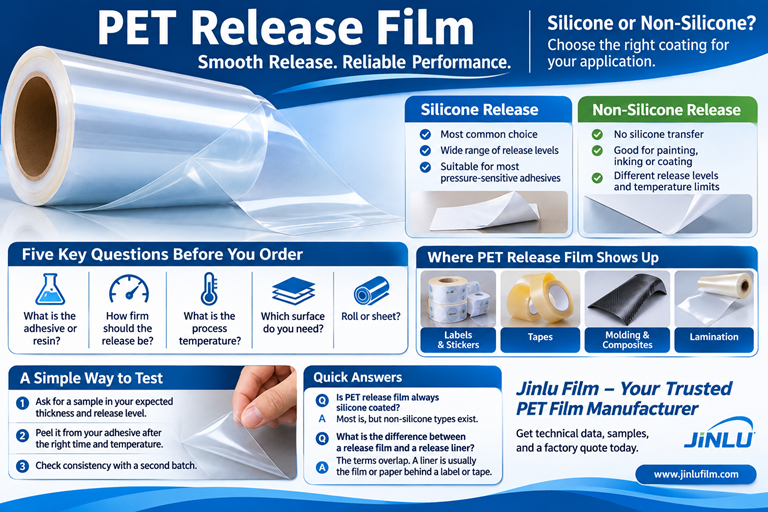
PET release film is polyester coated so that adhesives, resins, and labels peel away cleanly, and the first choice to make is whether the coating should be silicone or non-silicone
Ask for PET release film and a supplier will ask you three things back: what sticks to it, how firmly, and whether silicone is acceptable in your process. This guide explains those three questions in plain terms, with no numbers that depend on one product.
What PET Release Film Does
A release film gives something sticky a surface it can leave without damage. The PET base provides strength and flatness, and the coating provides the controlled release. It appears as the liner behind labels and tapes, as a carrier in lamination, and as a barrier in molding and composite work (a general description). For how release film is requested, see silicone release Mylar, and for the market behind it, our silicone film market overview.
Silicone or Non-Silicone?
- Silicone release: the most common choice, with a wide range of release levels, from light to tight. It suits most pressure-sensitive adhesives.
- Non-silicone release: chosen when silicone must not touch the product, such as where a later step needs a surface that will accept paint, ink, or a coating without contamination (a general explanation). Release levels and temperature limits differ from silicone, so ask for both.
If you are not sure which applies, ask yourself one question: could a trace of silicone transferring to my product cause a problem? If yes, say so in the request.
Five Questions to Settle Before You Order
- What is the adhesive or resin? Acrylic, rubber, epoxy, and others behave differently.
- How firm should the release be? Too tight tears the adhesive, too light lets labels lift early.
- What is the process temperature? A liner that goes through an oven needs low shrinkage. See PET film working temperature.
- Which surface do you need? Clear, matte, or hazy, depending on handling and visibility.
- Roll or sheet? See PET film rolls and PET film sheet.
Where PET Release Film Shows Up
- Labels and self-adhesive products. See self adhesive film market.
- Tapes and die-cut parts that need a protective liner.
- Molding and composite work, where the film keeps resin from sticking to a mold or tool.
- Lamination processes that use a carrier film that is removed afterward.
A Practical Way to Test
- Ask for a sample in the thickness and release level you expect.
- Peel it from your own adhesive after the time and temperature your product sees.
- Repeat on a second batch to check consistency.
Quick Answers
Is PET release film always silicone coated?
Most is, but non-silicone types exist.
What is the difference between a release film and a release liner?
The terms overlap. A liner is usually the film or paper behind a label or tape.
Can Jinlu Film supply PET release film?
Jinlu Film supplies PET film grades, including comparable-specification alternatives and domestic options, with datasheets and samples. Tell us your adhesive, thickness, and release level.
More PET Film Guides
- BOPET vs PET: what the two terms mean
- Silicone Release Mylar: how to specify release film
- PET Film for Magnetic Tape: why surface smoothness matters
- PET Film for Medical Packaging: five documents to ask for
- PET Film for Flexible Circuits: three datasheet clues to read first
Talk to Us
Jinlu Film can help you narrow a release film request. See our PET film manufacturer page, and contact us for technical data, samples, or a factory quote.
This article is general guidance for reference only. Please confirm the details of any grade with your supplier and the official datasheet.