How Silicone Film Supports Labels, Tapes, and Sealant Products Across the Self Adhesive Film Market
Market Overview
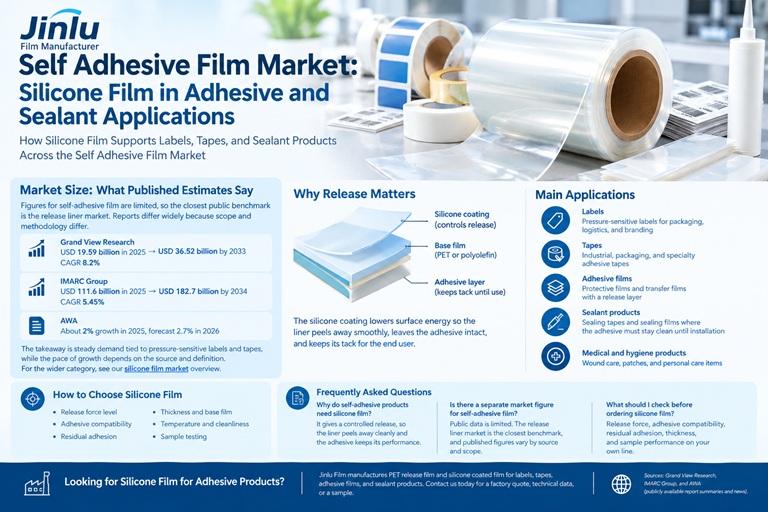
The Self Adhesive Film Market covers labels, tapes, protective films, and adhesive products that all share one need: a clean, controlled release. Silicone film, usually a PET or polyolefin base with a thin silicone coating, protects the adhesive layer until the moment of use. This article explains how silicone film is used in self-adhesive and sealant products and what published estimates say about the market behind it.
Why Release Matters in Self-Adhesive Products
Every self-adhesive product needs a carrier that holds the adhesive without bonding to it permanently. The silicone coating lowers surface energy so the liner peels away smoothly, leaves the adhesive intact, and keeps its tack for the end user. If the release is too tight, the adhesive tears or the liner is hard to remove. If it is too light, labels and tapes can lift too early on the converting line.
Market Size: What Published Estimates Say
Dedicated figures for self-adhesive film are limited, so the closest public benchmark is the release liner market, which supports labels, tapes, hygiene, medical, and industrial products. Reports differ widely because scope and methodology differ:
- Grand View Research: USD 19.59 billion in 2025, rising to USD 36.52 billion by 2033, at a CAGR of 8.2 percent.
- IMARC Group: USD 111.6 billion in 2025, rising to USD 182.7 billion by 2034, at a CAGR of 5.45 percent.
- AWA: the global release liner market grew about 2 percent in 2025, with growth of about 2.7 percent forecast for 2026.
The takeaway is that demand is steady and tied to pressure-sensitive labels and tapes, while the pace of growth depends on which source and definition you use. For the wider category, see our silicone film market overview.
Main Applications
- Labels: pressure-sensitive labels for packaging, logistics, and branding
- Tapes: industrial, packaging, and specialty adhesive tapes
- Adhesive films: protective films and transfer films with a release layer
- Sealant products: sealing tapes and sealing films where the adhesive must stay clean until installation
- Medical and hygiene products: wound care, patches, and personal care items
Many of these products use PET-based liners for thickness control and dimensional stability. To see how that segment is forecast, read our silicone coated PET film market forecast. For demand in the United States, see our US silicone film market article.
How to Choose Silicone Film for Adhesive Products
- Release force level: light, medium, or tight, matched to your adhesive
- Adhesive compatibility: acrylic, rubber, or silicone adhesive systems behave differently
- Residual adhesion: high retention shows the silicone does not contaminate the adhesive
- Thickness and base film: chosen for your converting process and end use
- Temperature and cleanliness requirements of your line
- Sample testing on your own adhesive before bulk orders
Frequently Asked Questions
Why do self-adhesive products need silicone film?
The silicone coating gives a controlled release, so the liner peels away cleanly and the adhesive keeps its performance.
Is there a separate market figure for self-adhesive film?
Public data is limited. The release liner market is the closest benchmark, and published figures vary by source and scope.
What should I check before ordering silicone film?
Release force, adhesive compatibility, residual adhesion, thickness, and sample performance on your own line.
Looking for Silicone Film for Adhesive Products?
Jinlu Film manufactures PET release film and silicone coated film for labels, tapes, adhesive films, and sealant products. Tell us your adhesive type, thickness, and release requirements, and we will recommend a suitable film. Contact us today for a factory quote, technical data, or a sample.
Sources: Grand View Research, IMARC Group, and AWA (publicly available report summaries and news).