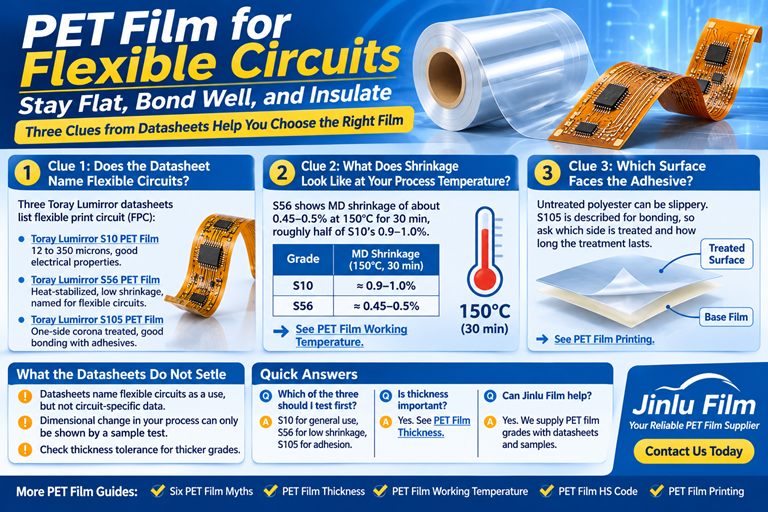
PET film for flexible circuits has to stay flat through heat, bond to adhesives, and insulate, and three lines on a datasheet tell you most of what you need to know
Flexible print circuits ask a lot of a thin film. If you are choosing PET film for flexible circuits, start with these three clues, each backed by a real datasheet.
Why PET Film for Flexible Circuits Is a Special Case
In a flexible circuit, the film is the base the conductors sit on. It goes through heat during processing, has to bond with adhesives, and must keep insulating. That is why general-purpose films, treated films, and low-shrinkage films all show up in this area (a general explanation).
Clue 1: Does the Datasheet Name Flexible Circuits?
Three Toray Lumirror datasheets list flexible print circuit (FPC) among their uses:
- Toray Lumirror S10 PET Film: the general-purpose standard film, from 12 to 350 microns, with good electrical properties.
- Toray Lumirror S56 PET Film: a heat-stabilized low-shrinkage film, named for flyback transformers and flexible circuits.
- Toray Lumirror S105 PET Film: a one-side corona treated S10, noted for good bonding with solvent or water based solutions such as adhesives and inks, like FPC.
Clue 2: What Does Shrinkage Look Like at Your Process Temperature?
S56 shows MD shrinkage of about 0.45 to 0.5 percent at 150°C for 30 minutes, roughly half of S10’s figure of about 0.9 to 1.0 percent at similar thicknesses. If your process heats the film, this is the line to compare. See PET film working temperature for how to read it.
Clue 3: Which Surface Faces the Adhesive?
Untreated polyester can be slippery for adhesives, which is why the treated S105 is described for bonding. Ask which side is treated and how long the treatment lasts. See PET film printing for the surface basics that apply to ink and adhesive alike.
What the Datasheets Do Not Settle
- The datasheets name flexible circuits as a use, but do not give circuit-specific data such as peel strength with a particular adhesive.
- Dimensional change in your own process, with your own temperature profile, can only be shown by a sample test.
- For thicker grades, check the thickness tolerance with your supplier.
Quick Answers
Which of the three should I test first?
Start with the one that matches your priority: S10 for general use, S56 for low shrinkage, S105 for adhesion.
Is thickness important?
Yes. See PET film thickness for how the range looks.
Can Jinlu Film supply films for flexible circuits?
Jinlu Film supplies PET film grades, including comparable-specification alternatives and domestic options, with datasheets and samples. Tell us your process.
More PET Film Guides
- Six PET Film Myths: things buyers get wrong
- PET Film Thickness: from 4.5 to 350 microns
- PET Film Working Temperature: three numbers to know
- PET Film HS Code: where to check before you ship
- PET Film Printing: why ink won’t stick and fixes
Talk to Us
Jinlu Film can suggest what to test for flexible circuits. See our PET film manufacturer page, and contact us for technical data, samples, or a factory quote.
This article is general guidance for reference only. Please confirm the details of any grade with your supplier and the official datasheet.