Heat stabilized polyester film: what it means and what to check first
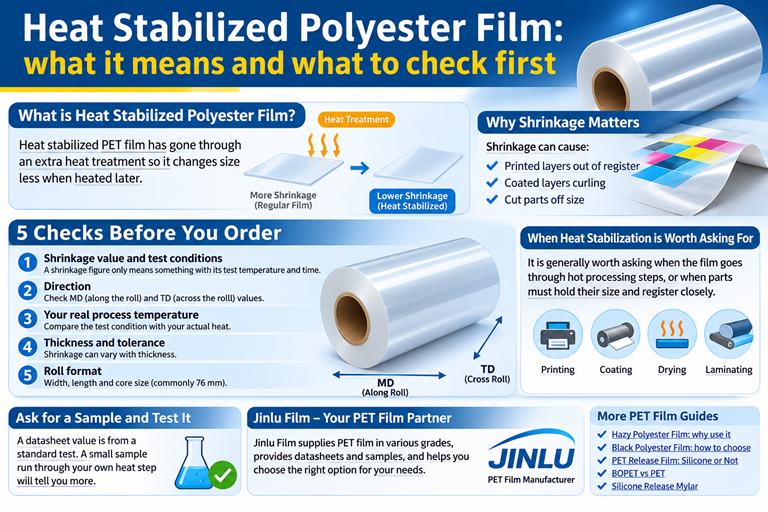
Heat stabilized polyester film is PET film that has gone through an extra heat treatment so it changes size less when it is heated later. The name appears on many datasheets, but it does not tell you how much shrinkage to expect. This guide explains what heat stabilization generally means, how shrinkage is described, and five checks to make before you order. It is general industry information, not a recommendation for any specific grade.
What is heat stabilized polyester film?
PET film is stretched during manufacturing, and that stretching leaves internal stress in the film. When the film is heated again, the stress can release and the film shrinks. Generally, heat stabilized film (sometimes called heat set or annealed film) is given an additional relaxing step so that less stress remains. The result is usually lower shrinkage when the film meets heat during printing, coating, drying or laminating. Standard film is still widely used, and many jobs do not need the extra stability.
Why shrinkage matters in processing
Shrinkage becomes a problem when a small change in size ruins the job. Printed layers can drift out of register, coated or laminated layers can curl, and cut parts can end up off size. If your process passes the film through an oven or a heated roller, shrinkage is worth checking even when the final product never gets hot. For the wider picture of how PET behaves with temperature, see our guide on PET film working temperature, melting point, shrinkage and thermal rating.
5 checks before you order
- 1. Shrinkage value and test conditions: a shrinkage figure only means something with its test temperature and time. Two datasheets are only comparable if the conditions match.
- 2. Direction: shrinkage is usually reported separately along the roll (MD) and across it (TD), and the two values can differ. Our note on MD and TD in PET film explains the directions.
- 3. Your real process temperature: compare the test condition on the datasheet with the heat your line actually applies, and how long the film stays in it.
- 4. Thickness and tolerance: shrinkage can vary with thickness, so ask for values at the thickness you plan to buy.
- 5. Roll format: width, length and core size. Our roll cores are 76 mm inner diameter.
When heat stabilization is worth asking for
It is generally worth asking about when the film goes through hot processing steps, or when parts must hold their size and register closely. Film used in electronics, for example, often has tight dimensional needs; we cover the datasheet items to read first in PET film for flexible circuits. If your process is cold, or the tolerance is loose, a standard film may be enough and may cost less.
Ask for a sample and test it your way
A datasheet value comes from a standard test, and your line is not a standard test. A small sample run through your own heat step, then measured, tells you more than any table. Compare the result against your size tolerance.
Talk to Us
Jinlu Film supplies PET film in various grades, and also supplies products with similar specifications, including domestic alternatives. We provide datasheets and samples. If you are comparing standard and heat stabilized film, send us your thickness, process temperature and size tolerance, and our team will help you narrow the options. Learn more about us as a PET film manufacturer.
More PET Film Guides
Hazy Polyester Film: why some buyers want haze on purpose.
Black Polyester Film: how to choose by color, surface and opacity.
PET Release Film: Silicone or Not: how to decide between silicone and non-silicone release.
BOPET vs PET: what the extra letters mean and when they matter.
Silicone Release Mylar: a plain-language look at release-coated polyester film.
General guidance for reference only. Trademarks belong to their respective owners.