Optical PET film: how to read haze, light transmittance and surface defects on a datasheet
Optical PET film is polyester film chosen for how it handles light and how clean its surface is. Buyers of optical film suppliers in China, and of functional optical film in general, often ask for “optical grade” without saying what that means for their job. The words alone do not tell a supplier much. This guide explains the three things that are usually checked first, so your enquiry is specific and your samples are easier to compare.
Optical PET film: what “optical grade” usually refers to
There is no single meaning of optical grade that every supplier shares. In general it points to film that is clear, even in appearance and free from visible flaws, so that it can sit in front of a display, a light source or a coated layer without distracting the eye. The exact limits depend on the product it goes into. For that reason, write down what the film must do instead of relying on the label.
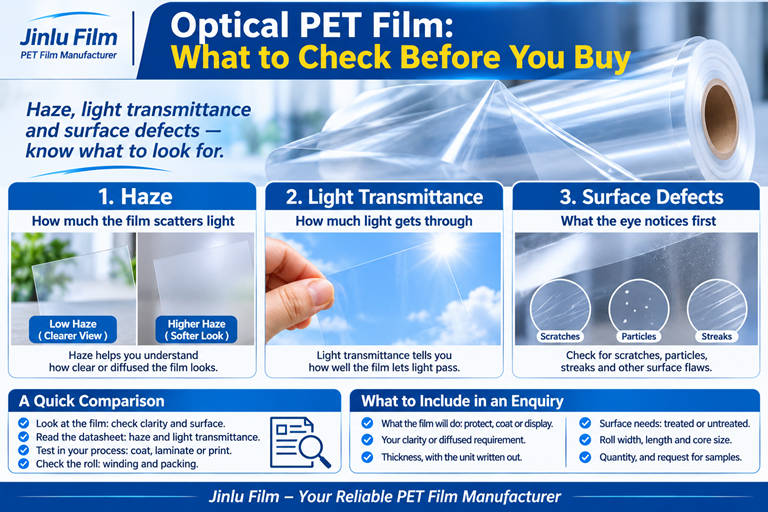
Haze: how much the film scatters light
Haze describes how much light is scattered as it passes through the film. A low-haze film looks clear and sharp. A higher-haze film looks cloudy or soft. Neither is better in every case: some jobs need the clearest film available, while others use haze on purpose to diffuse light or hide what is behind. Our article on why some buyers choose hazy polyester film shows the other side of this. When you compare samples, check that the haze reading on each datasheet was taken on the same thickness, because thickness changes what you see.
Light transmittance: how much light gets through
Light transmittance tells you how much light passes through the film. It is often read together with haze, since a film can let light through and still look cloudy. Ask which test method the datasheet used and look at the result next to your own requirement, not on its own. The datasheet items behind a “clear” claim are listed in what clear means for PET film.
Surface defects: what the eye notices first
On optical film, small surface problems often matter more than the headline numbers. Scratches, particles, gels, streaks, pits and wrinkles can all show up once the film is coated, laminated or placed in front of a light. Ask how the supplier inspects the film and how rolls are wrapped and protected for shipping. For film that will face a screen or a viewing surface, our page on PET film for screen protectors shows why surface quality is usually the first thing checked.
A quick way to compare samples
- Look at the film itself: hold it against a light and a dark background, and check for marks across the whole width.
- Read the datasheet: haze and light transmittance, with the thickness and test method stated.
- Test in your process: coat, laminate or print on the sample, since surface and treatment affect how layers bond.
- Check the roll: winding, edges and wrapping tell you how the film will arrive and unwind.
What to include in an enquiry
- What the film will do: protect, carry a coating, sit in front of a light, or be laminated.
- Whether you need the clearest film possible or a diffused look.
- Thickness, with the unit written out.
- Surface needs: treated or untreated, and which side is the working side.
- Roll width, length and core size. Our rolls use a 76 mm core.
- Quantity, and a request for datasheets and samples before the main order.
Talk to Us
Jinlu Film supplies PET film in various grades, and also supplies products with similar specifications, including domestic alternatives. We slit and convert PET film in our own facility, with custom roll widths, lengths and 76 mm cores, and we provide datasheets and samples. If you are looking for a PET film manufacturer to discuss an optical film requirement, send us the use, thickness, surface needs, size and quantity.
More PET Film Guides
Transparent PET Release Film or Matte: Which Finish to Pick: how the liner finish changes what you see.
5 Questions to Ask Before Buying Polyester Lidding Film: what to settle before ordering lids.
Industrial PET Film Wholesale: Which Grade for Which Job: how to match the grade to the use.
Polyester Film Sheeting Services: What to Put in Your Order: what to write in a custom size enquiry.
Adhesive Tape Films Market: Base Film: what the base film does in tape products.
General guidance for reference only. Trademarks belong to their respective owners.