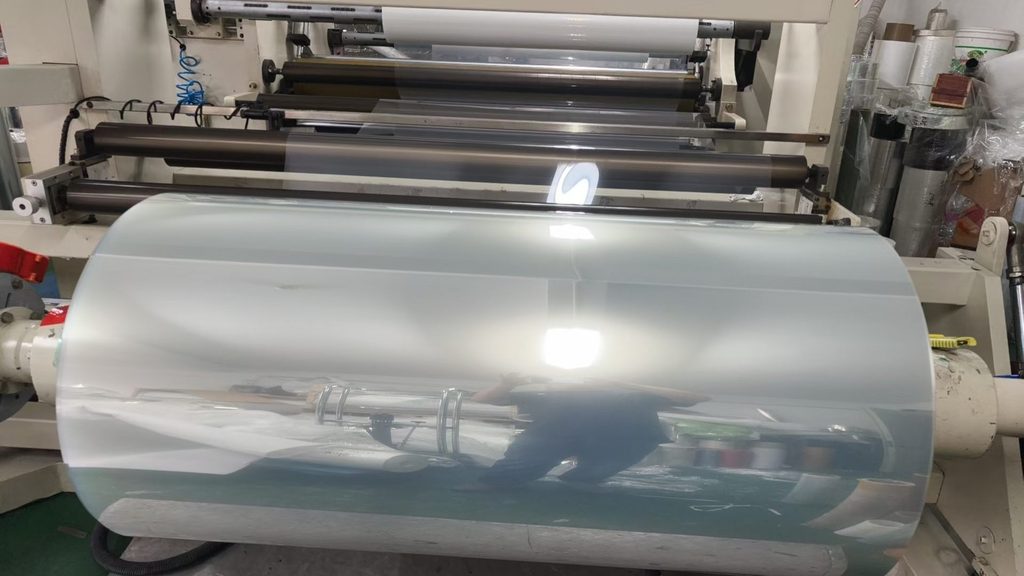
This PET film guide maps the whole family in one place: what the film is, the main types, where each is used, and how to start choosing
PET film is everywhere and mostly invisible: in labels, tapes, packaging, electrical insulation, and screens. This PET film guide explains what it is, how the family splits into types, and where to go for the detailed guide on each branch.
What PET Film Is
PET stands for polyethylene terephthalate, a polyester. Safety data sheets for polyester film list it as the only component, with a content above 99 percent and a melting point in the range of roughly 256 to 265°C. The polymer is formed into a sheet and stretched in two directions, which gives the film its strength and stability for its thickness (a general explanation). For the full basics, see PET Film Material Basics, and for safety information, the Toray Lumirror and SKC Skyrol safety data sheet guides.
The Main Types
- Clear films: built for see-through uses. See Toray Lumirror T60, SKC Skyrol SH71S, and SKC Skyrol SG00.
- White films: opaque backgrounds for printing and labels. See Toray Lumirror E20 and SKC Skyrol SW83G.
- Black films: light blocking. See Toray Lumirror X30 and SKC Skyrol SB00.
- Matte films: lower gloss. See Toray Lumirror X44.
- Treated films: prepared so inks and adhesives bond. See Toray Lumirror S105 and SKC Skyrol SH92.
- Insulation films: chosen for electrical strength. See Toray Lumirror S10, Toray Lumirror H10, and SKC Skyrol SR53.
Where PET Film Is Used
- Tapes: PET film tape uses film as the strong backing layer.
- Packaging: see PET film packaging for the four questions that decide the film.
- Screens and protectors: see PET film screen protector.
- Ribbons, capacitors, and electronics: very thin films such as Toray Lumirror F53 and Toray Lumirror C21.
The Two Brand Families Covered Here
Two brand lines are covered in detail. For Toray, start with the Lumirror grades map and the five popular models. For SKC, the SKC Skyrol SR50 guide is a short way in, and the SW83G safety data sheet guide lists the documents to ask for.
How to Start Choosing
- Name the job first: printing, insulating, laminating, blocking light, or holding adhesive.
- Choose the look: clear, white, black, or matte.
- Ask which side is treated, if you print or coat.
- Compare haze, strength, and shrinkage on the datasheet at your thickness.
- Test samples on your own line before a full order.
Buying PET Film
If you are ready to see what is available, start with our PET film manufacturer page. When you are ready to order, three guides help: seven questions for manufacturers in China, three things that matter more than price, and the PET film rolls terms guide. For importing, see the Malaysia import checklist, and if you are holding an older sheet, four checks for an old datasheet.
Quick Answers
What is PET film?
A thin, strong film made from polyethylene terephthalate, a polyester.
Is every PET film the same?
No. The chemistry is the same, but grades differ in clarity, color, surface, thickness, and heat behavior.
Can Jinlu Film supply PET film?
Yes. Jinlu Film supplies PET film grades, including comparable-specification alternatives and domestic options, with datasheets and samples. Tell us your application and we will suggest what to test.
More PET Film Guides
- Found a PET Film Datasheet From 2016?: four checks before using it
- PET Film Material Basics: what it is made of and why it is used
- PET Film Screen Protector: what the film layer does
- PET Film Tape: What the Backing Film Does: strength, color, and adhesion
- PET Film Packaging: Four Questions That Decide the Right Film: choosing a packaging grade
Talk to Us
Jinlu Film can match a PET film grade to your application. Tell us your use, thickness, and finish, and contact us for technical data, samples, or a factory quote.
This article is general guidance for reference only. Please confirm the details of any grade with your supplier and the official datasheet. Toray, Lumirror, SKC, Skyrol, and related names are trademarks of their respective owners.