A Plain-English Reading of the Toray Lumirror E20 Datasheet: Thickness, Mechanical Strength, Whiteness, and Light Blocking Performance
This guide explains the Toray Lumirror E20 PET Film technical data sheet (TDS) in plain English. It focuses on the relationship between film thickness, opacity, whiteness, optical density, and mechanical properties, helping buyers and material users understand how these figures relate to practical applications.
What Is Toray Lumirror E20 PET Film?
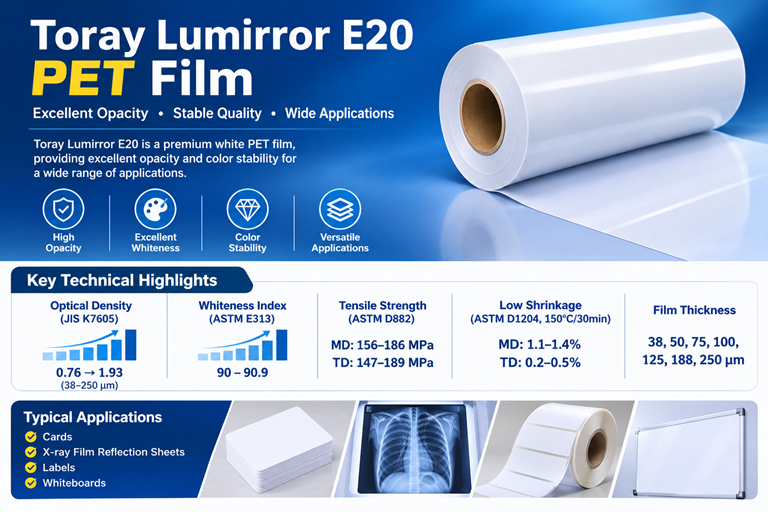
Toray Lumirror E20 is a standard white polyester (PET) film. According to its datasheet, it is a pigment-filled white film with excellent opacity and color stability.
Unlike transparent PET films, E20 is designed to provide a white appearance and block light transmission. These characteristics make it suitable for applications where a consistent white background, visual coverage, and light-blocking performance are important.
The datasheet lists cards, reflection sheets for X-ray film, labels, and whiteboards among its typical applications.
Lumirror E20 at a Glance
- Film type: Standard white PET film
- Film composition: Pigment-filled polyester film
- Key characteristics: Excellent opacity and color stability
- Available thickness: 50, 75, 100, 125, 188, and 250 μm
- Additional thickness data: The technical table also includes a 38 μm grade
- Appearance: White and opaque
- Typical applications: Cards, X-ray film reflection sheets, labels, and whiteboards
Technical Data from the Toray Datasheet
The following table summarizes the typical technical values listed in the Lumirror E20 datasheet. All thickness values are expressed in micrometers (μm).
MD refers to the machine direction, which is the direction in which the film runs during production. TD refers to the transverse direction, across the width of the film.
Mechanical Properties
Tensile Strength (MPa) – ASTM D882
| Property | 38 μm | 50 μm | 75 μm | 100 μm | 125 μm | 188 μm | 250 μm |
|---|---|---|---|---|---|---|---|
| MD | 186 | 176 | 168 | 161 | 161 | 156 | 156 |
| TD | 189 | 179 | 170 | 156 | 151 | 147 | 147 |
Elongation at Break (%) – ASTM D882
| Property | 38 μm | 50 μm | 75 μm | 100 μm | 125 μm | 188 μm | 250 μm |
|---|---|---|---|---|---|---|---|
| MD | 99 | 98 | 97 | 97 | 97 | 97 | 97 |
| TD | 85 | 85 | 85 | 87 | 90 | 90 | 90 |
Thermal and Optical Properties
Thermal Shrinkage (%) – ASTM D1204
Test condition: 150°C for 30 minutes.
| Property | 38 μm | 50 μm | 75 μm | 100 μm | 125 μm | 188 μm | 250 μm |
|---|---|---|---|---|---|---|---|
| MD | 1.4 | 1.3 | 1.3 | 1.2 | 1.2 | 1.1 | 1.1 |
| TD | 0.4 | 0.3 | 0.3 | 0.2 | 0.2 | 0.5 | 0.5 |
Whiteness Index (%) – ASTM E313
| Thickness | 38 μm | 50 μm | 75 μm | 100 μm | 125 μm | 188 μm | 250 μm |
|---|---|---|---|---|---|---|---|
| Whiteness Index | 90 | 90.5 | 90.9 | 90.9 | 90.9 | 90.9 | 90.9 |
Optical Density – JIS K7605
| Thickness | 38 μm | 50 μm | 75 μm | 100 μm | 125 μm | 188 μm | 250 μm |
|---|---|---|---|---|---|---|---|
| Optical Density | 0.76 | 0.86 | 1.01 | 1.18 | 1.29 | 1.59 | 1.93 |
Understanding the Key Performance Characteristics
1. Opacity and Optical Density: How Much Light Does the Film Block?
Opacity is one of the main characteristics of Lumirror E20. The datasheet describes it as a pigment-filled white film with excellent opacity.
Optical density provides a numerical reference for understanding the film’s light-blocking performance. In general, a higher optical density indicates that less light passes through the material under the relevant measurement conditions.
The E20 datasheet shows a clear increase in optical density as thickness increases:
- 38 μm: 0.76
- 50 μm: 0.86
- 75 μm: 1.01
- 100 μm: 1.18
- 125 μm: 1.29
- 188 μm: 1.59
- 250 μm: 1.93
The 250 μm grade has an optical density of 1.93, compared with 0.76 for the 38 μm grade. This demonstrates the relationship between thickness and light-blocking performance in the listed test results.
For buyers selecting white PET film, optical density is particularly relevant when the material is expected to cover an underlying surface or provide a more uniform visual background.
However, optical density is not the same as a direct percentage of opacity. The two measurements should not be treated as interchangeable.
2. Whiteness Index and Color Appearance
Whiteness is another important characteristic of Lumirror E20. The datasheet reports a whiteness index ranging from 90 to 90.9 across the listed thicknesses, measured according to ASTM E313.
The values increase from 90 at 38 μm to 90.9 at 75 μm, then remain at 90.9 for the thicker grades.
This indicates that the reported whiteness values are relatively consistent across the listed thickness range. The datasheet also describes E20 as having good color stability.
For applications such as cards, labels, and whiteboards, a consistent white appearance can be an important material-selection consideration.
It is worth distinguishing whiteness from opacity. Whiteness describes the visual appearance of the film, while opacity relates to how effectively it prevents light from passing through. A high whiteness index does not automatically mean a higher optical density.
3. Tensile Strength and Elongation at Break
Tensile strength indicates the maximum tensile stress a film can withstand before breaking under the specified test conditions. Elongation at break describes how much the material stretches before failure.
For Lumirror E20, the reported tensile strength ranges from 156 to 186 MPa in MD and from 147 to 189 MPa in TD.
The thinner grades generally show higher tensile strength values in the datasheet. For example, the 38 μm grade records 186 MPa in MD and 189 MPa in TD, while the 250 μm grade records 156 MPa and 147 MPa respectively.
Elongation at break remains relatively stable in MD, ranging from 97% to 99%. In TD, the reported values range from 85% to 90%.
These figures help buyers understand the mechanical behavior of the different thickness grades. For applications involving feeding, cutting, handling, or further converting, both tensile strength and elongation should be considered alongside the requirements of the actual production process.
4. Thermal Shrinkage and Dimensional Stability
The datasheet measures thermal shrinkage according to ASTM D1204 at 150°C for 30 minutes.
MD shrinkage ranges from 1.1% to 1.4%, while TD shrinkage ranges from 0.2% to 0.5%.
The MD values decrease slightly as thickness increases. However, TD shrinkage is not strictly progressive: it reaches 0.2% at 100 and 125 μm, then increases to 0.5% at 188 and 250 μm.
This directional difference is important when the film is used in processes involving heating, lamination, or other operations where dimensional changes may affect the finished product.
These results apply specifically to the stated test condition. They should not be interpreted as shrinkage values under every possible processing temperature or production environment.
How to Choose the Right Lumirror E20 Thickness
Lumirror E20 is listed in several thickness grades, from 38 μm to 250 μm in the technical data table. The datasheet’s available-thickness section separately lists 50, 75, 100, 125, 188, and 250 μm.
When selecting a thickness, buyers should consider the intended application rather than choosing solely by the highest optical density or tensile strength.
- 50–75 μm: These grades offer relatively lower material thickness while providing the white appearance and optical properties listed in the datasheet. They may be considered where a thinner film structure is required.
- 100–125 μm: These grades provide intermediate thickness options. The listed whiteness index is 90.9, while optical density increases from 1.18 to 1.29.
- 188–250 μm: These thicker grades have higher optical density values, reaching 1.59 and 1.93 respectively. They may be worth evaluating where greater light blocking and a thicker sheet structure are required.
The final selection should also take into account stiffness, converting requirements, product construction, and the performance of the finished application. Sample testing is recommended before confirming a production specification.
Typical Applications of Lumirror E20
The Toray datasheet identifies several typical applications for E20.
Cards
White PET film can provide a consistent background and an opaque base for card-related products. The required thickness depends on the card construction, printing method, and desired finished rigidity.
Reflection Sheets for X-ray Film
The datasheet specifically lists reflection sheets for X-ray film as an application. In this type of use, the white film’s optical characteristics are relevant to the reflective background or backing layer. The actual performance requirements should be confirmed with the finished product design and application testing.
Labels
For label applications, a white opaque PET base can provide a uniform background for printed information and graphics. Buyers should also check printing compatibility, surface treatment, ink adhesion, and the converting process, as these details are not fully specified in the available E20 data.
Whiteboards
The white appearance and opacity of E20 may be relevant to whiteboard-related constructions. However, the suitability of the film depends on the complete surface system, including coating, writing performance, erasability, and bonding requirements. These finished-product characteristics are not established by the TDS alone.
Important Points When Reading the E20 TDS
- The datasheet identifies E20 as a pigment-filled white film with excellent opacity and color stability.
- The technical table contains data for seven thicknesses, including 38 μm, while the available-thickness section lists six grades starting at 50 μm. Commercial availability of the 38 μm grade should therefore be confirmed separately.
- Optical density increases with thickness, but it should not be confused with a direct opacity percentage.
- Whiteness index values are relatively stable across the listed thickness range.
- Thermal shrinkage is reported at 150°C for 30 minutes. Results under other conditions may differ.
- The datasheet states that the listed figures are typical values under specific test conditions and are not intended as limiting specifications.
- Thickness tolerance, surface treatment, surface tension, surface resistivity, and detailed printing or coating performance are not provided in the supplied TDS.
Related Toray Lumirror PET Film Datasheets
Different Lumirror grades are designed for different material requirements and applications. The following articles explain other products in the same product range:
- Toray Lumirror E63 PET Film – A low-density white PET film for print receiver applications.
- Toray Lumirror E60L PET Film – A microvoided white PET film for LCD backlight applications.
- Toray Lumirror S10 PET Film – A standard clear polyester film with a broad thickness range.
- Toray Lumirror X42 PET Film – A matte PET film for hot stamping foil applications.
- Toray Lumirror X30 PET Film – A black PET film for cable tape applications.
Frequently Asked Questions
What is Toray Lumirror E20 PET Film?
It is a standard white polyester film filled with pigment. The datasheet describes it as having excellent opacity and color stability.
What thicknesses are listed for Lumirror E20?
The available-thickness section lists 50, 75, 100, 125, 188, and 250 μm. The technical table also includes data for 38 μm, so availability of that grade should be confirmed.
Does thicker Lumirror E20 provide higher optical density?
Yes. The listed optical density increases from 0.76 at 38 μm to 1.93 at 250 μm. Higher optical density generally indicates lower light transmission under the relevant measurement conditions.
What is the whiteness index of Lumirror E20?
The datasheet reports values from 90 to 90.9 according to ASTM E313, depending on thickness.
What are the main applications of Lumirror E20?
The datasheet lists cards, reflection sheets for X-ray film, labels, and whiteboards.
Are the technical values guaranteed specifications?
No. Toray identifies these figures as typical data under specific test conditions, not limiting specifications. Actual product specifications should be confirmed before ordering.
Can Jinlu Film supply Lumirror E20 or comparable white PET film?
Jinlu Film can assist with sourcing Lumirror E20 and comparable white PET film materials. Depending on the required thickness, width, quantity, and application, we can also help identify alternative materials and provide available technical data and samples for evaluation.
Looking for White PET Film for Your Application?
Jinlu Film supplies PET film and related polyester materials to industrial customers worldwide. For buyers looking for white PET film, we can help check available grades, compare technical data, and identify suitable material options according to the intended application.
When making an inquiry, please share your application, required thickness, roll or sheet width, and estimated purchasing quantity. This information helps us evaluate the material requirements and sourcing options more efficiently.
Contact Jinlu Film for product information, technical data, samples, or a quotation.
Source: Toray’s Lumirror E20 technical data sheet. The figures discussed in this article are typical data under the specific test conditions stated in the source document. Please refer to the latest official technical documentation for current product information. Lumirror and Toray are trademarks of their respective owners. This article is an independent technical explanation for reference only.