BOPET film specifications: how to write microns, mil and roll size so a quote comes back right
BOPET film specifications look simple until two people use different units. One buyer writes thickness in microns, another in mil, a third in gauge, and the supplier ends up quoting something nobody meant. A few lines of care in the enquiry save a lot of back and forth. Here is a plain way to write the specification, the way you would explain it to a friend in the trade.
BOPET film specifications start with thickness and its unit
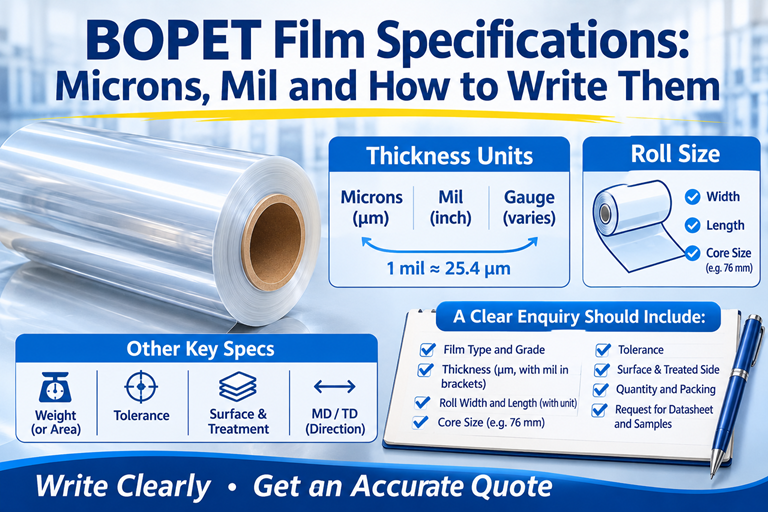
Thickness is the first thing on every quote, and it is where most mix-ups happen. Microns (µm) are the metric unit, and they are the most common way to write PET film thickness around the world. Mil means one thousandth of an inch, and it is common in the United States. As a rough guide, one mil is about 25.4 microns. Gauge is an older unit that some people still use, and its meaning can vary, so if someone sends you a gauge number, ask them to confirm it in microns or mil. Our guide to PET film thickness and where each is used shows how thickness ranges relate to uses.
The simple habit: always write the number and the unit together, and add the other unit in brackets if your customer uses it. For example, write the thickness in microns and put the mil value next to it, so nobody has to guess.
Width, length and core
After thickness, the roll itself needs describing. Write the roll width and the roll length, and say which unit each one uses, since millimeters, meters, inches and feet all show up in enquiries. Then give the core size. Our rolls use a 76 mm core, and we slit to custom widths and lengths, so tell us what your machine needs. If you are not sure how rolls are normally described, see our page on PET film rolls.
Weight, area and density
Some buyers think in weight (kilograms per roll), others in area (square meters). The two are linked through thickness and density, which is also called specific gravity. You can find density on the datasheet, and our article on BOPET film properties explains where to look. If you compare quotes, ask each supplier to say whether the figure is per kilogram, per square meter or per roll, and which thickness it applies to. Mixing these up is one of the easiest ways to think one quote is better than another when it is not.
Tolerance
Every size has a tolerance, which is how much it is allowed to vary. If your process is sensitive, say so and say which size matters most, thickness or width. If it is not sensitive, there is no need to ask for a tight tolerance. Asking for more than you need can make the enquiry harder to answer without helping the result.
Surface, direction and side
Specifications are not only numbers. Say whether the film is clear, matte, white or another type, which side is treated or coated, and whether direction matters. If you need a reminder on direction, see MD and TD in PET film.
A specification you can copy
- Film type and grade, with the model if you already use one.
- Thickness in microns, with the mil value in brackets if needed.
- Roll width and length, with the unit written out.
- Core size. Our rolls use a 76 mm core.
- Tolerance, only where it matters for your process.
- Surface: finish, treated side and any protective layer.
- Quantity and how you want it packed.
- A request for the datasheet and samples before the main order.
Talk to Us
Jinlu Film supplies PET film in various grades, and also supplies products with similar specifications, including domestic alternatives. We slit and convert PET film in our own facility, with custom roll widths, lengths and 76 mm cores, and we provide datasheets and samples. If you are looking for a PET film manufacturer to turn your specification into a quote, send us the grade, thickness, size and quantity.
More PET Film Guides
BOPET Film Price: What Affects It and What to Put in an Enquiry: what changes a quote.
Printable Polyester Film: Match the Surface to Your Print Method: how print methods change the surface you need.
Recycled BOPET Film: Which Documents to Ask a Supplier For: how to check a claim on paper.
SKC Skyrol PET Film: How to Find the Right Model: how to read a model code and where to find our model pages.
7 Things to Check When Choosing a PET Release Film Supplier: what to settle before sending an enquiry.
General guidance for reference only. Trademarks belong to their respective owners.