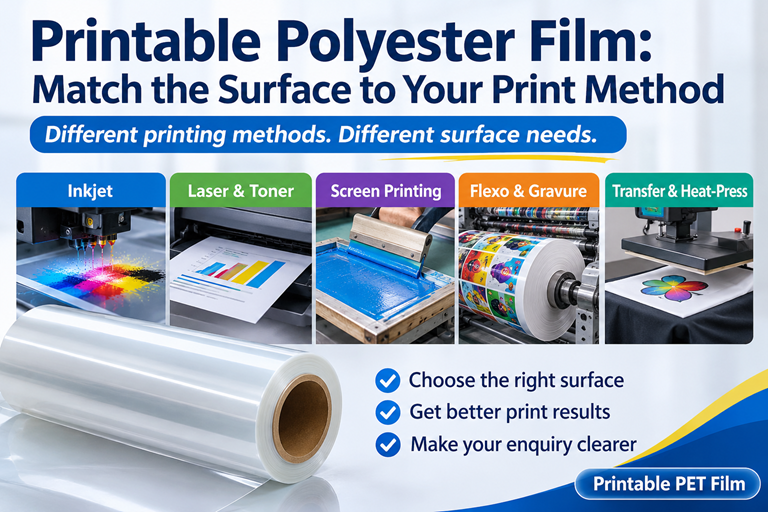
Printable polyester film: why the surface matters more than the film itself
Printable polyester film is not one product. Plain polyester has a smooth, low-energy surface that many inks do not grip, so a film sold as printable is usually treated or coated on one side to accept ink, toner or a coating. A surface that works for one printing method may give poor results on another. This guide compares the common methods and shows what to say in an enquiry, so the sample you receive is closer to what you need.
Printable polyester film: what “printable” usually means
In general, a printable grade has a surface that has been prepared to hold ink. The preparation can be a surface treatment on the film, or a thin coating applied to one side. Which one is used, and which side carries it, is stated on the datasheet. Never assume both sides print the same way. For more on one common surface treatment, see our page on corona treated PET film.
Match the surface to the printing method
Different printing methods put ink on the film in different ways, so each one asks different things of the surface. The points below are general guidance. The final answer always comes from testing a sample on your own equipment.
- Inkjet: ink is sprayed on and has to dry or cure on the surface. Buyers usually ask for a film with a coating made for the ink type they use, whether water-based, solvent or UV.
- Laser and toner printing: the film passes through heat, so ask the supplier about heat behavior and whether the grade is meant for this kind of printer.
- Screen printing: the surface should hold a thicker ink layer evenly. Ask about the surface and test the ink you plan to use.
- Flexo and gravure on rolls: the film runs through a machine, so flatness, roll winding and surface treatment all matter.
- Transfer and heat-press jobs: these use film as a carrier. Our page on PET film for DTF explains this use.
Finish and colour also change the result
A clear film shows what is behind the print, a matte film softens the look, and a white film gives a solid background. If the printed area must look the same from roll to roll, ask how colour and whiteness are checked. Our guide to white polyester film whiteness checks lists what to look at on a white grade.
Common mistakes when ordering printable film
- Asking for “printable film” without naming the printing method or the ink.
- Not saying which side is printed, which leads to a roll wound the wrong way round.
- Judging a sample by eye only, without printing a real job on it.
- Skipping a test of how the ink holds after drying, bending or contact with other materials.
- Ordering the full quantity before a sample has passed.
For a broader introduction to printing on polyester, see our page on PET film printing.
What to include in an enquiry
- The printing method, and the ink or toner type.
- Which side is printed, and whether the other side needs any treatment.
- Finish and colour: clear, matte or white.
- Thickness, with the unit written out.
- Roll width, length and core size, or sheet size. Our rolls use a 76 mm core.
- Quantity, and a request for datasheets and samples before the main order.
Talk to Us
Jinlu Film supplies PET film in various grades, and also supplies products with similar specifications, including domestic alternatives. We slit and convert PET film in our own facility, with custom roll widths, lengths and 76 mm cores, and we provide datasheets and samples. If you are looking for a PET film manufacturer to supply film for a print job, send us the printing method, ink type, finish, size and quantity.
More PET Film Guides
Recycled BOPET Film: Which Documents to Ask a Supplier For: how to check a claim on paper.
SKC Skyrol PET Film: How to Find the Right Model: how to read a model code and where to find our model pages.
7 Things to Check When Choosing a PET Release Film Supplier: what to settle before sending an enquiry.
Mylar Sheets Uses: Six Common Jobs and How to Order: what to specify for each common use.
PET Film for Electrical Insulation: What to Ask a Supplier: questions about thickness, heat, surface and documents.
General guidance for reference only. Trademarks belong to their respective owners.