PET protective film: the main types and what to specify before you order
PET protective film is a thin polyester film used to cover a surface so it stays clean and unscratched while the product is made, moved or installed. The name covers many different products, and buyers often ask for “protective film” without saying which type they mean. This guide explains the common types, including die cut, antistatic and high transparent film, and what to tell a supplier before you request a quote. It is general industry information, not a recommendation for any specific grade.
What is PET protective film?
Generally, PET protective film is a PET base film with a surface that lets it stay in place on the item it covers and come off again later. Depending on the product, it may hold on through a light adhesive layer or through a self-clinging surface. PET is chosen as the base because it is clear, strong for its thickness and stable in size. Because “protective film” describes a job and not a single grade, two products with the same name can behave very differently.
Common types of PET protective film
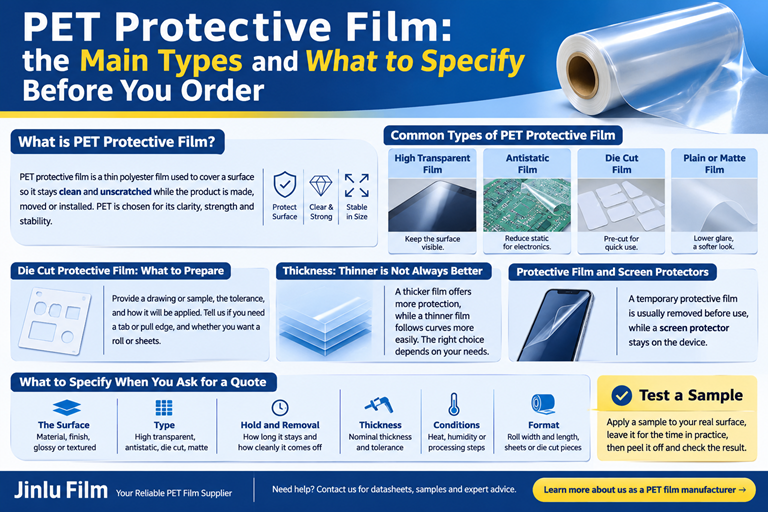
- High transparent film: used where the covered surface, such as a display or a glossy panel, must stay visible and be checked through the film.
- Antistatic film: treated to reduce static build-up, which matters around electronics and dust-sensitive surfaces. For the base material, see our guide to anti-static PET film.
- Die cut film: supplied already cut to the shape of the part, so it can be applied quickly and consistently instead of being trimmed by hand.
- Plain or matte film: used where a softer look or lower glare is acceptable or wanted.
These are not exclusive. A film can be both high transparent and antistatic, for example, so describe every property you need.
Die cut protective film: what to prepare
For die cut film, the supplier needs a drawing or sample of the part, the tolerance you can accept, and how the film will be applied, by hand or by machine. Tell them whether you need a tab or pull edge to make peeling easier, and how the pieces will be supplied, on a carrier roll or as sheets. Clear information up front avoids a second round of sampling.
Thickness: thinner is not always better
A thicker film is generally easier to handle and gives more cushioning against scratches, while a thinner film is lighter and follows curves more easily. The right choice depends on the surface you protect and how the film is applied. Our overview of PET film thickness and where each is used shows how the range is generally used.
Protective film and screen protectors are not the same thing
A temporary protective film is usually removed before the product is used, while a screen protector stays on the device. If your project is closer to the second case, read our guide on PET film for screen protectors, because the requirements are different.
What to specify when you ask for a quote
- The surface being protected: material, finish, and whether it is glossy or textured.
- Type: high transparent, antistatic, die cut, matte, or a combination.
- Hold and removal: how long the film stays on, and how cleanly it must come off. Ask for the supplier’s data on this instead of assuming it.
- Thickness and tolerance: the nominal thickness and the allowed variation.
- Conditions: heat, humidity or processing steps the film must survive while it is on.
- Format: roll width and length, sheets or die cut pieces. Our roll cores are 76 mm inner diameter.
Test a sample on the real surface
How a protective film holds and releases depends on the surface and the conditions, so a datasheet cannot settle it alone. Apply a sample to the real part, leave it for the time it will stay on in practice, then peel it off and check the surface.
Talk to Us
Jinlu Film supplies PET film in various grades, and also supplies products with similar specifications, including domestic alternatives. We provide datasheets and samples. If you are comparing protective film types, send us your surface, thickness and format needs and our team will help you narrow the options. Learn more about us as a PET film manufacturer.
More PET Film Guides
Heat Stabilized Polyester Film: five checks before ordering.
Hazy Polyester Film: why some buyers want haze on purpose.
Black Polyester Film: how to choose by color, surface and opacity.
PET Release Film: Silicone or Not: how to decide between silicone and non-silicone release.
BOPET vs PET: what the extra letters mean and when they matter.
General guidance for reference only. Trademarks belong to their respective owners.