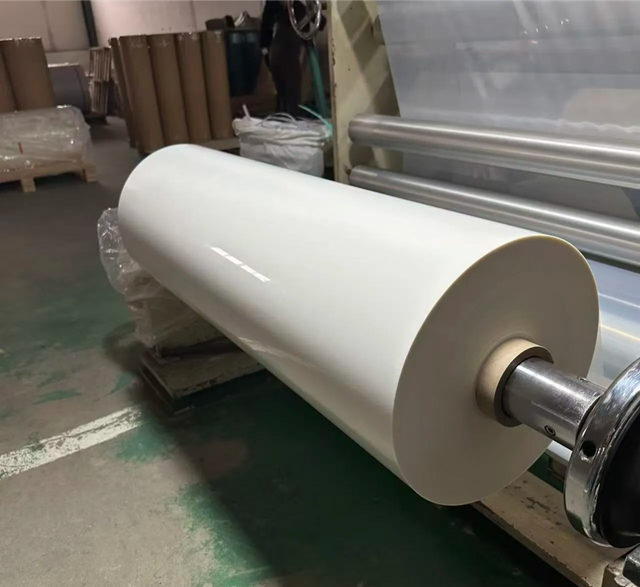
PET film for magnetic tape is the thin base that carries a magnetic coating, and its surface smoothness, flatness, and dimensional stability decide how well the tape holds a signal
A magnetic tape looks like a ribbon, but it is a stack: a thin polyester base, a magnetic coating on one side, and sometimes a back coating on the other. The base does not store anything, yet it controls how well everything above it performs. This is a general explanation, since none of the datasheet guides on this site covers a magnetic tape grade.
What PET Film for Magnetic Tape Has to Do
- Carry the coating evenly: an uneven or rough surface shows up as an uneven magnetic layer.
- Stay flat and stable: the tape must run past a head at a precise distance, so a film that curls or stretches changes the signal (a general explanation).
- Be strong when very thin: thin base allows more tape on a reel, but only if the film can carry the tension.
- Wind and run smoothly: the surface needs just enough texture to avoid sticking, without roughening the coating side.
Reading Datasheets With a Tape in Mind
If you are comparing films for this kind of use, these are the rows worth checking, with an example of each from the guides:
- Surface smoothness and gloss: a smooth, high-gloss grade, such as SKC Skyrol SH71S PET Film, shows how a datasheet describes a smooth surface, with gloss near 200 percent.
- Surface roughness (Ra): a few datasheets list it. The Toray Lumirror F53 PET Film sheet gives about 0.10 for a ribbon base, which is very smooth. Many datasheets do not list it at all, so ask.
- Friction: the coefficient of friction tells you how the film will slide on rollers and against itself.
- Tension strength and stretch: the F-5 value, the stress needed to stretch the film by 5 percent, appears on thin-film sheets such as F53 and tells you how the film resists tension.
- Shrinkage: low and balanced shrinkage keeps the film flat through coating and drying ovens. See PET film working temperature.
Thin Film Brings Its Own Handling Rules
At a few microns thick, small forces matter. Tension control, clean rooms, and careful winding become part of the job. See PET film thickness for what the thin end of the range looks like.
Questions for a Supplier
- What is the surface roughness on each side, and how is it measured?
- What is the thickness tolerance, and how uniform is it across the width?
- How clean is the film, and how is it packed?
- Can I test a sample under my coating and slitting process?
Quick Answers
Is any PET film suitable for tape?
Not automatically. Surface and thickness uniformity matter, and need confirming.
Is this the same as adhesive tape film?
No. See PET film tape for backing film used with adhesive.
Can Jinlu Film supply thin base film?
Jinlu Film supplies PET film grades, including comparable-specification alternatives and domestic options, with datasheets and samples. Tell us your coating process and thickness.
More PET Film Guides
- PET Film for Medical Packaging: five documents to ask for
- PET Film for Flexible Circuits: three datasheet clues to read first
- Six PET Film Myths: things buyers get wrong
- PET Film Thickness: from 4.5 to 350 microns
- PET Film Working Temperature: three numbers to know
Talk to Us
Jinlu Film can go through the surface questions with you. See our PET film manufacturer page, and contact us for technical data, samples, or a factory quote.
This article is general guidance for reference only and does not claim any grade for magnetic tape use. Please confirm the details of any product with your supplier and the official datasheet.