Rigid PET sheet: where it is used, how it differs from thin film, and what to put in an enquiry
Rigid PET sheet is the thicker, stiffer cousin of PET film. It is cut into flat pieces or supplied on rolls for printing, packaging and forming, and it shows up in places where thin film would be too floppy. Here is the chatty version, the way you would explain it to a friend who has just been asked whether to buy film or sheet.
Rigid PET sheet: how it differs from PET film
Both are PET, but they are used differently. Thin film is usually stretched, wound on rolls and run through printing, laminating and coating lines. Rigid sheet is thicker and stiffer, holds its shape on its own and is often formed, cut or printed as a panel. There is no sharp line where one becomes the other, so say what you need the material to do and let the supplier suggest which side of the line you are on. For thinner polyester sheets, see Mylar sheets uses.
Where rigid PET sheet is commonly used
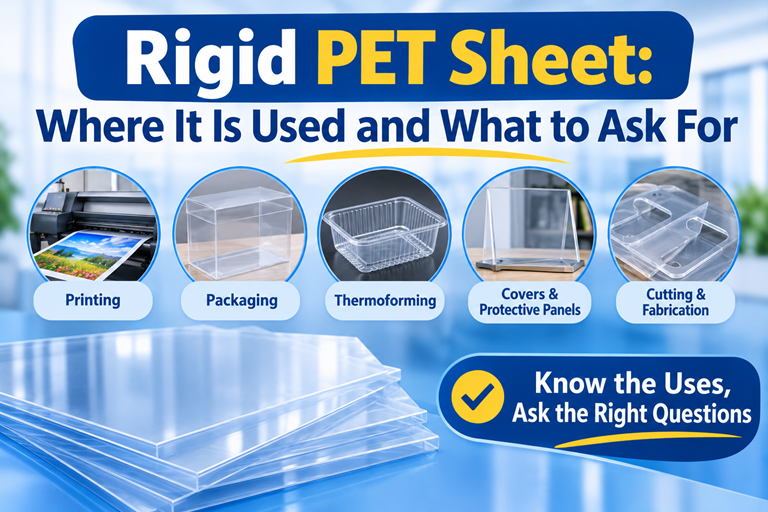
- Printing: signs, displays, cards and panels that need a flat, printable surface.
- Packaging: clear trays, blisters, boxes and windows, where the sheet is formed or folded.
- Thermoforming: sheet is heated and shaped into trays, covers and shells. Ask the supplier whether the grade is meant for forming.
- Covers and protective panels: clear or colored pieces that sit over a part or a display.
- Cutting and fabrication: pieces cut, folded or assembled into small products.
What to think about before you ask for a quote
- Clear, colored or opaque: and how clear it has to look.
- Surface: glossy or matte, and whether it will be printed or laminated.
- Thickness: with the unit written out, and the range you want to try.
- Size: roll width, or sheet length and width, with the tolerance you can accept.
- Forming or cutting method: thermoforming, die cutting, laser or hand cutting.
- Protective layer: whether the surface needs a film on it during shipping and handling.
Common mistakes
- Asking for “PET sheet” without saying what it will be used for.
- Judging a sample by looks only, without testing it in your own printing, cutting or forming process.
- Mixing units for thickness. See BOPET film specifications: microns, mil and how to write them for a clean way to write it.
- Skipping the packing question, since sheets can scratch or dent if stacked without protection.
If the sheet touches food
Do not rely on a name like “food grade” alone. Tell the supplier the market you sell into and ask for the documents your customer requires. See food grade PET film for what to ask.
What to include in an enquiry
- What the sheet is for, in one sentence.
- Clear, colored or opaque, and the finish.
- Thickness, with the unit written out.
- Size, or roll width and length. Our rolls use a 76 mm core.
- Printing, forming or cutting method.
- Packing needs and quantity.
- A request for datasheets and samples before the main order.
Talk to Us
Jinlu Film supplies PET film in various grades, and also supplies products with similar specifications, including domestic alternatives. We slit and convert PET film in our own facility, with custom roll widths, lengths and 76 mm cores, and we provide datasheets and samples. If you are looking for a PET film manufacturer to quote PET film or sheet, send us the use, thickness, size and quantity.
More PET Film Guides
Is PET the Same as Polyester? The Short, Plain Answer: how PET, polyester, BOPET and Mylar relate.
Where to Buy PET Film: Five Places and What to Ask Each: which seller fits the amount you need.
8 PET Release Film Questions New Buyers Ask First: plain answers for buyers just starting.
PET Release Film Sample Request: What to Write in Your Email: a copy-and-paste enquiry template.
PET Release Film Terms: A Plain-English Glossary: the words on a quote, explained.
General guidance for reference only. Trademarks belong to their respective owners.