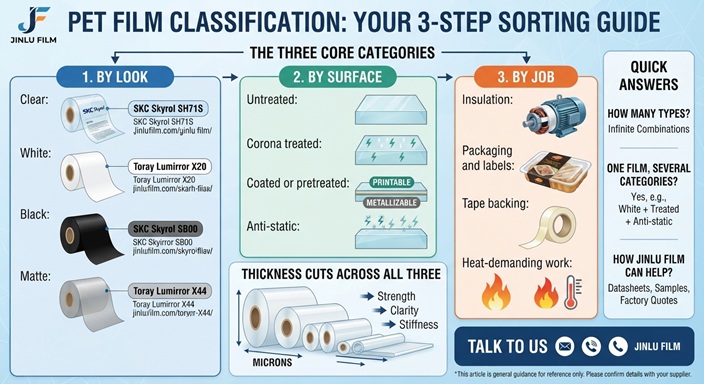
PET film classification gets easier when you sort the family three ways: by how it looks, by what is done to its surface, and by the job it is built for
Ask for “PET film” and a supplier has to ask three more questions. The classification below is the shortest route to answering them, with a link to a detailed guide at each stop.
1. By Look
- Clear: built for see-through uses. See SKC Skyrol SH71S PET Film.
- White: a bright, opaque background. See Toray Lumirror X20 PET Film.
- Black: light blocking. See SKC Skyrol SB00 PET Film.
- Matte: lower gloss. See Toray Lumirror X44 PET Film.
2. By Surface
- Untreated: plain polyester, smooth and chemically resistant.
- Corona treated: surface energy raised for ink and adhesive. See corona treated PET film.
- Coated or pretreated: prepared for printing or metallizing. See metallized PET film.
- Anti-static: charge spreads instead of building up. See anti-static PET film.
3. By Job
- Insulation: chosen for electrical strength. See Toray Lumirror H10 PET Film.
- Packaging and labels: printable and tough. See PET film packaging.
- Tape backing: see PET film tape.
- Heat-demanding work: see PET film working temperature.
Thickness Cuts Across All Three
Every type comes in a range of thicknesses, and thickness changes strength, clarity, and stiffness. State it in microns when you ask.
How to Use the Sorting
- Pick the look first.
- Pick the surface for your ink, adhesive, or coating.
- Pick the job-specific properties: heat, insulation, clarity.
- Confirm the thickness and ask for samples.
Quick Answers
How many types of PET film are there?
No fixed count. Grades are combinations of look, surface, thickness, and job.
Can one film cover several categories?
Yes. A film can be white, treated, and anti-static at once.
Can Jinlu Film help sort a request?
Jinlu Film supplies PET film grades, including comparable-specification alternatives and domestic options, with datasheets and samples. Tell us your use.
More PET Film Guides
- PET Film Working Temperature: three numbers to know
- Heat-Sealable PET Film: how it differs from standard polyester
- Anti-Static PET Film: why static builds and what helps
- Corona Treated PET Film: what the treatment does
- Metallized PET Film: why the surface under the metal matters
Talk to Us
Jinlu Film can place your request in this map. See our PET film manufacturer page, and contact us for technical data, samples, or a factory quote.
This article is general guidance for reference only. Please confirm the details of any grade with your supplier and the official datasheet.