PET film manufacturing: the process in six plain-language steps
PET film manufacturing turns small plastic chips into thin, strong, clear film wound on large rolls. Knowing the main steps helps buyers understand why film properties such as thickness, shrinkage and surface differ from one grade to another. This guide walks through the process in general terms and shows what each step means for the film you order. It is general industry information, not a description of any specific plant or grade.
PET film manufacturing in six steps
Details vary between producers, but the overall order is generally the same. Here are the six steps.
Step 1: Raw material and drying
The process starts with PET resin, usually supplied as small chips. PET absorbs moisture easily, so the chips are generally dried before melting. Water left in the resin can damage the polymer when it is heated and cause defects in the film. Additives, such as fine particles that help the film wind smoothly, can also be introduced at this stage.
Step 2: Melting and extrusion
The dried chips are melted and pushed through a flat die, which forms the molten polymer into a wide sheet. The melt is generally filtered first to remove contamination, because small impurities show up later as spots or weak points in thin film.
Step 3: Casting into a sheet
The molten sheet is cooled quickly on a chilled surface. Fast cooling keeps the polymer mostly non-crystalline at this point, which makes the sheet easy to stretch in the next step. The sheet at this stage is much thicker and weaker than the final film.
Step 4: Stretching in two directions
This is the step that gives PET film most of its strength and clarity. The sheet is stretched along the machine direction and across it, which aligns the polymer chains. Film made this way is commonly called biaxially oriented, which is where the name BOPET comes from; our guide to BOPET film covers the term. Because the two stretching directions are not always identical, the film can behave differently along and across the roll, which is explained in our note on MD and TD in PET film.
Step 5: Heat setting and cooling
After stretching, the film is generally held under controlled heat to lock in its structure and reduce internal stress, then cooled. This step strongly affects how much the film shrinks when it is heated later. Grades with a stronger heat treatment generally show lower shrinkage.
Step 6: Winding, treatment and slitting
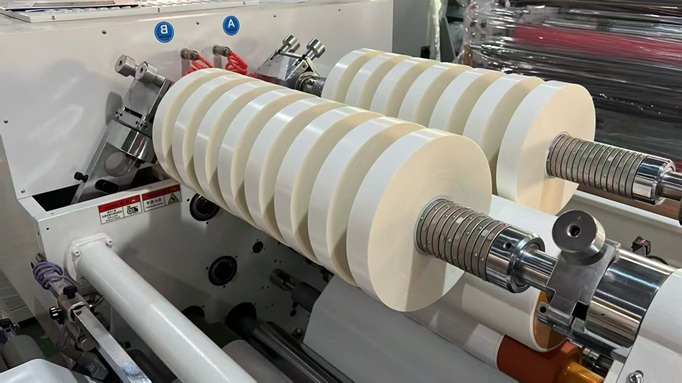
The finished film is wound into very wide master rolls. From there it can be given a surface treatment or a coating, for example to help inks or adhesives hold, and then slit into narrower rolls to the widths customers order. Our article on corona treated PET film explains one common surface treatment. Slit rolls are inspected and packed, and our roll cores are 76 mm inner diameter.
What the process means for buyers
- Thickness and tolerance: controlled mainly by extrusion and stretching, so ask for the tolerance as well as the nominal value.
- Shrinkage: linked to heat setting, so check the test conditions on the datasheet.
- Surface and clarity: affected by additives and by any later treatment or coating.
- Roll format: set at slitting, so confirm width, length and core size before ordering.
Ask for a sample before you commit
A datasheet describes a film, but only a sample shows how it behaves on your own line. Test it in your own process and compare the result with your requirements.
Talk to Us
Jinlu Film supplies PET film in various grades, and also supplies products with similar specifications, including domestic alternatives. We provide datasheets and samples. If you are matching a film to a process, send us your thickness, surface and format needs and our team will help you narrow the options. Learn more about us as a PET film manufacturer.
More PET Film Guides
Polyester Film Distribution: who sells and what to ask.
PET Protective Film: types, uses and what to specify.
Heat Stabilized Polyester Film: five checks before ordering.
Hazy Polyester Film: why some buyers want haze on purpose.
Black Polyester Film: how to choose by color, surface and opacity.
General guidance for reference only. Trademarks belong to their respective owners.