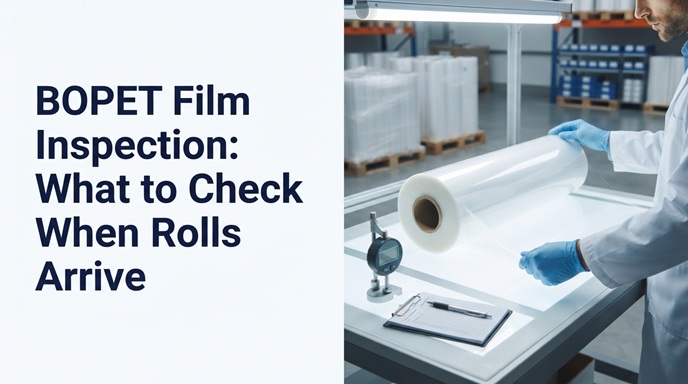
BOPET film inspection: a short checklist for the day the rolls arrive
BOPET film inspection does not need a lab. Most problems with a new delivery can be spotted in the first ten minutes with your eyes, a ruler and the paperwork. Doing it on the day of arrival also makes any conversation with the supplier much easier, because the facts are fresh. Here is the checklist we would give a friend who just received a pallet and is wondering what to look at first.
BOPET film inspection starts with the paperwork
Before you open anything, compare the label and the delivery note with your order. Check the grade or model, the thickness, the roll width, the roll length, the core size and the quantity. Our rolls use a 76 mm core, so if your order says that, the core should match. If your order used a unit that could be misread, our page on BOPET film specifications: microns, mil and how to write them shows how to avoid it next time. Keep a photo of the label, since batch or lot numbers help trace any later question.
Look at the outside of the roll
- Packing: are the cartons, wrapping and end protection intact, or are there dents, tears or water marks?
- Roll ends: are the edges even, or do you see telescoping, where layers slide out to one side?
- Outer layers: look for scratches, dirt, creases or marks from the wrapping.
- Core: check that it is not crushed or damaged at the ends.
Look at the film itself
Unwind a short length and look at the surface under good light, against a light and a dark background. Check for scratches, particles, streaks, wrinkles or uneven areas across the full width. Clear and optical grades show surface marks more easily, so our notes on what to check on optical PET film are worth a look. If the film has a treated or coated side, confirm which side is which, and whether that matches your order.
Measure what you can
- Width: measure across a few points on the roll and note the result.
- Thickness: if you have a gauge, measure at several points, and write the unit clearly. Remember that thickness has a tolerance, so small differences from the nominal value are normal.
- Roll length or weight: compare with the delivery note if you can.
Run a short test
The best check is the real process. Run a short length through your printer, coater, laminator or cutter, and watch how it tracks, whether it wrinkles and how it behaves at the edges. A film that looks perfect by eye can still behave differently on your machine, and a short test costs far less than a full job. If you plan to store the roll afterward, see BOPET film storage: how to keep rolls in good shape.
Write it down
Keep a simple record for every delivery: date, roll number, label photo, what you checked and what you saw. If something looks wrong, add photos of the roll, the label and the problem area, and note where on the roll it appears. A clear description lets a supplier work out the cause much faster than a message saying the film is bad.
What to tell your supplier if you find a problem
- The order number, grade, thickness and roll number.
- What you see, where on the roll, and how far it extends.
- Photos of the label, the roll and the problem.
- What you did with the film so far, including any test run.
- What you need next: a replacement, a credit or technical advice.
Talk to Us
Jinlu Film supplies PET film in various grades, and also supplies products with similar specifications, including domestic alternatives. We slit and convert PET film in our own facility, with custom roll widths, lengths and 76 mm cores, and we provide datasheets and samples. If you are looking for a PET film manufacturer who can talk through a delivery with you, send us the order number, the roll number and a few photos.
More PET Film Guides
BOPET Film Storage: How to Keep Rolls in Good Shape: simple habits for receiving and storing rolls.
BOPET Film Thickness: How to Choose the Right One: a simple way to narrow down thickness.
BOPET Film Specifications: Microns, Mil and How to Write Them: how to write a clean specification.
BOPET Film Price: What Affects It and What to Put in an Enquiry: what changes a quote.
Printable Polyester Film: Match the Surface to Your Print Method: how print methods change the surface you need.
General guidance for reference only. Trademarks belong to their respective owners.