BOPET film storage: simple habits that keep rolls flat, clean and ready to run
BOPET film storage is not complicated, but a few small habits decide whether a roll arrives on your machine in good shape or with dented edges, dust and creases. Most problems we hear about are not the film itself. They come from how a roll was stacked, lifted or left standing for a while. Here is the plain version, the way you would tell a new colleague on the shop floor.
BOPET film storage starts at the receiving door
When a delivery arrives, look at the outside first. Check the pallet, the cartons and the wrapping for dents, tears or marks. If something looks off, take a photo before you open it, and write a short note on the delivery paper. It is much easier to sort out a problem on the day it arrives than a month later. Our guide to PET film rolls explains how rolls are normally described, which helps when you compare what arrived with what you ordered.
Where to keep the rolls
- Clean and dry: keep rolls in an indoor, dry, dust-free area, away from water, oil and open windows.
- Away from heat and sunlight: strong heat or direct sun can affect film and packaging. Your datasheet and supplier can tell you what conditions suit a particular grade.
- Off the floor: use pallets or racks, so rolls do not sit on a damp or dirty surface.
- Keep the wrapping on: leave the protective film or carton on until you are ready to use the roll. Re-wrap a partly used roll before storing it again.
Horizontal or vertical
The safest habit is to keep the roll supported so its weight does not press on one spot. Many users store rolls on a shaft or cradle, or on end in their original packing, depending on the roll size and the packing method. The main thing to avoid is letting a roll rest on its edge on a hard surface, since a dented edge can cause trouble when the film unwinds. If you are not sure, ask us how the rolls were packed and follow the same orientation.
Lifting and moving
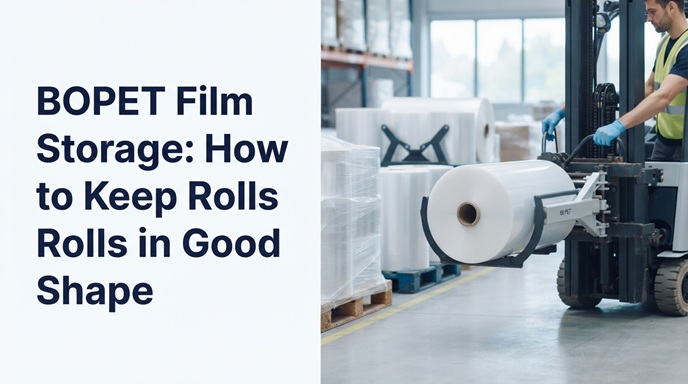
- Use a proper lift or cart, and handle the roll by the core or the packing, not by the film edge.
- Do not drag a roll on the floor or let it drop, even from a small height.
- Wear clean gloves when you handle bare film, because fingerprints and dust show up on clear or optical grades. See our notes on what to check on optical PET film for why surface care matters.
- Keep sharp tools away from the roll when you open the packing.
Before you use a stored roll
If a roll has been stored for a while, let it sit in your production area for some time before opening it, so it can settle to the room conditions. Then check the edges, the outer layers and the surface by eye. Run a short test length before the main job. If you notice waves, creases or an uneven edge, write down what you see and the roll number. A good description helps a supplier work out whether the cause was storage, handling or something else. Our article on reading datasheet clues for flexible circuits shows the kind of detail worth noting when a film is used in a sensitive process.
What to tell your supplier
- How long rolls are normally stored before use, in your own words.
- How you store them: shaft, cradle, pallet or original carton.
- The conditions in your store, such as indoor, dry or air-conditioned.
- Roll width, length and core size you work with. Our rolls use a 76 mm core.
- Any special packing you need, such as end protection or extra wrapping.
Talk to Us
Jinlu Film supplies PET film in various grades, and also supplies products with similar specifications, including domestic alternatives. We slit and convert PET film in our own facility, with custom roll widths, lengths and 76 mm cores, and we provide datasheets and samples. If you are looking for a PET film manufacturer who can discuss packing and roll format with you, send us the roll size, your storage method and the quantity.
More PET Film Guides
BOPET Film Thickness: How to Choose the Right One: a simple way to narrow down thickness.
BOPET Film Specifications: Microns, Mil and How to Write Them: how to write a clean specification.
BOPET Film Price: What Affects It and What to Put in an Enquiry: what changes a quote.
Printable Polyester Film: Match the Surface to Your Print Method: how print methods change the surface you need.
Recycled BOPET Film: Which Documents to Ask a Supplier For: how to check a claim on paper.
General guidance for reference only. Trademarks belong to their respective owners.