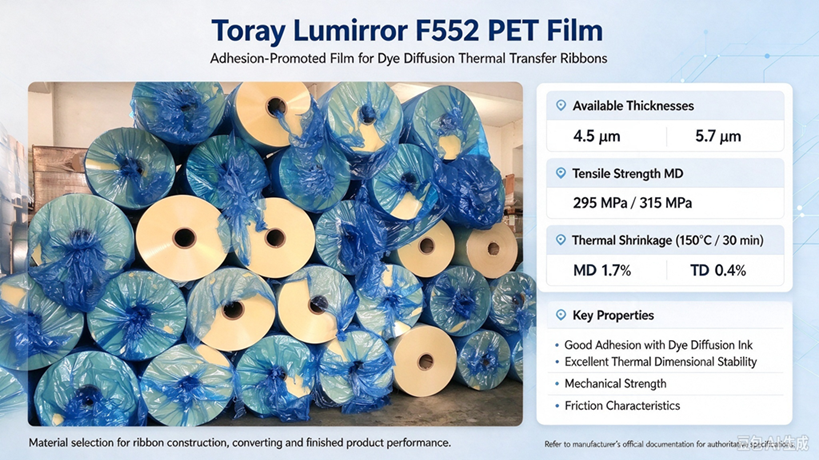
Toray Lumirror F552 PET Film is an ultra-thin, adhesion promoted base film at 4.5 and 5.7 micron, made for dye diffusion thermal transfer ribbon
A thermal transfer ribbon has to carry ink on a base film only a few microns thick, survive the heat of the print head without wrinkling, and hold its ink coating firmly. Toray Lumirror F552 PET Film is built for exactly that job at 4.5 and 5.7 um.
The Problem a Ribbon Base Film Has to Solve
In a thermal transfer ribbon, the base film is the part you never see in the final print, but it decides whether the ribbon runs cleanly. It has to be thin enough for heat from the print head to pass through quickly, yet strong enough to be pulled through the printer under tension, and stable enough not to shrink or wave when it is heated (a general explanation, not from this datasheet).
That is the set of demands behind Lumirror F552. According to its datasheet, it is an adhesion promoted film for thermal transfer ribbon applications, offered in 4.5 and 5.7 um, with dye diffusion thermal transfer ribbon listed as its application.
Toray Lumirror F552 PET Film in Five Numbers
- Thickness: 4.5 um and 5.7 um, which is ultra-thin for a PET film
- Tensile strength: about 295 to 315 MPa in MD and 245 MPa in TD (ASTM D882)
- Heat shrinkage at 150°C for 30 minutes: about 1.7 percent in MD and 0.4 percent in TD (ASTM D1204)
- F-5 value: about 115 MPa in MD and 105 MPa in TD (ASTM D882)
- Coefficient of friction: about 0.5 static and 0.4 dynamic (ASTM D1894)
The datasheet also gives elongation at break of about 100 to 110 percent in MD and 120 to 125 percent in TD. The values are the same or very close for both thicknesses, apart from tensile strength in MD, which is a little higher at 5.7 um.
What These Numbers Mean for a Ribbon
Strength at a few microns. A tensile strength near 300 MPa is high for a film this thin. In a ribbon, the film is pulled through the printer under tension, so strength is what keeps it from stretching or snapping. Note that MPa is force per unit area, and at 4.5 um the total load the film can carry is still very small, so tension control on the ribbon line matters.
The F-5 value. F-5 value is generally the stress needed to stretch the film by 5 percent (a general explanation, not from this datasheet). A higher figure means the film resists stretching under tension, which helps the ribbon keep its shape in the printer. The datasheet lists about 115 MPa in MD and 105 MPa in TD.
Heat stability. The datasheet lists excellent thermal dimensional stability. The numbers behind it are about 1.7 percent shrinkage in MD and 0.4 percent in TD after 30 minutes at 150°C, with the same values for both thicknesses. In general, low shrinkage helps a ribbon avoid wrinkling when it passes the print head. As with most films, MD shrinkage is higher than TD.
Friction. Coefficient of friction describes how easily film surfaces slide. Values of about 0.5 and 0.4 point to a film that winds and unwinds smoothly. The datasheet does not state which side the friction was measured on.
Adhesion with dye ink. The datasheet lists good adhesion with dye diffusion ink as a property. Adhesion promoted generally means the film surface has been treated or coated so that ink layers stick to it (a general explanation, not from this datasheet). The datasheet does not say whether one side or both sides are treated, so confirm this before ordering.
4.5 um or 5.7 um?
- The two grades are nearly identical in shrinkage, friction, and F-5 value.
- The 5.7 um grade shows slightly higher tensile strength in MD (315 versus 295 MPa) and slightly higher elongation.
- If your priority is the thinnest possible base film, choose 4.5 um. If you want a little more strength margin on your line, 5.7 um is the option to test.
- Whichever you choose, run both through your own coating and printing process before deciding.
How It Differs from Neighboring Grades
The closest thin film in the same range is Toray Lumirror F71 PET Film, which comes in 12 and 19 um. Reading the two datasheets side by side:
- F552 is far thinner, at 4.5 and 5.7 um versus 12 and 19 um.
- Tensile strength in MD is similar or a little higher on F552 (295 to 315 MPa versus 285 to 300 MPa), even though the film is much thinner.
- F552 shows slightly lower elongation (about 100 to 125 percent versus about 125 to 160 percent), so it stretches a little less before breaking.
- Friction is a little lower on F552 (about 0.5 and 0.4 versus 0.6 and 0.5).
- Applications differ: F552 for dye diffusion thermal transfer ribbon, F71 for metallic yarn and dry film photoresist. F71 is also described as glossy and transparent, while the F552 datasheet does not list optical values.
What the Datasheet Does Not Say
- The figures are typical values under specific test conditions and are not limiting specifications, as the datasheet itself notes.
- No optical values (haze, transmittance), surface roughness, surface tension, or thickness tolerance are listed.
- It does not say which side is adhesion promoted, or whether both are.
- Only 150°C shrinkage is given, with no data at higher temperatures.
Questions Buyers Ask About Toray Lumirror F552 PET Film
What thicknesses does Lumirror F552 come in?
The datasheet lists 4.5 and 5.7 um.
Why are ribbon base films so thin?
Thinner film lets print head heat pass through faster, which generally supports sharper, more efficient transfer (a general explanation, not from this datasheet).
What does adhesion promoted mean here?
The datasheet describes F552 as an adhesion promoted film with good adhesion with dye diffusion ink. Ask for details on the treated side before ordering.
Does the datasheet list haze or light transmittance?
No. If your design depends on optical values, request them separately.
Can I buy Toray Lumirror F552 PET Film from Jinlu Film?
Yes. Jinlu Film supplies Toray Lumirror F552 PET Film. If you prefer a comparable-specification alternative, including domestic options, we can offer those as well, together with datasheets and samples so you can test them on your own line.
More PET Film Guides
- Toray Lumirror F71 PET Film: a glossy transparent film at 12 and 19 um for metallic yarn and photoresist
- Toray Lumirror H10 PET Film: a hazy plain film for motor insulation
- Toray Lumirror T62 PET Film: a high transparent film for metallizing
- Toray Lumirror T60 PET Film: a high transparent film from 25 to 250 um
- Toray Lumirror X30 PET Film: a black film for cable tape use
Sourcing Ribbon Base Film
Jinlu Film supplies Toray Lumirror F552 PET Film, along with comparable ultra-thin polyester film grades, including domestic alternatives, for thermal transfer ribbon and similar applications. Tell us your ribbon type, thickness, and coating needs, and contact us for technical data, samples, or a factory quote.
Source: Toray’s publicly available Lumirror F552 technical data sheet (typical values). Please refer to the latest official version. Lumirror, Toray, and related names are trademarks of their respective owners. This article is an independent explanation for reference only.