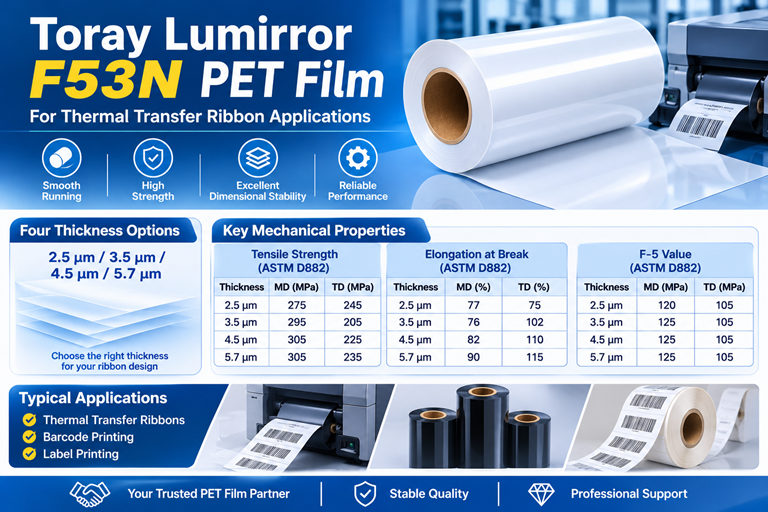
Understanding how Lumirror F53N’s mechanical properties, friction characteristics, and heat stability support thermal transfer ribbon processing.
Toray Lumirror F53N PET Film is a thin polyester film developed for thermal transfer ribbon applications. According to the manufacturer’s description, it offers excellent handling properties for smooth running, making it suitable for processes where consistent film movement and reliable handling are important.
Thermal transfer ribbons are used in barcode printers and other printing systems. In these applications, the PET film serves as the base material for the ribbon construction. Its mechanical strength, dimensional stability, friction characteristics, and surface condition can all influence how the film behaves during processing and use.
Lumirror F53N is available in four thicknesses, from 2.5 μm to 5.7 μm. This review examines the manufacturer’s technical data and explains how the reported properties relate to the handling and processing requirements of thermal transfer ribbon film.
Why Is Smooth Running Important for Thermal Transfer Ribbon Film?
The manufacturer describes Lumirror F53N as a polyester film for thermal transfer ribbons, with excellent handling properties for smooth running. This is an important product characteristic because thin film materials must move through processing equipment in a controlled and consistent manner.
Thermal transfer ribbon production involves handling a thin film base during coating, winding, slitting, and other converting operations. Film behavior during these processes can affect production efficiency and the consistency of the finished rolls.
For a thin PET film, smooth running is not determined by a single property. Mechanical strength, elongation, friction, surface roughness, and dimensional stability may all contribute to its handling characteristics. The F53N technical data provides several measurements that help users evaluate these aspects.
Four Thickness Options from 2.5 to 5.7 μm
Lumirror F53N is listed in four thicknesses: 2.5 μm, 3.5 μm, 4.5 μm, and 5.7 μm. This range gives thermal transfer ribbon manufacturers several options when selecting a polyester film base for their product construction.
Thickness selection should take account of the intended ribbon design, coating requirements, processing equipment, and finished product performance. A thinner film may be appropriate for a particular construction, while a different thickness may be preferred where handling or mechanical requirements call for it.
The manufacturer’s tensile strength and elongation data also show that the measured properties vary across the four thickness options. These differences should be considered together rather than using thickness alone as the basis for material selection.
Tensile Strength and Elongation: Understanding Film Strength
The F53N technical sheet reports tensile strength in both the machine direction (MD) and transverse direction (TD), measured according to ASTM D882.
| Thickness | MD (MPa) | TD (MPa) |
|---|---|---|
| 2.5 μm | 275 | 245 |
| 3.5 μm | 295 | 205 |
| 4.5 μm | 305 | 225 |
| 5.7 μm | 305 | 235 |
The machine-direction tensile strength increases from 275 MPa at 2.5 μm to 305 MPa at 4.5 μm, remaining at the same listed value for 5.7 μm. The transverse-direction values show a different pattern, ranging from 205 MPa to 245 MPa.
Elongation at break is another important mechanical measurement. It indicates how much the test specimen stretches before breaking under the specified test conditions.
| Thickness | MD (%) | TD (%) |
|---|---|---|
| 2.5 μm | 77 | 75 |
| 3.5 μm | 76 | 102 |
| 4.5 μm | 82 | 110 |
| 5.7 μm | 90 | 115 |
These results show that the reported elongation values differ between MD and TD and also vary with thickness. When evaluating F53N, users should consider both tensile strength and elongation rather than treating either measurement as a complete indication of film performance.
What Does the F-5 Value Tell Users?
The manufacturer’s technical table includes an F-5 value for all four thicknesses, with separate measurements in MD and TD.
| Thickness | MD (MPa) | TD (MPa) |
|---|---|---|
| 2.5 μm | 120 | 105 |
| 3.5 μm | 125 | 105 |
| 4.5 μm | 125 | 105 |
| 5.7 μm | 125 | 105 |
The listed values are measured according to ASTM D882. The technical sheet identifies this property as F-5 value, but the exact definition and evaluation criteria should be checked against the original manufacturer’s documentation before using it for detailed engineering comparisons.
For material evaluation, this measurement should therefore be considered alongside tensile strength, elongation, and the actual requirements of the thermal transfer ribbon production process.
How Do Friction Characteristics Relate to Film Handling?
Lumirror F53N includes coefficient of friction measurements in its technical data. Friction is relevant to thin film handling because contact between film surfaces and other materials can influence feeding, winding, and movement through processing equipment.
| Thickness | Reported value 1 | Reported value 2 |
|---|---|---|
| 2.5 μm | 0.55 | 0.50 |
| 3.5 μm | 0.46 | 0.38 |
| 4.5 μm | 0.43 | 0.37 |
| 5.7 μm | 0.43 | 0.35 |
The source table lists two coefficient of friction rows under ASTM D1894. The original row notation should be confirmed before assigning a specific meaning to each value.
The reported values generally decrease as the film thickness increases across the listed range. However, friction measurements depend on the test configuration and the surfaces in contact. These figures should be used as reference data rather than as a guarantee of performance in every machine or processing environment.
Surface Roughness and Film Surface Characteristics
The F53N technical sheet also includes surface roughness (Ra), providing another reference for understanding the film’s surface characteristics.
| Thickness | Surface Roughness (Ra) |
|---|---|
| 2.5 μm | 0.12 |
| 3.5 μm | 0.16 |
| 4.5 μm | 0.16 |
| 5.7 μm | 0.14 |
The listed test method is DIN 4768. Surface roughness can be relevant when considering contact between the film and other materials during coating, winding, and converting operations.
The unit shown in the available text transcription requires confirmation against the original TDS. The numerical values are therefore presented here without assigning an unverified unit.
Thermal Shrinkage and Dimensional Stability
Thermal shrinkage is another property to consider when evaluating polyester film for thermal transfer ribbon applications. The F53N technical sheet reports shrinkage after exposure to 150°C for 30 minutes, measured according to ASTM D1204.
| Thickness | MD (%) | TD (%) |
|---|---|---|
| 2.5 μm | 1.7 | 0.3 |
| 3.5 μm | 1.9 | 0.8 |
| 4.5 μm | 1.9 | 0.8 |
| 5.7 μm | 1.9 | 0.9 |
The figures show different shrinkage values in the machine and transverse directions. This directional difference is relevant when considering dimensional changes during heating and subsequent processing.
These results are based on the stated laboratory test conditions. Actual dimensional behavior in a production process may vary depending on temperature, exposure time, tension, equipment settings, and the overall ribbon construction.
Where Is Lumirror F53N Used?
The manufacturer identifies thermal transfer ribbons, including ribbons used in barcode printers, as the general application for Lumirror F53N.
In this type of product, the polyester film acts as the base material for the ribbon. Its handling properties and mechanical characteristics are relevant during converting and when the finished ribbon is transported through a printer.
For manufacturers evaluating a film for this application, important considerations may include:
- Available thickness and compatibility with the intended ribbon construction
- Mechanical strength and elongation in both directions
- Friction characteristics during feeding and winding
- Surface roughness and compatibility with coating processes
- Thermal shrinkage under relevant processing conditions
The manufacturer’s description highlights excellent runnability, good handling properties, heat stability, and good mechanical properties. Final suitability should still be evaluated using the actual coating materials, equipment, and production conditions.
Understanding the Typical Values in the Lumirror F53N TDS
The manufacturer states that the listed figures are typical data obtained under specific test conditions and are not intended for use as limiting specifications.
This means the values are useful for understanding the general characteristics of Lumirror F53N, but they should not automatically be treated as guaranteed tolerances or contractual acceptance limits.
Before selecting a thickness for production, buyers should confirm the required specifications, processing conditions, and material compatibility with their supplier. Where a particular property is critical, application-specific testing is recommended.
Finding a Suitable PET Film for Thermal Transfer Ribbons
Lumirror F53N is a specialized thin PET film designed for thermal transfer ribbon applications. Its available thickness range, mechanical properties, friction measurements, surface characteristics, and thermal shrinkage data provide useful references for evaluating its handling and processing behavior.
At Jinlu Film, we help buyers source PET film and related film materials according to their application and processing requirements. If you are evaluating Lumirror F53N or looking for a comparable thin polyester film for thermal transfer ribbons, you can share the intended application, required thickness, width, and estimated purchasing quantity with us.
We can then review your requirements and discuss suitable material options based on availability and application needs.
Related PET Film Articles
- Toray Lumirror E20 White PET Film
- Toray Lumirror F71 PET Film
- Toray Lumirror H10 PET Film
- Toray Lumirror T62 PET Film
- Toray Lumirror T60 PET Film