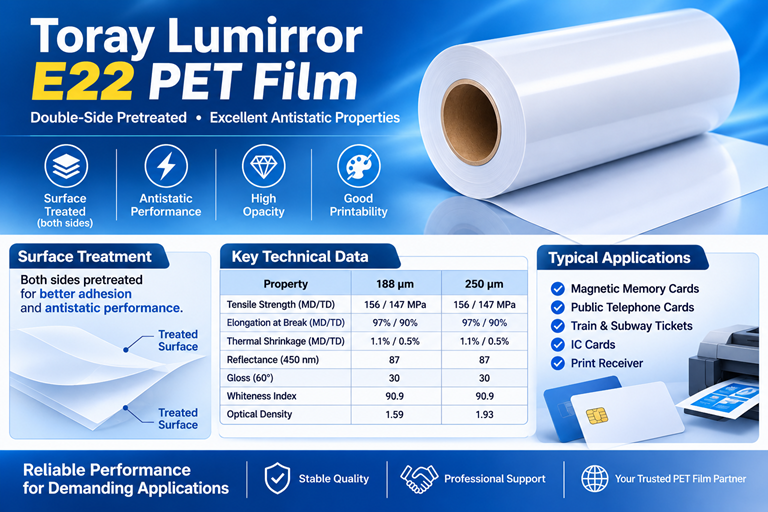
How double-side surface treatment supports adhesion and antistatic performance in specialized white PET film applications.
Toray Lumirror E22 PET Film is a pretreated white polyester film developed from the Lumirror E20 type. Its defining feature is double-side surface treatment, designed to support good adhesion and antistatic performance in applications involving printing, bonding, and further processing.
This distinction is important when a PET film is used in products that require printing, surface bonding, or further processing. Instead of focusing only on the film’s color and mechanical properties, users also need to consider how its treated surfaces interact with inks, coatings, and other materials.
The following review examines the available technical data for Lumirror E22 and explains what its surface treatment and measured properties may mean in practical applications.
What Makes Lumirror E22 Different from Standard White PET Film?
The main distinction of Lumirror E22 is its surface treatment. The product description identifies it as a pretreated version of Lumirror E20, with both sides treated to provide good adhesion and antistatic properties.
For applications involving printing or bonding, surface condition can be just as important as the underlying polyester film. An untreated film may require additional surface preparation before certain inks, coatings, or adhesives can be applied effectively. A pretreated surface is intended to help improve this interaction.
Because both sides of Lumirror E22 are treated, the film offers treated surfaces on either side. This can be useful in processes where both surfaces may come into contact with printing materials, coatings, or other components. Actual suitability depends on the materials and processing conditions involved.
Available Thicknesses and Mechanical Properties
The Lumirror E22 technical sheet lists two available thicknesses: 188 μm and 250 μm. Both thicknesses have the same listed tensile strength: 156 MPa in the machine direction (MD) and 147 MPa in the transverse direction (TD), according to ASTM D882.
Elongation at break is reported as 97% in MD and 90% in TD for both thicknesses. These figures describe the elongation recorded before the test specimen breaks under the specified test method.
The thermal shrinkage values are 1.1% in MD and 0.5% in TD after exposure to 150°C for 30 minutes, according to ASTM D1204. These results provide a reference for understanding dimensional change under the stated heating conditions.
When selecting between 188 μm and 250 μm, users should consider the required thickness, stiffness, handling characteristics, and construction of the finished product rather than relying on one technical value alone.
How Does the Antistatic Property Affect Film Handling?
Lumirror E22 is specifically described as having antistatic properties. Its technical data also includes a surface resistivity value for both thicknesses.
Static electricity can affect film handling, feeding, printing, and contact with other materials. In some production environments, static charge may contribute to dust attraction or difficulties when separating and transporting film sheets.
The supplied technical data shows a surface resistivity value of 10¹⁰ for both thicknesses. The original unit and notation should be confirmed against the manufacturer’s source document before this figure is used as an engineering acceptance criterion.
Antistatic performance should not be interpreted as eliminating static under every operating condition. Humidity, processing speed, contact materials, and the surrounding environment can all influence static behavior.
Reflectance, Gloss, Whiteness, and Optical Density
The Lumirror E22 TDS provides several optical measurements. Reflectance at 450 nm is listed as 87 for both thicknesses. Specular gloss is listed as 30, and the whiteness index is 90.9 for both 188 μm and 250 μm.
Optical density differs between the two thicknesses. The 188 μm film has a listed value of 1.59, while the 250 μm film has a value of 1.93. These figures provide a reference for comparing the light-blocking characteristics of the two thicknesses.
Optical density should not be interpreted directly as a percentage of opacity. It is a separate optical measurement, and users should consider the test method and the visual requirements of the finished product when evaluating the material.
Why Is Double-Side Treatment Relevant to Card and Printing Applications?
The manufacturer lists magnetic memory cards, public telephone cards, train tickets, subway tickets, IC cards, and print receiver applications among the uses of Lumirror E22.
These applications help explain why surface treatment is an important part of the product description. Card constructions and printing-related processes may involve inks, coatings, bonding layers, or other materials that need to interact with the film surface.
For example, a card construction may require the film to bond with another layer, while a printing process may depend on suitable surface characteristics for ink or coating application. The double-side pretreatment of Lumirror E22 is intended to support these types of requirements.
However, the technical sheet does not specify compatibility with every ink, adhesive, coating, or printing process. Users should evaluate the film with their actual materials and production conditions before confirming suitability.
Understanding the Typical Values in the Lumirror E22 TDS
The manufacturer states that the listed values are typical data obtained under specific test conditions and are not intended to serve as limiting specifications.
This distinction matters when using the technical sheet for material selection. Typical values help users understand general product characteristics, but they should not automatically be treated as contractual tolerances or guaranteed acceptance limits.
For purchasing and production decisions, users should confirm the required specifications, available thickness, surface requirements, and application-specific testing with the material supplier.
Finding a Suitable Pretreated White PET Film
Lumirror E22 is a specialized white PET film option for applications where double-side surface treatment, adhesion support, and antistatic characteristics are relevant. Its listed uses in magnetic memory cards, IC cards, and printing-related applications provide useful guidance when evaluating the material.
At Jinlu Film, we help buyers source PET film and related film materials according to their application and processing requirements. If you are evaluating Lumirror E22 or looking for a comparable pretreated white PET film, you can share the intended application, required thickness, width, and estimated purchasing quantity with us.
We can then review the requirements and discuss suitable material options based on availability and application needs.
Related PET Film Articles
- Toray Lumirror E20 White PET Film
- Toray Lumirror F71 PET Film
- Toray Lumirror H10 PET Film
- Toray Lumirror T62 PET Film
- Toray Lumirror T60 PET Film