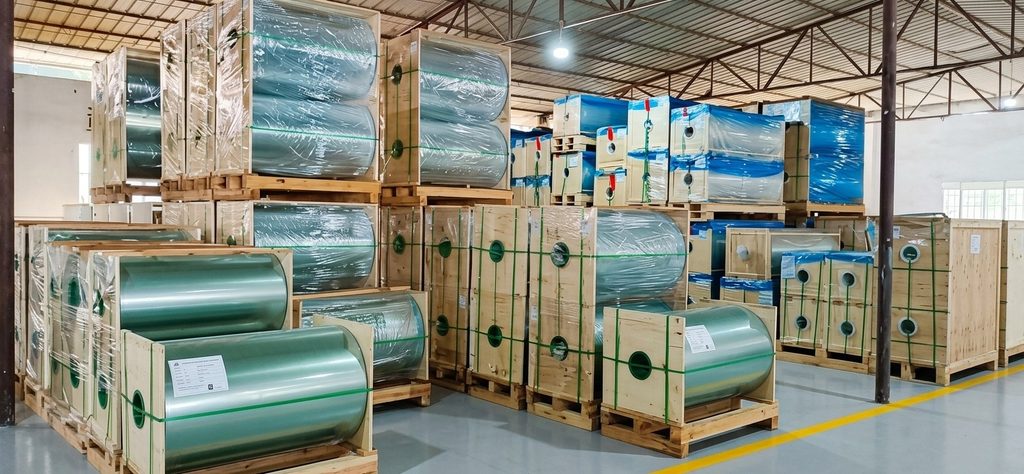
PET metallized film is a polyester film coated with a very thin layer of aluminum through a vacuum metallizing process. The aluminum coating gives the film a reflective metallic appearance and improves its barrier properties against light, moisture, and gases. It is widely used in flexible packaging, insulation, decoration, and industrial laminates where the combination of PET film strength and metallic performance is required.
How Is PET Metallized Film Made?
PET metallized film is generally produced by depositing aluminum onto the surface of a PET base film inside a vacuum chamber. Aluminum is heated until it evaporates, and the vapor condenses onto the moving PET film, forming a thin metallic layer.
The process requires controlled vacuum conditions, coating speed, and surface quality. The final appearance and performance depend on the PET base film, aluminum deposition conditions, and the intended application. For general information about PET material, see our guide to PET film and polyester film terminology.
Key Properties of PET Metallized Film
- Metallic appearance: The aluminum layer creates a reflective silver surface commonly used in packaging and decorative applications.
- Light barrier: The metallic coating reduces light transmission compared with transparent PET film.
- Moisture and gas barrier: Metallization can improve barrier performance, although the actual result depends on coating quality, film structure, and processing conditions.
- Dimensional stability: The PET base film provides strength and dimensional stability during converting and handling.
- Surface compatibility: Depending on the grade, the film may be suitable for printing, laminating, or other converting processes. Surface treatment and adhesion should be checked before production.
PET film is available in different thicknesses for different converting requirements. The appropriate thickness depends on the required strength, flexibility, handling conditions, and final application. See our PET film thickness guide for more information about selecting a suitable gauge.
Common Applications of PET Metallized Film
PET metallized film is used in a range of industrial and packaging applications, including:
- Flexible packaging: Used as a metallic layer in laminated packaging structures for food and non-food products.
- Insulation materials: Used in reflective insulation structures where a lightweight reflective surface is required.
- Decorative materials: Used for metallic visual effects in labels, gift packaging, and other decorative products.
- Industrial laminates: Used as one layer in multi-material structures where appearance and barrier performance are important.
For laminated packaging, the performance of the finished structure depends on all layers, adhesives, sealing conditions, and converting processes. PET metallized film should therefore be evaluated as part of the complete structure rather than as an isolated material.
PET Metallized Film vs. Transparent PET Film
Both materials use PET as the base film, but their surface characteristics and typical functions are different.
| Item | PET Metallized Film | Transparent PET Film |
|---|---|---|
| Surface appearance | Metallic and reflective | Clear and transparent |
| Light transmission | Reduced by the aluminum coating | Allows visual transmission through the film |
| Barrier performance | Generally improved by metallization | Depends mainly on the PET grade and film structure |
| Typical uses | Packaging, reflective materials, decorative laminates | Printing, lamination, insulation, and general industrial converting |
Transparent PET film is selected when visibility through the material is important, while metallized PET film is used when a reflective appearance or improved barrier performance is required. Buyers looking for general PET film materials can also explore our PET film product range.
What Specifications Should Buyers Check?
When sourcing PET metallized film, buyers should confirm the complete specification rather than selecting material based only on its metallic appearance.
- Base film thickness: Confirm the required PET thickness and thickness tolerance.
- Film width: Specify the required roll width and acceptable width tolerance.
- Roll length and roll size: Confirm the required length, core diameter, and maximum roll diameter.
- Optical density: Check the required optical density (OD) when the metallic coating level is important to the application.
- Surface treatment: Confirm whether corona treatment or another surface treatment is required for printing or lamination.
- Adhesion and converting requirements: Check aluminum layer adhesion and compatibility with the intended laminating, printing, or converting process.
- Application: Explain the final use so that the appropriate film structure and grade can be evaluated.
For buyers comparing different PET film grades, it is also useful to distinguish between base film thickness and the properties created by additional surface treatments or coatings. These factors should be specified separately in the purchase requirements.
Why Should Optical Density Be Checked?
The aluminum coating is extremely thin, so its performance cannot always be judged by appearance alone. Optical density (OD) is commonly used to evaluate the optical characteristics of metallized film and provides a more useful reference than relying only on a general description of the aluminum layer.
However, optical density is not the only factor that determines barrier performance. Pinholes, coating uniformity, film handling, lamination, and the finished package structure can also affect the final result.
For a more detailed explanation, see our guide: PET metallized film: why the aluminum layer number on a specification sheet can be misleading. This article explains why buyers should consider optical density and coating quality rather than relying on a single aluminum-layer figure.
Frequently Asked Questions
Is PET metallized film the same as aluminum foil?
No. PET metallized film is a PET base film with a very thin aluminum coating deposited on its surface. Aluminum foil is a separate metal material and has a different structure, thickness, flexibility, and performance profile.
Does a higher optical density always mean better performance?
Not necessarily. A higher optical density indicates a different optical coating level, but the best specification depends on the application. Buyers should also consider barrier requirements, coating uniformity, lamination conditions, and converting performance.
Can PET metallized film be laminated with PE film?
Yes. PET metallized film can be used in laminated structures with PE film and other materials. The suitable structure depends on the required barrier properties, sealing performance, adhesive system, and final application. The complete structure should be tested before mass production.
Can PET metallized film be printed?
Printing may be possible depending on the surface treatment, coating side, ink system, and printing process. Buyers should confirm the required surface and printing conditions before ordering.
What information should I provide when requesting a quotation?
Please provide the required thickness, width, roll length, quantity, intended application, and any special requirements for optical density, surface treatment, or lamination. A technical data sheet or sample specification can also help clarify the material requirements.
About Jinlu
Dongguan Jinlu Electronics Co., Ltd. supplies PET film and related flexible film materials for industrial and converting applications. We work with material producers and arrange suitable specifications, slitting, rewinding, and sheet cutting according to project requirements.
If you are sourcing PET metallized film, please send us your required thickness, width, quantity, and application details for evaluation. You can also visit our PET film category to review related material options.
Contact Jinlu for PET film inquiries
Disclaimer
The information in this article is provided for general reference only. Actual material properties and performance may vary depending on the film grade, metallization quality, production conditions, and end-use requirements. Buyers should confirm the relevant specifications and conduct application testing before production.