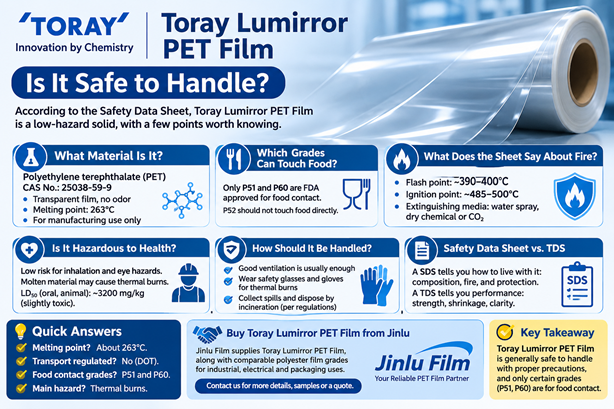
Toray Lumirror PET Film is a polyethylene terephthalate film, and its safety data sheet describes a low-hazard solid with a few points worth knowing: melting, burning, hot-film burns, and food contact named for only two grades
A film that ends up in motors, labels, and food packaging gets the same question from every buyer’s safety team: what does the safety data sheet say? Toray Lumirror PET Film has a short one, and it is worth reading before an order.
What Material Is It?
According to the sheet, the chemical name is polyethylene terephthalate, the trade name is Lumirror, and PET is the only component listed (CAS number 25038-59-9). It appears as a transparent film with no odor, solubility in water is negligible, and the melting point is 263°C. The sheet is issued by Toray Industries, with its head office in Tokyo and a production plant in Gifu, Japan. Its precautionary label reads: for manufacturing use only.
Which Grades Can Touch Food?
The same precautionary label adds that the film is not FDA approved except for P51 and P60. That is a narrow statement, and it matches the individual datasheets: Toray Lumirror P60 PET Film and Toray Lumirror P51 PET Film state that they conform to food contact specifications, while Toray Lumirror P52 PET Film asks that it not touch food directly. Regulations differ by market and by packaging structure, so confirm what applies to your product with your supplier and your compliance team.
What Does the Sheet Say About Fire?
- Flash point: about 390 to 400°C
- Ignition point: about 485 to 500°C
- Extinguishing media: water spray, dry chemical, or carbon dioxide
- Firefighting procedure: wear self-contained breathing apparatus and protective clothing
- Combustion products: as with any organic material, carbon dioxide and carbon monoxide
- Stability: stable, with oxidizing materials listed as incompatible and able to cause a reaction
Is It Hazardous to Health?
The sheet describes inhalation and eye hazards as low for normal industrial handling. The skin entry is the one to remember: molten material will cause thermal burns, and the first aid section deals with cooling such burns as quickly as possible. For animal toxicity, it gives data representative of PET polymers, with an acute oral LD50 of about 3200 mg/kg and a classification of slightly toxic. In plain terms, the film itself is a low-hazard solid, and the real risk in a plant is heat.
How Should It Be Handled, Spilled, and Disposed Of?
- Spills: collect and contain for salvage and disposal
- Waste disposal: incineration, observing all federal, state, and local regulations on health and the environment
- Ventilation: good general ventilation should be sufficient
- Respiratory protection: not needed
- Eye and skin protection: safety glasses with side shields or goggles, and gloves against thermal burns; a safety shower and washing facilities should be provided
- Special storage and handling requirements: not needed
- Transportation: not regulated under DOT classification
How Is a Safety Data Sheet Different from a Technical Data Sheet?
A technical data sheet, like those for grades such as Toray Lumirror S10 PET Film, tells you how a film performs: strength, shrinkage, clarity. The safety data sheet tells you how to live with it: what it is made of, what happens in a fire, and what protection is needed. Both are worth having. This one covers the Lumirror family as a whole rather than each grade separately.
What the Sheet Does Not Say
- It is a general sheet for the family, with no grade-by-grade information, and some fields such as specific gravity and boiling point are blank in the text available here.
- No numerical exposure limit is shown.
- The sheet states that the information is furnished without warranty of any kind, and that users must make their own determinations of suitability and completeness, using it as a supplement to other information.
- This article summarizes it for reference only and does not replace the official safety data sheet. Please follow the latest official version and your local regulations.
Quick Answers
What is the melting point?
About 263°C.
Is it regulated for transport?
The sheet lists it as not regulated under the DOT classification.
Which grades are named for food contact?
P51 and P60, according to the precautionary label.
What is the main hazard?
Thermal burns from molten material. Inhalation and eye hazards are described as low for normal handling.
Can I buy Toray Lumirror PET Film from Jinlu Film?
Yes. Jinlu Film supplies Toray Lumirror PET Film. If you prefer a comparable-specification alternative, including domestic options, we can offer those as well, together with datasheets and samples so you can test them on your own line.
More PET Film Guides
- Toray Lumirror F57 PET Film: a wide ribbon base with heat stability
- Toray Lumirror F531 PET Film: an anti-stick back coated ribbon film
- Toray Lumirror F53 PET Film: the world standard ribbon base film
- Toray Lumirror X53 PET Film: an anti-static clear film without coating
- Toray Lumirror S15A PET Film: a one-side pretreated film for adhesive tape
Sourcing Lumirror Film
Jinlu Film supplies Toray Lumirror PET Film, along with comparable polyester film grades, including domestic alternatives, for industrial, electrical, and packaging uses. Tell us your application, grade, and thickness, and contact us for technical data, safety documents, samples, or a factory quote.
Source: Toray’s publicly available Lumirror material safety data sheet (typical information). Please refer to the latest official version. Lumirror, Toray, and related names are trademarks of their respective owners. This article is an independent explanation for reference only.