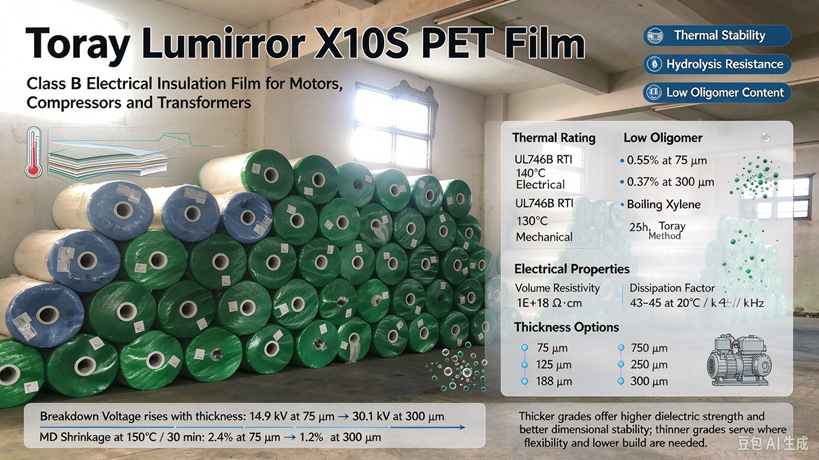
Toray Lumirror X10S PET Film is a low oligomer, hydrolysis resistant polyester film from 75 to 300 micron, rated for hot-running compressor and transformer insulation
Three things set Toray Lumirror X10S PET Film apart on its datasheet: a drastically reduced oligomer content, high hydrolysis resistance, and a UL746B rating of 140°C for electrical use.
What the Datasheet Promises, in Plain Terms
According to its datasheet, Lumirror X10S is a polyester film that can be used for Class B products. It combines excellent thermal stability and hydrolysis resistance with a drastic reduction in oligomer content. Its listed applications are Class B motor and compressor insulation, including rotary compressor motors for refrigerators and air conditioners, and heat-endurable material for generators and transformers.
Three terms deserve a quick explanation, all of them general rather than from the datasheet. Oligomers are small, low molecular weight polyester chains that can migrate to the film surface, so a lower content generally means a cleaner film. Hydrolysis is the slow breakdown of polyester by moisture at high temperature, so hydrolysis resistance matters where a film lives in a warm, damp environment. Class B is generally an insulation class for equipment designed to run at a temperature in the region of 130°C.
The Numbers That Stay Constant
- Thermal rating: UL746B RTI of 140°C for electrical properties and 130°C for mechanical properties
- Extracted oligomer with boiling xylene for 24 hours: about 0.55 percent at 75 um, falling to about 0.37 percent at 300 um (Toray method)
- Volume resistivity at 20°C: about 1E+18 ohm-cm for the thin grades and 5E+17 for the thick grades (ASTM D149)
- Dissipation factor at 20°C and 1 kHz: about 43 to 45 (JIS C2151), with no unit stated in the datasheet
Walking Through the Thicknesses
The datasheet table gives data for 75, 125, 188, 250, and 300 um. MD is the machine direction and TD is the transverse direction.
75 um. The thinnest grade has the highest shrinkage at 150°C for 30 minutes, about 2.4 percent in MD and 2.1 percent in TD (ASTM D1204), and a breakdown voltage of about 14.9 kV (ASTM D149). MD tensile strength is about 277 MPa (ASTM D882). It also carries the most extractable oligomer of the five, about 0.55 percent.
125 um. Very close to 75 um on strength (about 270 MPa in both directions), shrinkage (about 2.3 percent MD and 2.0 percent TD), and oligomer (about 0.53 percent), with a higher breakdown voltage of about 19.6 kV.
188 um. Here the picture changes. Tensile strength drops to about 221 MPa in MD and 219 MPa in TD, shrinkage falls to about 1.6 and 1.7 percent, and breakdown voltage rises to about 24.5 kV. Extractable oligomer is about 0.49 percent.
250 um. Shrinkage drops again to about 1.2 percent in MD and 1.1 percent in TD, breakdown voltage reaches about 28.2 kV, and extractable oligomer is about 0.46 percent. Tensile strength is about 215 MPa in MD and 208 MPa in TD.
300 um. The thickest grade shows the lowest extractable oligomer at about 0.37 percent, shrinkage of about 1.2 percent in MD and 1.0 percent in TD, and the highest breakdown voltage at about 30.1 kV. Tensile strength is about 213 MPa in MD and 199 MPa in TD.
Elongation at break stays in a similar band across all five grades, about 123 to 137 percent in MD and 104 to 128 percent in TD (ASTM D882).
What This Pattern Means for a Motor Designer
Insulation strength follows thickness. Breakdown voltage rises steadily from about 14.9 kV at 75 um to about 30.1 kV at 300 um. If a design needs more voltage margin, thickness is the lever.
Heat movement follows the opposite pattern. The thinner grades shrink more at 150°C, so a slot liner or wedge made from a thin grade should be checked for dimensional change at your process temperature. The thick grades are noticeably steadier.
Cleanliness improves with thickness. The extractable oligomer figure is lowest for the thickest grade. For sealed compressor motors, where film components sit in a closed system, a low and consistent extractable level is generally what designers look for (a general explanation, not from this datasheet).
Resistivity is very high. Values of about 5E+17 to 1E+18 ohm-cm mean the film strongly resists current passing through it, which supports its use as electrical insulation.
The thermal rating is the headline. A UL RTI of 140°C electrical and 130°C mechanical is the number to bring into a design review. For a specific end product, please confirm the current UL listing.
How It Differs from Neighboring Grades
- Toray Lumirror S10 PET Film is a standard film with a UL RTI of 105°C for both electrical and mechanical properties, so X10S sits clearly higher on the thermal rating. At 75 um, S10 breakdown voltage is about 14.9 kV, essentially the same as X10S. But X10S shrinks noticeably more at 150°C in the thin grades (about 2.4 percent MD at 75 um versus about 1.0 percent for S10), while volume resistivity is higher for X10S in the thin grades (about 1E+18 versus 2E+17 ohm-cm).
- Toray Lumirror H10 PET Film is the hazy, stiff motor insulation film for slot liners and wedges, also with a UL RTI of 105°C. It does not list oligomer or hydrolysis data, which is the area where X10S is specifically described.
What the Datasheet Leaves Out
- The values are typical data under specific test conditions and are not limiting specifications, as the datasheet itself notes. The datasheet also refers readers to a separate X10S data sheet for detailed features.
- The available thickness line lists 210 um, but the table has no 210 um column, so please confirm availability and data for that grade when you order.
- It does not give a hydrolysis test result in numbers, only the description.
- It does not list thickness tolerance, haze, or friction.
- The unit and scaling of the dissipation factor are not stated.
Questions Buyers Ask About Toray Lumirror X10S PET Film
What does Class B mean on this datasheet?
The datasheet says Lumirror X10S can be used for Class B products. Class B is generally a thermal class for insulation systems, so confirm the class requirement of your own motor or transformer design.
What is the UL rating?
UL746B RTI of 140°C for electrical properties and 130°C for mechanical properties.
How much oligomer is extracted?
About 0.37 to 0.55 percent in boiling xylene over 24 hours, depending on thickness, lowest in the 300 um grade.
Which thickness is the most heat-stable?
Of the five grades in the table, the 250 and 300 um grades show the lowest shrinkage at 150°C, about 1.0 to 1.2 percent.
Can I buy Toray Lumirror X10S PET Film from Jinlu Film?
Yes. Jinlu Film supplies Toray Lumirror X10S PET Film. If you prefer a comparable-specification alternative, including domestic options, we can offer those as well, together with datasheets and samples so you can test them on your own line.
More PET Film Guides
- Toray Lumirror P60 PET Film: a one-side corona treated film for snack and retort pouch packaging
- Toray Lumirror P52 PET Film: a 12 um pretreated film for metallizing, compared with P525
- Toray Lumirror F552 PET Film: an ultra-thin base film for thermal transfer ribbon
- Toray Lumirror F71 PET Film: a glossy transparent film at 12 and 19 um for metallic yarn and photoresist
- Toray Lumirror H10 PET Film: a hazy plain film for motor insulation
Sourcing Heat-Rated Insulation Film
Jinlu Film supplies Toray Lumirror X10S PET Film, along with comparable heat-resistant and low oligomer polyester film grades, including domestic alternatives, for motor, compressor, and transformer insulation. Tell us your thermal class, thickness, and application, and contact us for technical data, samples, or a factory quote.
Source: Toray’s publicly available Lumirror X10S technical data sheet (typical values). Please refer to the latest official version. Lumirror, Toray, and related names are trademarks of their respective owners. This article is an independent explanation for reference only.