Toray Lumirror P60 PET Film is a standard one-side corona treated film at 12 and 16 micron, and its datasheet reads like a packaging converter’s checklist
Choosing a clear film for a snack wrapper or retort pouch comes down to three questions: can it carry ink, can it be laminated, and can it go near food? Toray Lumirror P60 PET Film speaks to all three on its datasheet.
What Is Toray Lumirror P60 PET Film, and Why Is Only One Side Treated?
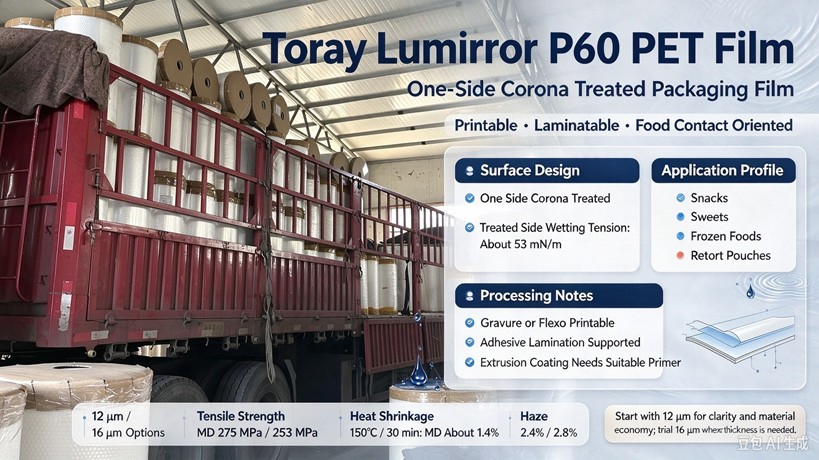
According to its datasheet, Lumirror P60 is a standard biaxially oriented polyester film for packaging, with one side corona treated. The treated side has a wetting tension of about 53 mN/m (JIS K6768). Wetting tension is a measure of surface energy, and a higher value generally means inks and adhesives spread and bond more easily (a general explanation, not from this datasheet).
Leaving one side untreated is a design choice. The datasheet notes that the choice of other materials, ink, adhesive, and so on varies a lot because one side is corona treated, so you plan your printing and laminating around which side faces which layer.
Can Lumirror P60 Carry Ink?
Yes, with the right ink. The datasheet says Lumirror P60 can be gravure or flexo printed, using inks formulated for plain polyester films. It adds that in-line corona treatment before the first printing station improves ink adhesion. For more critical applications, the datasheet points to Lumirror P51 instead. We do not have a P51 datasheet in this series, so if your print requirements are demanding, ask for it separately.
Can It Be Laminated or Extrusion Coated?
The datasheet says Lumirror P60 can be laminated using adhesives with or without solvent. Extrusion coating requires a suitable primer. In practice that means lamination is the straightforward route, and extrusion coating needs a primer step planned into your structure.
Can It Touch Food?
The datasheet states that Lumirror P60 is composed only of substances accepted by the FDA (Food and Drug Administration) and conforms to specifications for materials intended for contact with foodstuffs. Its listed applications are packaging of snacks, sweets, frozen foods, and retort pouches. Regulations differ by market and by the final packaging structure, so confirm what applies to your product with your supplier and your own compliance team.
12 um or 16 um?
The available thickness line lists 12 um, but the data table shows both 12 and 16 um columns, so please confirm availability when you order. Reading the two columns:
- Tensile strength in MD is about 275 MPa at 12 um and 253 MPa at 16 um, and in TD about 237 and 231 MPa (ASTM D882).
- Elongation at break is about 130 to 142 percent in MD and 150 to 155 percent in TD.
- Heat shrinkage at 150°C for 30 minutes is about 1.4 percent in MD for both, and TD is very low, about 0 to 0.2 percent (ASTM D1204).
- Haze is about 2.4 percent at 12 um and 2.8 percent at 16 um (ASTM D1003), so the thinner grade is slightly clearer.
If your priority is clarity and material economy, start with 12 um. If you want a little extra thickness for handling or barrier structure, 16 um is the one to trial.
What Do the Strength, Shrinkage, and Haze Numbers Mean?
Strength. A tensile strength of about 230 to 275 MPa is solid for a film this thin. It helps the film survive tension on printing and laminating lines. Note that MPa is force per unit area, so a 12 um film carries little total load, and tension control still matters.
Shrinkage. About 1.4 percent in MD and close to nothing in TD after 30 minutes at 150°C is typical of a standard PET film. It helps the film stay flat through drying ovens. MD shrinkage is higher than TD.
Haze. About 2.4 to 2.8 percent is what the datasheet calls good transparency. Clear enough to show printed artwork and, depending on your structure, the product inside.
How It Differs from Neighboring Grades
- Toray Lumirror P52 PET Film is also a 12 um packaging film, but it is pretreated for metallizing, with haze of about 2.6 to 2.7 percent. Its datasheet says FDA compliance is not guaranteed and asks that the film not touch food directly. P60 is the one whose datasheet describes food contact conformity.
- Toray Lumirror S10 PET Film is a general-purpose industrial film in ten thicknesses. At 12 um its MD tensile strength is similar to P60 (about 271 versus 275 MPa), but its TD strength is lower (about 215 versus 237 MPa). S10 is listed for electrical and industrial uses rather than food packaging.
Gaps in the Datasheet
- The values are typical data under specific test conditions and are not limiting specifications, as the datasheet itself notes.
- The datasheet does not list light transmittance, gloss, thickness tolerance, or a friction coefficient.
- Only 150°C shrinkage is given.
- The wetting tension is given for the treated side only, and the untreated side is not described.
A Few More Quick Answers
What applications does the Lumirror P60 datasheet list?
Packaging of snacks, sweets, frozen foods, and retort pouches.
Which side should face the ink?
The datasheet does not say, but the corona treated side has the higher wetting tension (about 53 mN/m), so printing and laminating are generally planned around it. Confirm with your supplier.
Does Lumirror P60 need a primer?
For extrusion coating, yes, a suitable primer is required according to the datasheet.
Can I buy Toray Lumirror P60 PET Film from Jinlu Film?
Yes. Jinlu Film supplies Toray Lumirror P60 PET Film. If you prefer a comparable-specification alternative, including domestic options, we can offer those as well, together with datasheets and samples so you can test them on your own line.
More PET Film Guides
- Toray Lumirror P52 PET Film: a 12 um pretreated film for metallizing, compared with P525
- Toray Lumirror F552 PET Film: an ultra-thin base film for thermal transfer ribbon
- Toray Lumirror F71 PET Film: a glossy transparent film at 12 and 19 um for metallic yarn and photoresist
- Toray Lumirror H10 PET Film: a hazy plain film for motor insulation
- Toray Lumirror T62 PET Film: a high transparent film for metallizing
Sourcing Packaging Film
Jinlu Film supplies Toray Lumirror P60 PET Film, along with comparable one-side corona treated packaging film grades, including domestic alternatives. Tell us your product, printing method, and lamination structure, and contact us for technical data, samples, or a factory quote.
Source: Toray’s publicly available Lumirror P60 technical data sheet (typical values). Please refer to the latest official version. Lumirror, Toray, and related names are trademarks of their respective owners. This article is an independent explanation for reference only.