PVC film uses: six common jobs and what to tell your supplier for each one
PVC film uses are wide, because flexible PVC can be clear or colored, glossy or matte, plain or printed, and it laminates, folds and seals easily. That also means enquiries are often too short: “PVC film, some thickness, some width”. Here is the chatty version, the way you would explain it to a friend who has just started buying PVC film.
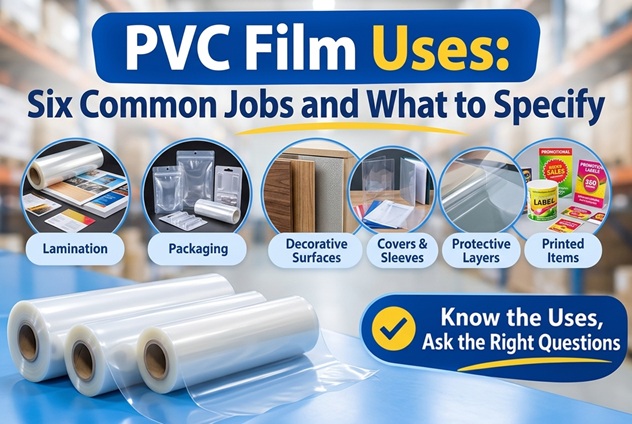
PVC film uses: six common jobs
The same flexible film can end up in very different products. What changes is the thickness, the softness, the color, the surface and how the film is processed afterwards. Here are the six we see most.
1. Lamination
PVC film is often laminated onto boards, cards, paper or other films to give a protective or decorative face. Tell the supplier what it is laminated to, how (heat, adhesive or both) and which side faces the substrate.
2. Packaging
Clear or colored film is used for pouches, covers, blister backing and wrapping. Describe the product being packed, how the film is sealed or formed and whether it needs to be see-through.
3. Decorative surfaces
Printed, embossed or colored PVC film is used to decorate furniture parts, panels and interior items. Say what look you want, such as glossy, matte or textured, and what the film will be applied to.
4. Covers, sleeves and folders
Flexible clear film is cut and sealed into book covers, folders, document sleeves and protective covers. Tell the supplier the finished item, how it is cut or welded and how stiff or soft it should feel.
5. Protective and masking layers
PVC film is also used to cover a surface during processing or transport. Say what is being protected, how long it stays covered and whether it must come off cleanly.
6. Printed and promotional items
Many buyers print on PVC film for promotional goods, labels and display items. Say the print method, which side is printed and whether the finish should be glossy or matte.
What to include in an enquiry
- Which of the six jobs the film is for, in one sentence.
- Clear, colored or printed, and the finish: glossy, matte or textured.
- How soft or stiff it should feel, in your own words, compared with a film you already use.
- Thickness, with the unit written out. See microns, mil and how to write them for a clean way to write it.
- Roll width, length and core size, or sheet size.
- Process: laminating, printing, sealing or forming.
- Quantity, and a request for datasheets and samples. For how to talk about a first order, see how to ask about minimum order quantity.
Common mistakes with PVC film enquiries
- Asking for “PVC film” with no use, so the supplier has to guess.
- Not saying rigid or flexible, which changes the product. For the rigid kind, see PVC sheet uses.
- Judging a sample by hand only, without trying it in your own laminating, printing or sealing process.
- Forgetting which side is the working side when the film has different surfaces.
If your customer asks for documents
Requirements differ by market and by product, especially for packaging and anything touching food or skin. Do not assume any film carries a given approval. Tell the supplier which documents your customer asks for and compare what you receive with your own requirement before ordering a full quantity.
Talk to Us
Jinlu Film manufactures and supplies PVC film in various specifications, and also cuts and converts to size in our own facility, with custom widths, lengths and thicknesses on request, and we provide datasheets and samples. If you are looking for a PVC film manufacturer to quote a job, send us the use, thickness, width and quantity.
More PVC Film Guides
PVC Sheet Uses: Six Common Jobs and What to Specify: the rigid side of PVC.
PE Film Uses: Six Common Jobs and What to Specify: what to tell a supplier for each job.
Rigid PET Sheet: Where It Is Used and What to Ask For: how thick sheet differs from thin film.
Is PET the Same as Polyester? The Short, Plain Answer: how the common film names relate.
Where to Buy PET Film: Five Places and What to Ask Each: which seller fits the amount you need.
General guidance for reference only. Trademarks belong to their respective owners.