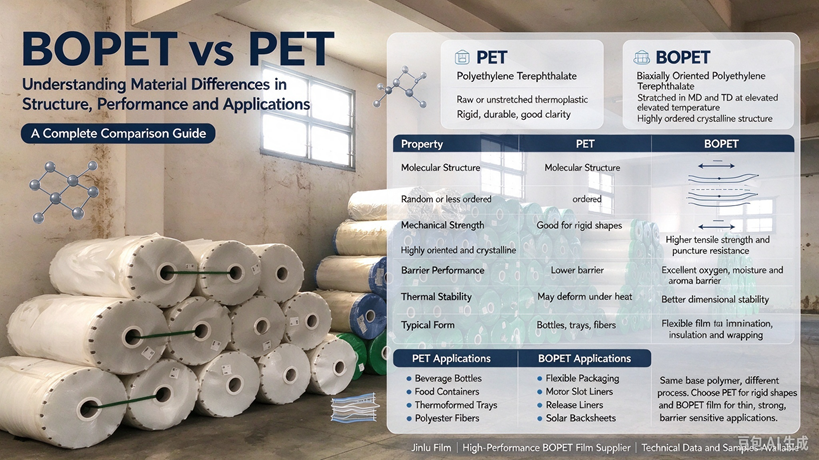
A Complete Comparison Guide to Molecular Structures, Performance, and Applications
Introduction: BOPET vs PET
In the packaging and manufacturing industries, the terms PET and BOPET are often used interchangeably. However, they describe different stages of the same base material. Understanding the difference between BOPET vs PET is essential for engineers, packaging designers, and procurement teams who need to select the right material for specific performance requirements. This guide breaks down their structural differences, physical properties, and ideal applications.
What is PET?
PET stands for Polyethylene Terephthalate. It is a widely used thermoplastic polymer resin. In its raw, unstretched form (often referred to as APET or CPET), PET is rigid, durable, and offers good clarity. It is the standard material for manufacturing 3D structures like plastic water bottles, food trays, and thermoformed packaging.
What is BOPET?
BOPET stands for Biaxially Oriented Polyethylene Terephthalate. It is produced by taking the amorphous PET sheet and stretching it in two perpendicular directions (Machine Direction and Transverse Direction) at high temperatures. This process forces the polymer chains to align into a highly ordered, crystalline structure.
Key Differences: BOPET vs PET
The molecular alignment during the biaxial stretching process fundamentally changes the physical properties of the material:
- Mechanical Strength: BOPET has a significantly higher tensile strength and puncture resistance compared to standard unstretched PET, allowing it to be used in extremely thin films (down to 12 um).
- Barrier Properties: BOPET provides an excellent barrier against oxygen, moisture, and aromas, making it the preferred choice for flexible food packaging. Standard PET offers much lower barrier protection.
- Thermal Stability: BOPET maintains its dimensional stability and does not shrink easily at high temperatures, whereas standard PET will deform under similar heat conditions.
- Form Factor: Standard PET is typically used for rigid, 3D shapes (bottles, trays). BOPET is produced as a flexible, flat film used for lamination, wrapping, and electrical insulation.
Industry Applications
Both materials are essential in modern manufacturing, but their applications differ based on their properties:
- PET Resin: Beverage bottles, food containers, thermoformed trays, and polyester fibers.
- BOPET Film: Flexible packaging, electrical insulation (motor slot liners), flexible printed circuits (FPC), release liners, and solar backsheets.
Frequently Asked Questions
Are BOPET and PET the same material?
Chemically, they are made from the same base polymer (Polyethylene Terephthalate). The difference lies in the manufacturing process. BOPET undergoes biaxial stretching, which significantly alters its physical properties.
Which material is better for packaging?
It depends on the packaging type. Standard PET is best for rigid bottles and trays. BOPET is superior for flexible packaging where high strength, optical clarity, and barrier properties are required.
Is BOPET recyclable?
Yes. BOPET is a mono-material that is fully recyclable in standard PET recycling streams.
Looking for High-Performance BOPET Film?
Jinlu Film is a direct manufacturer of high-performance BOPET films. We produce standard and specialty films for flexible packaging, electronics, and industrial applications. If you are evaluating BOPET vs PET for your next project, our team can help you select the right specifications. Contact us today for a factory quote, technical data, or a sample.
Sources: Industry standards and material science data.