A Data-Backed Guide to Market Estimates, Demand Drivers, and Sourcing Considerations for Flexible Packaging
Market Overview: What the Published Estimates Say
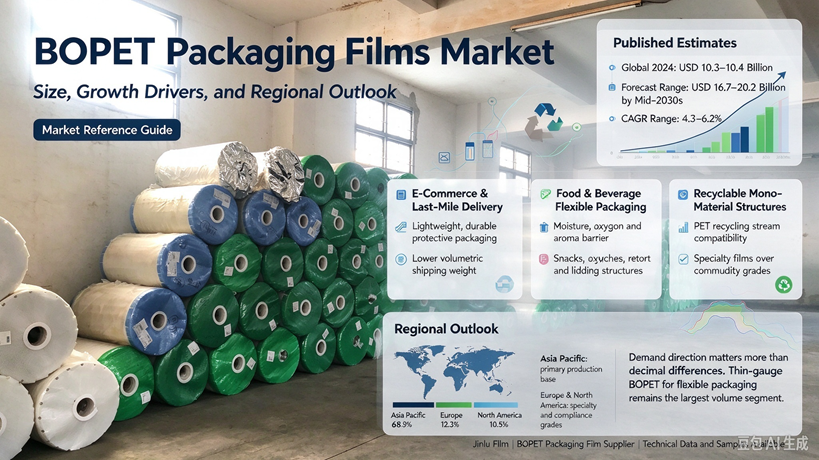
The BOPET Packaging Films Market sits at the center of the flexible packaging industry. BOPET (Biaxially Oriented Polyethylene Terephthalate) film is used across food, beverage, pharmaceutical, personal care, and industrial packaging because of its tensile strength, thermal stability, and barrier performance against moisture, oxygen, and aroma. Published market estimates differ because report scopes and methodologies differ. The figures below are presented as reference ranges, not as a single consensus number.
- Global Market Insights: the global BOPET packaging films market was valued at USD 10.3 billion in 2024 and is estimated to reach USD 18.2 billion by 2034, at a CAGR of 5.9 percent.
- Orion Market Research / MarketResearch.com: the broader BOPET films market was USD 10.4 billion in 2024 and is projected to reach USD 20.2 billion by 2035, at a CAGR of 6.2 percent.
- GII (Global Information): the BOPET films market is forecast to grow from USD 10.9 billion in 2025 to USD 16.7 billion by 2035, at a CAGR of 4.3 percent.
- HNY Research: the BOPET market is projected to grow from USD 16.16 billion in 2025 to USD 22.40 billion by 2031, at a CAGR of 5.59 percent.
The spread between 4.3 percent and 6.2 percent reflects differences in how each report defines “packaging films” versus the wider BOPET film category. For sourcing decisions, the direction matters more than the decimal: demand is expanding, and thin-gauge BOPET for flexible packaging remains the largest volume segment. To understand the material differences driving these choices, read our guide on BOPET vs PET.
What Is Driving Demand: E-Commerce, Food Packaging, and Sustainability
Three demand drivers appear consistently across market reports.
1. E-commerce and last-mile delivery. The growth of online retail has increased demand for lightweight, durable, and protective packaging. BOPET films are adaptable to different product dimensions, which helps reduce volumetric shipping weight and logistics costs.
2. Food and beverage flexible packaging. BOPET is widely used in snacks, ready-to-eat meals, stand-up pouches, retort pouches, and lidding films because it provides a barrier against moisture, oxygen, and UV light. The food and beverage end-use segment remains the largest application block for BOPET packaging films.
3. The shift toward recyclable and mono-material structures. Regulatory pressure and brand sustainability targets are pushing converters toward mono-material BOPET designs that fit existing PET recycling streams. This is increasingly favoring high-value specialty films over commodity-grade materials.
Regional Outlook: Where the Volume Sits
Asia Pacific is the largest consumption region for BOPET films. One industry report places Asia Pacific at 68.9 percent of global consumption, with China, India, and Southeast Asia contributing most of the incremental volume. Europe and North America account for smaller shares, at approximately 12.3 percent and 10.5 percent respectively, and demand growth in those regions is more focused on high-performance functional films and imported specialty grades.
The practical implication for buyers is that Asia Pacific remains the primary production base for thin-gauge packaging film, while Europe and North America are stronger markets for specialty and compliance-driven grades.
Application Segments: Where BOPET Packaging Film Is Used
- Food and beverages: snack bags, stand-up pouches, retort pouches, lidding films, and metallized barrier structures.
- Pharmaceuticals: blister packs, strip packaging, and pouches that require barrier protection and sterilization compatibility.
- Personal care and cosmetics: printed and metallized packaging where surface finish and barrier performance both matter.
- Industrial and protective packaging: applications that require puncture resistance and dimensional stability.
Thin BOPET films remain the largest segment by volume because flexible packaging applications favor lower gauges for cost efficiency and barrier performance. For display or adhesive tape applications that require a bright white background, refer to our guide on Toray Lumirror X20 PET Film.
Frequently Asked Questions
What is the BOPET Packaging Films Market size?
Published estimates range from roughly USD 10.3 billion in 2024 to USD 10.9 billion in 2025, with forecast values between USD 16.7 billion and USD 20.2 billion by the mid-2030s, depending on the report scope.
Which region consumes the most BOPET packaging film?
Asia Pacific is the largest consumption region, with China, India, and Southeast Asia as the main volume contributors. Europe and North America are smaller in volume but important for specialty and compliance-driven grades.
What is driving growth in this market?
E-commerce and last-mile delivery, food and beverage flexible packaging, and the shift toward recyclable mono-material structures are the three most consistently cited drivers across market reports.
What should buyers check before sourcing BOPET packaging film?
Confirm the grade and thickness for your application, the barrier requirement, whether the film is corona-treated or metallized, and the compliance documentation for your destination market. Request a sample and test it on your own converting line before bulk ordering.
Sourcing BOPET Packaging Film
Jinlu Film manufactures BOPET packaging films for food, pharmaceutical, and industrial flexible packaging applications. Tell us your thickness, barrier requirement, and destination market, and we will recommend a suitable grade and provide technical data or a sample for your line trial.
Sources: Global Market Insights, Orion Market Research / MarketResearch.com, GII (Global Information), HNY Research, and other publicly available report summaries. Figures are presented for reference; report scopes and methodologies differ. Please verify against the latest published versions before making procurement decisions.
More BOPET Film Guides
- BOPET vs PET: material differences and molecular structures explained
- Toray Lumirror X20 PET Film: brilliant white film with low opacity for displays and adhesive tapes
- Toray Lumirror X44 PET Film: the highest-gloss grade of the X42, X43, X44 matte trio
- Toray Lumirror X43 PET Film: a direct matted film from 12 to 150 um for hot stamping foil
- Toray Lumirror X10S PET Film: a low oligomer, heat-rated film for Class B motor insulation