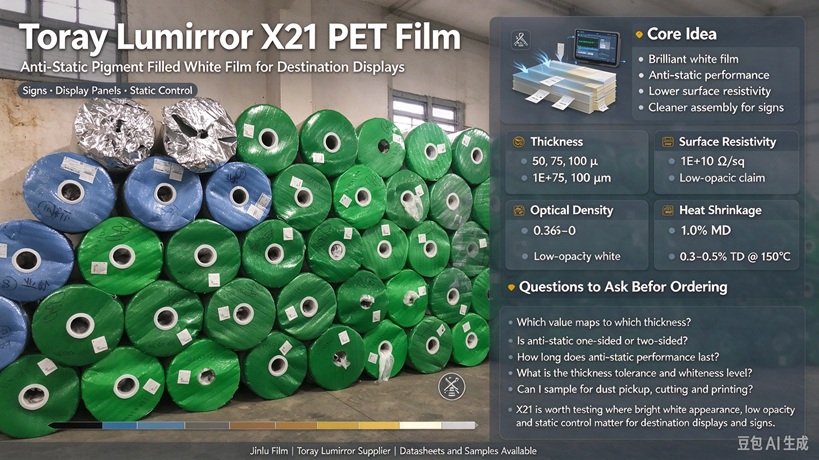
Toray Lumirror X21 PET Film is an anti-static, pigment filled white film at 50, 75, and 100 micron, and its datasheet points straight at signs and display panels
Most white films are chosen for how white they look. Toray Lumirror X21 PET Film adds something else to its datasheet: anti-static performance, with a surface resistivity several orders of magnitude lower than its non-anti-static sibling.
The Problem on a Destination Display
According to its datasheet, Lumirror X21 is a pigment filled white film with anti-static properties, described as brilliant white. The listed applications are destination display, signs, and similar uses. A destination display is generally the panel on a vehicle or at a station that shows where service is going, so the film behind or in it needs to look clean and bright for years (a general explanation, not from this datasheet).
Static charge is a practical headache for that kind of product. A film that holds static tends to pull in dust, cling to itself during cutting and stacking, and make assembly harder (a general explanation). That is the reason an anti-static white film is worth a look for signage.
The Numbers the Datasheet Gives
- Thickness: 50, 75, and 100 um
- Tensile strength: about 205 MPa in MD for all three grades, and about 225, 196, and 196 MPa in TD (ASTM D882)
- Elongation at break: about 160, 140, and 140 percent in MD, and about 130 percent in TD (ASTM D882)
- Heat shrinkage at 150°C for 30 minutes: about 1.0 percent in MD, and about 0.3 to 0.5 percent in TD (ASTM D1204)
- Surface resistivity: on the order of 1E+10 ohm per square (ASTM D257)
- Optical density: about 0.36 to 0.38 in the figures given (JIS K7605)
Surface resistivity shows how easily static charge can spread across a surface, and a lower number means charge dissipates more easily (a general explanation). Optical density measures how much light the film blocks, and a higher number means less light gets through. Strength and heat behavior are very similar across the three thicknesses, so the choice between them is mostly about the stiffness and opacity your product needs. Note that MPa is force per unit area, so a thicker film can still carry more total load.
How It Differs from Neighboring Grades
- Toray Lumirror X20 PET Film is the closest relative: also a brilliant white, pigment filled film, in 38, 75, and 125 um, listed for display and adhesive tape. Its optical density is in a similar low range (about 0.33 to 0.53), but its surface resistivity is about 1E+15 to 1E+16 ohm per square. X21’s figure is on the order of 1E+10, so it is the one that carries the anti-static claim.
- Toray Lumirror E63 PET Film is also an anti-static white film, in 50 and 75 um, but it is a low density, one-side treated film for print receivers. Its optical density is much higher (about 0.76 to 0.93 versus about 0.36 to 0.38 for X21), so it blocks more light. Its surface resistivity is about 3.8E+11 to 5.0E+11 ohm per square.
Questions to Ask a Supplier Before You Order
The datasheet leaves a few things open, and they are the questions worth putting to any supplier:
- Which surface resistivity and optical density value belongs to which thickness? The datasheet text does not make the mapping clear.
- Is the anti-static property on one side or both, and is it built into the film or a surface treatment? The datasheet does not say.
- How long does the anti-static effect last, and does it depend on humidity? The datasheet gives no test data.
- What is the thickness tolerance, and what whiteness level can be expected? Neither is listed.
- Can samples be sent in your thickness so you can test dust pickup, cutting, and printing on your own line?
What the Datasheet Does Not Say
- The values are typical data under specific test conditions and are not limiting specifications, as the datasheet itself notes.
- No whiteness index, gloss, haze, light transmittance, tensile modulus, surface tension, or thickness tolerance are listed.
- Only 150°C shrinkage is given.
- Some figures are summarized here as approximate ranges. Please check the official datasheet for the exact value at your thickness.
Quick Answers About Toray Lumirror X21 PET Film
What is Lumirror X21?
A pigment filled white film with anti-static properties, described as brilliant white.
What thicknesses does the datasheet cover?
50, 75, and 100 um.
What applications does the datasheet list?
Destination display, signs, and similar uses.
How is it different from Lumirror X20?
Both are brilliant white and fairly low in opacity. X21 adds an anti-static claim, with a much lower surface resistivity than X20.
Can I buy Toray Lumirror X21 PET Film from Jinlu Film?
Yes. Jinlu Film supplies Toray Lumirror X21 PET Film. If you prefer a comparable-specification alternative, including domestic options, we can offer those as well, together with datasheets and samples so you can test them on your own line.
More PET Film Guides
- Toray Lumirror X20 PET Film: a brilliant white film at 38, 75, and 125 um for display and adhesive tape
- Toray Lumirror X44 PET Film: the highest-gloss grade of the X42, X43, X44 matte trio
- Toray Lumirror X43 PET Film: a direct matted film from 12 to 150 um for hot stamping foil and releasing
- Toray Lumirror X10S PET Film: a low oligomer, heat-rated film for Class B motor insulation
- Toray Lumirror P60 PET Film: a one-side corona treated film for snack and retort pouch packaging
Sourcing Anti-Static White Film
Jinlu Film supplies Toray Lumirror X21 PET Film, along with comparable anti-static white polyester film grades, including domestic alternatives, for display and signage applications. Tell us your product, thickness, and the opacity and anti-static level you need, and contact us for technical data, samples, or a factory quote.
Source: Toray’s publicly available Lumirror X21 technical data sheet (typical values). Please refer to the latest official version. Lumirror, Toray, and related names are trademarks of their respective owners. This article is an independent explanation for reference only.