A Plain-English Reading of the Toray Lumirror E60L PET Film Datasheet: A Microvoided, Very Low Density White Film at 188 Micron
This guide explains the Toray Lumirror E60L PET Film technical data sheet (TDS) in plain English, so buyers and engineers can read the figures with confidence.
What Is Toray Lumirror E60L PET Film?
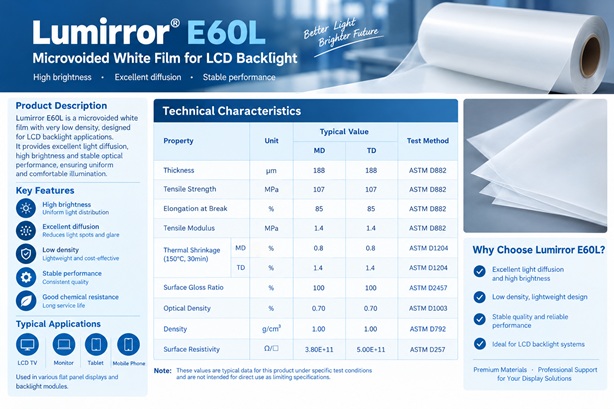
Toray Lumirror E60L PET Film is a white polyester (PET) film from Toray’s Lumirror range. According to its datasheet, it is a microvoided white film with very low density, especially designed as a back light film of LCD. The datasheet lists a single available thickness of 188 um.
Lumirror E60L at a Glance
- Type: microvoided white film with very low density
- Available thickness: 188 um
- Listed application: back light film of LCD
- Listed properties: very low density and especially light, softness, white
Key Properties from the Datasheet
MD is the machine direction (the running direction of the film) and TD is the transverse direction. All values are for the 188 um grade.
- Tensile strength, MD: 107 MPa. TD: 107 MPa (ASTM D882)
- Elongation at break, MD: 85 percent. TD: 70 percent (ASTM D882)
- Thermal shrinkage at 150°C for 30 minutes, MD: 1.4 percent. TD: 0.8 percent (ASTM D1204)
- Whiteness index: 100 percent (ASTM E313)
- Surface gloss ratio: 25 percent (ASTM D2457)
- Optical density: 1.3 (JIS K7605)
- Density: 0.84 g/cm3
What the Numbers Mean
Microvoided structure. Microvoided means the film contains very small voids inside its structure. This is what lowers the density and gives the film its white, opaque appearance. The datasheet describes the result as very low density and especially light.
Density. At 0.84 g/cm3, the density is below 1.00 g/cm3. Compared with the Lumirror E63 datasheet, which lists 1.00 g/cm3, Lumirror E60L is lighter per unit volume.
Strength and stretch. Tensile strength is 107 MPa in both directions, so strength is even across the film. Elongation at break is 85 percent in MD and 70 percent in TD, so the film stretches more along the running direction.
Heat stability. After 30 minutes at 150°C, the film shrinks 1.4 percent in MD and 0.8 percent in TD. Lower shrinkage means better dimensional stability, which matters if your process includes heat steps. As with many films, MD shrinkage is higher than TD.
Appearance and opacity. A whiteness index of 100 percent means a very white film, and the gloss ratio of 25 percent describes how shiny the surface is. Optical density of 1.3 reflects how much light the film blocks. Note that this figure is for a 188 um film, so it should not be compared directly with the optical density of thinner films.
Typical Application: LCD Back Light Film
The datasheet lists back light film of LCD as the application. Back light films sit behind the LCD panel, where brightness and weight both matter, and a white, very low density film fits that profile. The datasheet does not list reflectance or light transmittance values, so if your design depends on them, ask for that data and test samples in your own assembly.
Points to Keep in Mind When Reading the TDS
- The values are typical data under specific test conditions and are not intended as limiting specifications, as the datasheet itself notes.
- Only the 188 um grade is listed. Data for other thicknesses is not given.
- The datasheet does not list tensile modulus, surface resistivity, reflectance, or thickness tolerance.
- Always test samples on your own line before placing a bulk order.
Related datasheet: see our reading of Toray Lumirror E63 PET Film, a pretreated low density white film in 50 to 75 um listed for print receiver use.
Frequently Asked Questions
What is Toray Lumirror E60L PET Film?
It is a microvoided white PET film with very low density, described in its datasheet as especially designed as a back light film of LCD.
What thickness does the Lumirror E60L datasheet cover?
188 um.
What is the density of Lumirror E60L?
The datasheet lists 0.84 g/cm3.
Are the datasheet values guaranteed?
No. They are typical values under specific test conditions, not limiting specifications.
Can I buy Toray Lumirror E60L PET Film from Jinlu Film?
Yes. Jinlu Film supplies Toray Lumirror E60L PET Film. If you prefer a comparable-specification alternative, including domestic options, we can offer those as well, together with datasheets and samples so you can test them on your own line.
Looking for Toray Lumirror E60L PET Film?
Jinlu Film supplies Toray Lumirror E60L PET Film, along with comparable white and low density PET film grades, including domestic alternatives, for display and similar applications. Tell us your application, thickness, and optical needs, and contact us for technical data, samples, or a factory quote.
Source: Toray’s publicly available Lumirror E60L technical data sheet (typical values). Please refer to the latest official version. Lumirror, Toray, and related names are trademarks of their respective owners. This article is an independent explanation for reference only.