Understanding the Science Behind Biaxially Oriented Polyethylene Terephthalate in Modern Manufacturing
Introduction: The Backbone of Modern Materials
BOPET stands for Biaxially Oriented Polyethylene Terephthalate. If you look at the packaging of your favorite snack, the protective film on your smartphone screen, or the internal insulation of an electric vehicle, you are likely looking at BOPET film. It is one of the most versatile and widely used polymer films in the world, prized for its exceptional strength, optical clarity, and thermal stability.
How is BOPET Film Made?
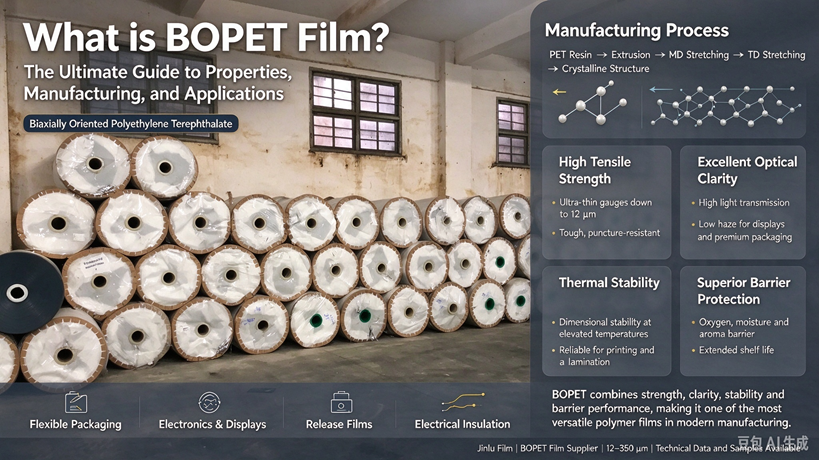
The secret to BOPET’s performance lies in its manufacturing process. Standard PET resin is extruded into a thick sheet and then stretched in two perpendicular directions (Machine Direction and Transverse Direction) at high temperatures. This dual stretching forces the long polymer chains to align tightly, creating a highly ordered, crystalline structure. To see exactly how this compares to its raw predecessor, read our detailed guide on BOPET vs PET.
Key Properties of BOPET Film
This molecular alignment gives BOPET film a unique combination of properties that few other materials can match:
- High Tensile Strength: BOPET offers outstanding mechanical toughness, allowing it to be produced in ultra-thin gauges (down to 12 um) without tearing or puncturing.
- Excellent Optical Clarity: It provides high light transmission and low haze, making it ideal for graphic arts, displays, and premium packaging.
- Thermal Stability: BOPET maintains its dimensional stability even at elevated temperatures, ensuring it does not shrink or warp during high-speed printing and lamination.
- Superior Barrier Protection: It acts as a strong barrier against oxygen, moisture, and aromas, extending the shelf life of perishable goods.
Major Applications Across Industries
Because of its versatile properties, BOPET is used across a vast range of industries:
- Flexible Packaging: It is the primary substrate for food and beverage packaging, providing the necessary strength and barrier properties. The BOPET Packaging Films Market continues to expand rapidly driven by e-commerce and sustainability trends.
- Electronics and Displays: Used in flexible printed circuits (FPC), membrane switches, and protective films.
- Release Films: When coated with silicone, it becomes a crucial release liner for labels and tapes. You can explore the demand drivers in our Silicone Coated PET Film Market overview.
- Electrical Insulation: Used in motor slot liners, transformers, and battery wraps for electric vehicles.
Frequently Asked Questions
What is the difference between PET and BOPET?
Chemically, they are the same polymer. However, BOPET is stretched in two directions during manufacturing, which significantly increases its tensile strength, barrier properties, and thermal stability compared to standard unstretched PET.
Is BOPET film recyclable?
Yes. BOPET is a mono-material that is highly compatible with existing PET recycling streams, making it a preferred choice for sustainable packaging designs.
What thicknesses are available?
Jinlu Film provides BOPET films ranging from 12 um to 350 um, catering to applications from ultra-thin capacitors to heavy-duty motor insulation.
Sourcing BOPET Film
Jinlu Film is a direct manufacturer of high-performance BOPET films. We operate advanced production lines to deliver consistent, high-quality materials for packaging, electronics, and industrial applications. Tell us your thickness, application, and compliance requirements, and we will recommend the right film for your project. Contact us today for a factory quote, technical data, or a sample.
More BOPET Film Guides
- Silicone Coated PET Film Market: market size, key drivers, and regional trends
- BOPET Packaging Films Market: published size estimates, growth drivers, and regional outlook
- BOPET vs PET: material differences and molecular structures explained
- Toray Lumirror X20 PET Film: brilliant white film with low opacity for displays and adhesive tapes
- Toray Lumirror X44 PET Film: the highest-gloss grade of the X42, X43, X44 matte trio