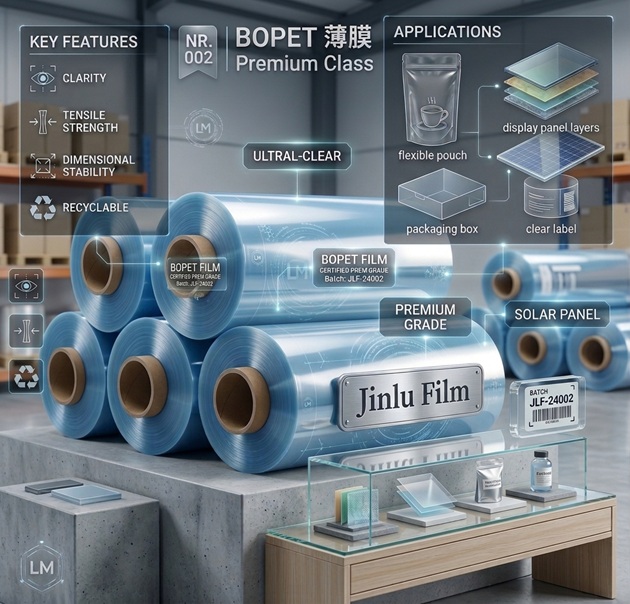
Decoding Extrusion, Casting, Biaxial Stretching, and Heat Setting in Modern Polyester Film Manufacturing
Product Overview
When B2B buyers source flexible packaging or industrial films, they look at data sheets for tensile strength, haze, and shrinkage. But to truly understand the quality of a film, you have to look at how it was made. The BOPET Film Production Process is a masterpiece of precision engineering. While global giants like Toray, DuPont PET Film, and SKC PET Film have refined this process over decades, the fundamental steps remain a marvel of material science. This guide breaks down the exact journey from raw PET pellets to a high-performance BOPET roll.
The 4 Critical Stages of Manufacturing
Creating a film with exceptional dimensional stability and optical clarity is not simple. It requires four highly controlled stages:
- Extrusion and Casting
The process begins with raw PET (Polyethylene Terephthalate) resin pellets. These pellets are dried to remove moisture and then melted in an extruder. The molten polymer is filtered and extruded through a flat die, immediately cast onto a highly polished, chilled drum. This rapid cooling forms a thick, amorphous (non-crystalline) sheet. - Machine Direction (MD) Stretching
The thick cast sheet is then heated and passed between a series of rollers running at increasing speeds. This mechanical stretching forces the long polymer chains to align in the longitudinal direction, significantly increasing the film’s tensile strength. - Transverse Direction (TD) Stretching
Next, the film enters a massive “tenter frame.” Clips grip the edges of the film and stretch it sideways in a heated oven. This dual-directional (biaxial) stretching locks the molecules into a tight, grid-like structure, giving BOPET its legendary durability. - Heat Setting (Crystallization)
If the film were cooled immediately, it would shrink drastically when exposed to heat. To prevent this, the film undergoes “heat setting.” It is heated under tension to crystallize the molecular structure, locking in its properties and ensuring low thermal shrinkage. Finally, it is cooled and wound into master rolls.
Technical Characteristics
The following values represent the typical capabilities of our precision-manufactured BOPET film:
- Material: Biaxially Oriented Polyethylene Terephthalate
- Thickness Range: 12 μm to 50 μm
- Tensile Strength: MD 180 to 250 MPa / TD 180 to 245 MPa
- Thermal Shrinkage at 150°C, 30min: MD 0.9% to 1.5% / TD 0.1% to 0.4%
- Haze: 0.6% to 3.0% (depending on grade)
- Certifications: RoHS, REACH, FDA compliant grades available
Why Choose Jinlu Film as Your Supplier
Jinlu Film operates a state-of-the-art BOPET Film Production Process. We combine advanced extrusion technology with precise heat-setting controls to deliver films that match the reliability of top-tier brands. Whether you need standard packaging films or specialized industrial grades, our factory-direct pricing and strict quality control ensure you get the best material.
Contact us today for a factory quote, technical data, or a sample of BOPET Film.