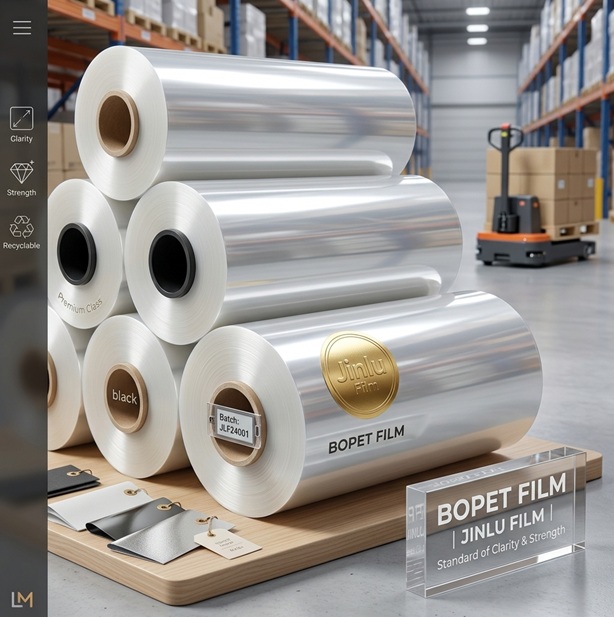
Decoding the Biaxial Molecular Alignment, Heat Seal Performance, and Thermal Stability for High-Temperature Processing
Product Overview
When food or medical products must survive high-pressure sterilization at 121°C or higher, standard plastics fail instantly. They melt, warp, or lose their structural integrity. To survive the brutal conditions of retort processing, manufacturers rely on the incredible BOPET Film Tensile Strength. While global giants like Toray, DuPont PET Film, and SKC PET Film have long championed high-performance films, BOPET remains the industry benchmark. But how does an ultra-thin film withstand such extreme heat and mechanical stress? The answer lies in the physics of biaxial stretching.
The Science of Biaxial Strength
The exceptional durability of BOPET film is not an accident; it is engineered at the molecular level. During manufacturing, the raw PET sheet is stretched in two perpendicular directions: Machine Direction (MD) and Transverse Direction (TD).
- This dual stretching forces the long polymer chains to align tightly into a rigid, grid-like structure.
- This molecular alignment is what gives the film its massive tensile strength (often exceeding 200 MPa) and allows it to resist puncturing and tearing even under immense tension.
Mastering Thermal Stability for Retort Processes
Tensile strength is useless if the film shrinks under heat. This is where thermal stability becomes the second critical pillar.
- Retort packaging requires films to undergo heat sealing and high-temperature steam sterilization.
- BOPET film features a highly controlled thermal shrinkage profile (often less than 1.5% at 150°C), ensuring it remains dimensionally stable. It does not warp, curl, or delaminate during the cooking process.
Key Applications Across Industries
The unique combination of high tensile strength and thermal stability makes BOPET indispensable for:
- Retort Pouches: Used as the outer structural layer in ready-to-eat meals, pet food, and medical sterile packaging.
- Heat-Seal Laminates: Providing a robust backbone that protects the inner sealing layers during high-heat lamination.
- Electronics Manufacturing: Used in flexible circuits where dimensional stability under heat is mandatory.
Sourcing a Reliable Alternative
While the Toray Lumirror series is a legendary standard, global B2B buyers often seek a DuPont PET Film or SKC PET Film alternative to optimize costs. A successful replacement requires a manufacturer that can guarantee the BOPET Film Tensile Strength while strictly controlling the thermal shrinkage. If the balance is off, your retort lines will suffer from seal failures and product spoilage.
Technical Characteristics
The following values represent the typical capabilities of our high-strength BOPET film range:
- Material: Biaxially Oriented Polyethylene Terephthalate
- Thickness Range: 12 μm to 50 μm (Standard for laminates)
- Tensile Strength: MD 180 to 250 MPa / TD 180 to 245 MPa
- Thermal Shrinkage at 150°C, 30min: MD 0.9% to 1.5% / TD 0.1% to 0.4%
- Barrier Properties: Excellent oxygen and moisture barrier
- Certifications: RoHS, REACH, FDA compliant grades available
Why Choose Jinlu Film as Your Supplier
Jinlu Film is a leading manufacturer of high-performance BOPET films. We offer a direct factory substitute that matches the exceptional BOPET Film Tensile Strength of top-tier brands. Whether you are producing retort pouches or high-heat flexible laminates, our films deliver the exact thermal stability and mechanical toughness your production lines require.